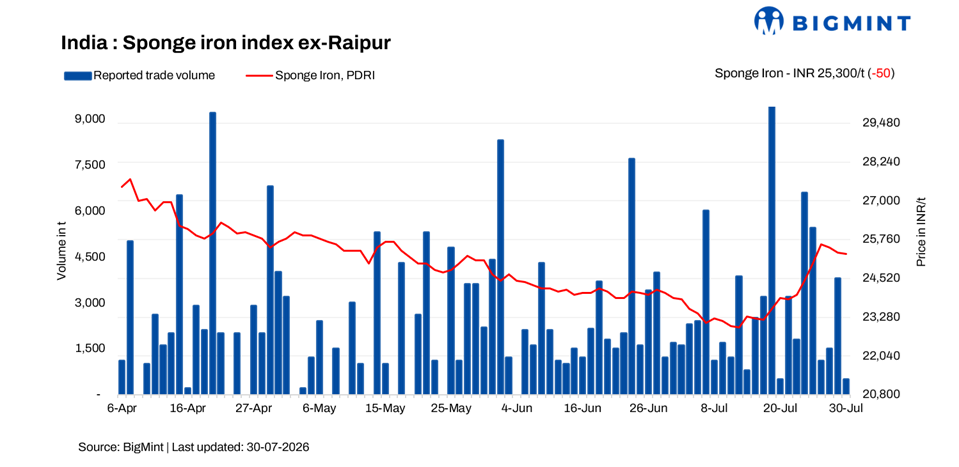
- Trade activity remained dull amid weak buying interest
- Buyers made enquiries only at lower price levels
The sponge iron market remained under pressure on 30 July 2026, with prices declining by INR 50-200/t across several markets. Raipur PDRI prices were assessed at around INR 25,300/t, declining slightly by INR 50/t due to firm seller offers. Trading activity was slow as buyers stayed cautious, and limited transactions were concluded at lower price levels. Sellers attempted to attract buyers by offering discounted rates, but overall market participation remained subdued. Most purchases were restricted to immediate, need-based requirements rather than fresh stocking.
Demand conditions continued to remain weak, resulting in a dull market sentiment. Finished steel consumption has not shown any significant improvement, prompting steelmakers to maintain a cautious procurement strategy for sponge iron. As a result, buying interest remained limited despite softer prices, with participants preferring to wait for clearer demand signals before making larger commitments. Overall, market sentiment remained bearish amid weak downstream demand.
On the cost side, elevated raw material prices continued to exert pressure on producers’ margins. At the same time, the ongoing monsoon season has further slowed construction and infrastructure activities, reducing demand for finished steel and, in turn, impacting sponge iron consumption.
BigMint recorded 8,000 t of sponge iron trades during the day, around 4,000 t lower than the previous session, indicating that softer prices failed to attract buyers. Market participants remained in a cautious mode, with procurement limited to immediate requirements despite the decline in prices.
Rationale
Prices have been derived based on transactions, offers, bids, and indicative price data sets. Transactions are considered as T1 and given a weightage of 50%, whereas other data sets are considered as T2 and given a weightage of the balance 50%.
Click here for detailed methodology



Leave a Reply