- Firm overseas scrap payabilities keep import costs elevated.
- LME copper slips 1% w-o-w, limiting domestic price declines.
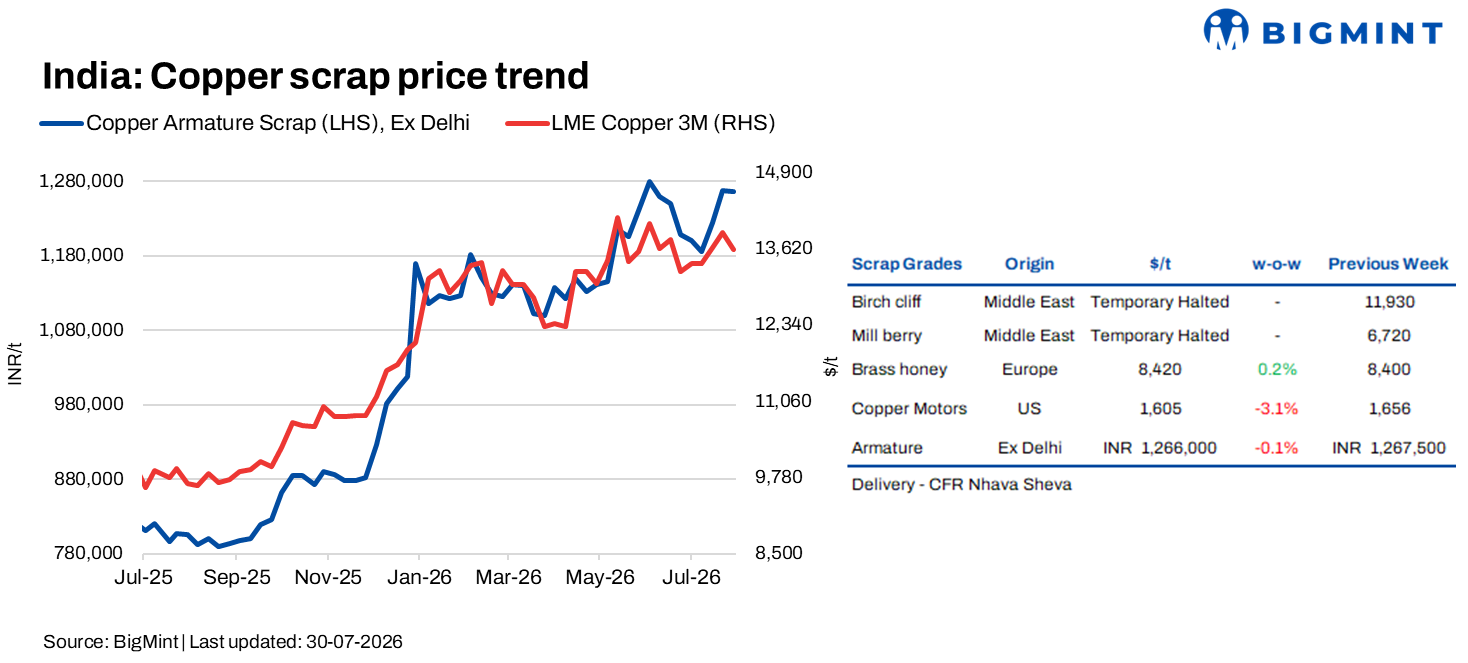
Copper cathode and scrap prices in India declined marginally w-o-w on 30 July 2026, tracking a modest correction in LME copper prices. However, the downside remained limited as tightening global inventories and continued concerns over mine supply supported the broader market.
As per BigMint’s assessment, ex-Mumbai copper cathode prices eased by 1.1% w-o-w to around INR 1,333,000/t on 30 July from nearly INR 1,348,000/t last week, while Ahmedabad prices declined by 1.1% w-o-w to around INR 1,335,000/t from INR 1,350,000/t. Meanwhile, copper armature scrap, ex-Delhi, edged down by 0.3% w-o-w to around INR 1,266,000/t from INR 1,270,000/t over the same period.
The domestic correction mirrored a nearly 1% w-o-w decline in LME copper prices. The market remained supported by continued drawdowns in global exchange inventories and weaker-than-expected Chilean mine production, while improved output from Peru provided limited relief to the supply outlook.

Market sentiments
Demand in the domestic cathode market remained largely requirement-based, the recent price correction encouraged some fresh enquiries, buyers largely refrained from rebuilding inventories, preferring to wait for greater price stability before committing to large-volume purchases.
China’s firm scrap payabilities support prices
Firm physical conditions in China continued to support the Indian market. Tight spot availability and resilient cathode premiums limited any meaningful correction in global copper prices. At the same time, Chinese scrap payabilities remained firm despite softer LME prices, with Mill Berry at 97.2-98.5% of LME and Candy Berry at 95.2-97%.
The elevated bids kept imported scrap replacement costs high, limiting Indian buyers’ ability to negotiate lower-priced cargoes.
Inventory surge in US shifts market dynamics
Ahead of a potential Section 232 tariff decision, US importers continued to accelerate copper purchases, lifting COMEX inventories by 40% since the beginning of 2026. The resulting diversion of metal into the US, alongside declining LME and SHFE stocks, tightened copper availability in other regions. This continued to support global copper and imported scrap prices, keeping procurement costs elevated for Indian consumers.
A weaker US dollar partly offset these pressures by improving buying sentiment across the base metals market.
Meanwhile, monsoon continued to weigh on domestic trading activity, particularly across northern and western India, where slower construction and infrastructure activity limited consumption. However, demand from the electrical, power transmission and renewable energy sectors remained relatively resilient, preventing a sharper slowdown in copper offtake.
Overall, market sentiment remained cautiously positive. While both cathode and scrap prices softened marginally during the week, tight global inventories, resilient physical premiums and India’s continued appetite for imported scrap continued to provide support to the market. Spot trading remained moderate as buyers maintained a hand-to-mouth procurement strategy amid seasonal demand weakness.
Deals heard
- Copper armature scrap, ex-Delhi at INR 1,266/kg
- USA-origin meatballs at $2,700/t CIF India
- USA-origin Candy/Berry scrap at 98% of LME
- UK-origin Brass Honey at 63% of LME
- Birch/Cliff scrap at 93% of LME
Outlook
The Indian copper market is expected to remain cautiously firm in the near term, with domestic cathode and scrap prices likely to track movements in LME copper. Although the recent correction may encourage some incremental buying, procurement is expected to remain largely requirement-based as downstream consumers continue to avoid large inventory build-ups during the monsoon season.
On the global front, tightening exchange inventories, constrained copper concentrate availability, and resilient scrap payabilities are expected to keep the physical market well supported. Continued competition for high-quality imported scrap, particularly from Asian buyers, is likely to limit any meaningful decline in landed scrap costs for Indian recyclers.

Leave a Reply