- Shipping disruption lifts freight and insurance costs
- India’s scrap-dependent secondary sector faces supply risk
- Copper prices remain resilient despite geopolitical tensions
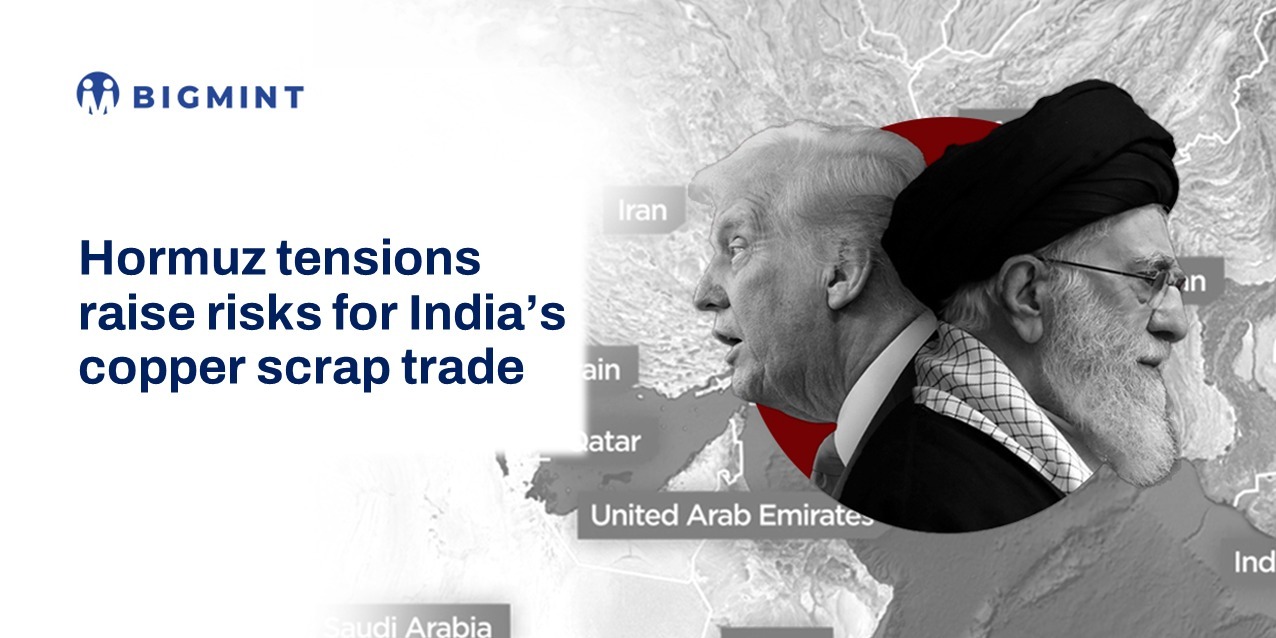
Escalating geopolitical tensions around the Strait of Hormuz, a key maritime corridor connecting Gulf producers with Asian markets, are beginning to raise logistical risks for India’s copper trade flows, particularly for scrap imports used by the secondary sector. While global copper supply remains largely stable, disruptions to shipping routes in the Gulf have pushed freight and insurance costs higher, creating uncertainty for buyers dependent on shipments routed through the region.
Copper prices show limited reaction
Copper markets have reacted relatively mildly to the geopolitical developments compared with commodities such as oil and aluminium. On the London Metal Exchange (LME), copper cash prices were reported at $12,959/t on 4 March, down from $13,229.5/t on 2 March when the shipping disruption was first reported. Prices are currently trading near $12,900/t.
Market participants note that copper’s globally diversified supply base has limited the immediate price impact despite rising shipping risks. However, the price trajectory will depend largely on how long tensions persist around the Strait of Hormuz. A short-term disruption may have limited impact, but prolonged instability could gradually tighten regional supply chains and push up physical premiums.
Scrap import dependence raises risks for India
India could face indirect pressure due to its reliance on imported copper scrap. In 2025, the country imported around 430,000 t of copper scrap, of which roughly 85,000 t originated from the Middle East, mainly from the UAE and Saudi Arabia. Any disruption to Gulf shipping routes could therefore slow scrap inflows into the Indian recycling industry.
India also imported about 181,300 t of finished copper long products — including wires, bars, rods and profiles — with nearly 115,000 t sourced from the UAE. This highlights India’s dependence on Gulf trade flows for semi-finished copper products.
Logistics costs have already started to rise. Market participants reported that war-risk insurance premiums have increased by 100-200%, while emergency war surcharges of $2,000-3,000 per container have emerged. Freight rates for 40-ft containers are currently around $2,450-2,460.
Some vessels carrying scrap cargo have reportedly remained idle despite being loaded as shipping companies reassess risk levels in the region. Potential rerouting of vessels could also increase transit times, tightening near-term scrap availability.
Sulfur supply concerns emerge
Another potential risk relates to sulfur shipments from Middle Eastern producers. Companies such as Abu Dhabi National Oil Company are among the world’s largest producers of granulated sulfur, a key raw material used to produce sulfuric acid.
Sulfuric acid is essential for solvent extraction-electrowinning (SX-EW) copper production at several African mines. Prolonged disruption to sulfur shipments could therefore indirectly affect copper cathode output from some African operations.
Market sentiment
A major Indian industry participant said higher freight costs could raise production costs for primary copper producers, as India relies heavily on imported copper concentrates. An increase in freight and fuel costs could eventually push up the cost of the final product, the participant said, adding that market participants are closely watching price revisions from primary producers for copper cathodes.
A UAE-based trader noted that copper supply remains available through alternative ports and there is currently no significant shortage of material, although freight costs have increased. Other traders indicated that buyers in China are increasingly sourcing copper from African suppliers, while Western scrap suppliers have raised global scrap prices by around 1.5-2% as trade flows adjust.
Outlook
The overall impact on copper markets will depend on the duration of tensions around the Strait of Hormuz. If shipping conditions stabilise in the coming weeks, trade flows to Gulf hubs could normalise with limited long-term impact. However, prolonged disruption may lead to higher freight costs, tighter scrap supply for India’s secondary sector, and firmer regional copper premiums.
Leave a Reply