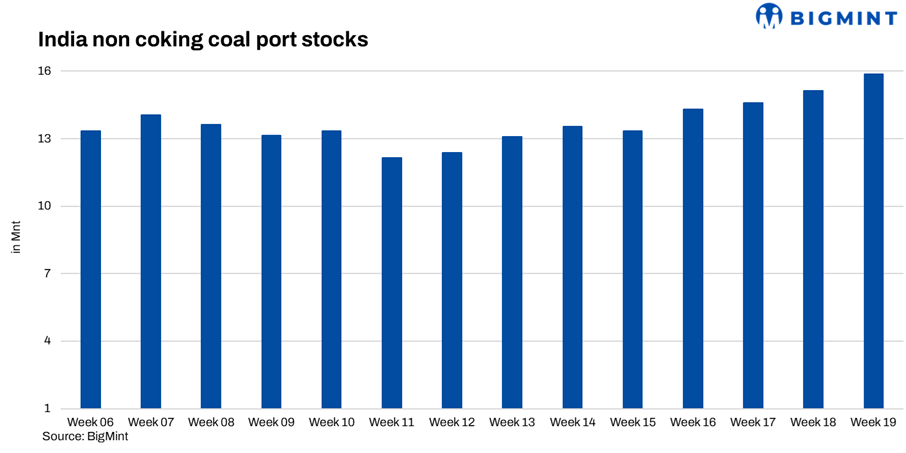
- Inventories rise on steady inflows
- Weak demand limits coal movement
India’s non-coking coal inventories at major ports increased by 4.8% w-o-w in week 19, rising to 15.87 mnt from 15.14 mnt in week 18, indicating continued cargo inflows despite weak downstream demand. The inventory level reached its highest point in the past 25 weeks, last seen at a similar level of 15.87 mnt in week 25 of 2025.
Higher arrivals across select western and eastern ports, coupled with moderate evacuation, kept overall stock levels elevated. Market participants continued requirement-based procurement amid ample supply and subdued industrial sentiment.
Mixed port movement reflects selective cargo positioning
Port-wise inventory movement remained mixed during the week. Significant increases were recorded at Krishnapatnam, Vizag, Tuticorin, Karaikal and Mangalore, indicating fresh cargo arrivals and repositioning of imported material. Krishnapatnam inventories rose sharply by 38% w-o-w, while Vizag and Tuticorin also posted strong gains.

Mundra, Dhamra and Paradip witnessed moderate inventory increases, reflecting continued inflows at key trading and industrial hubs. Meanwhile, Tuna, Haldia, Gopalpur and Pipavav recorded noticeable declines, suggesting ongoing evacuation and lower fresh arrivals.
The overall inventory trend reflected balanced market activity rather than aggressive stocking, with traders and industrial buyers adjusting positions according to regional demand and cargo economics.

Weak industrial demand dampens imports
Imported South African coal sentiment remained under pressure during the week despite rising international offers and higher freight costs. Market participants noted that rising oil prices and firm freight rates pushed up landed costs, leading traders to increase offer levels. However, buying activity remained limited as sponge iron and steel demand stayed weak, while ample domestic coal availability continued offering cheaper alternatives to consumers. Buyers largely avoided aggressive bookings and continued requirement-based procurement amid elevated inventories, cautious downstream sentiment, and limited enquiries across key imported coal markets.
India’s imports of South African non-coking coal declined sharply by 43.4% m-o-m to 1.97 mnt in April from 3.48 mnt in March, reflecting lower industrial demand and growing preference for domestic coal.
Lower domestic coal prices and comfortable supply availability continued reducing import appetite across sponge iron and industrial consumers.
Indonesian coal stays firm; US coal inflows increase
Indonesian thermal coal prices strengthened during the week due to tight cargo availability and rupee depreciation near INR 95/$. Stronger Chinese buying and supply-side tightness supported imported Indonesian prices, although high Indian inventories continued restricting aggressive spot buying.
US North Appalachian thermal coal continued gaining traction in India’s cement sector as buyers increasingly shifted away from expensive imported pet coke. More than 3.1 mnt of US coal was headed towards Indian ports, while softer cement demand and the approaching monsoon season kept overall market sentiment cautious.
Imported US pet coke prices also declined further amid weak buying interest and cheaper coal availability. Market participants expect further correction in pet coke prices if coal availability remains comfortable.
Outlook
The continued increase in inventories suggests that supply conditions are likely to remain comfortable in the near term. Weak sponge iron and steel demand, falling domestic coal prices and cautious industrial procurement are expected to keep pressure on imported coal demand.
Going forward, movement in sponge iron prices, monsoon-related demand slowdown and domestic auction trends will remain key factors influencing inventory movement and market sentiment. Until demand improves meaningfully, buyers are likely to continue requirement-based procurement instead of aggressive stock-building.

Leave a Reply