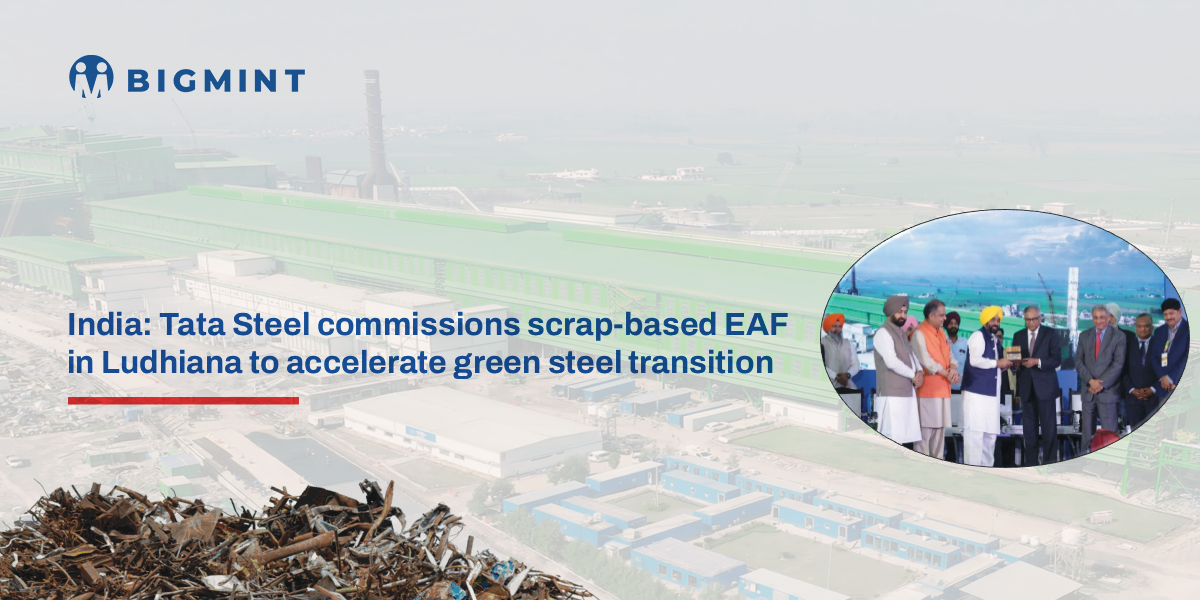
- 0.75 mnt/year scrap-based capacity commissioned in north India
- Focus on circular economy and construction steel segment
Tata Steel commissioned its first scrap-based Electric Arc Furnace (EAF) facility in Ludhiana, with an installed capacity of 0.75 million tonnes per annum (mnt/year). The plant, built with an investment of INR 3,200 crore, is designed to operate on 100% steel scrap, reinforcing the company’s transition towards low-carbon steelmaking.
Chief Minister of Punjab S. Bhagwant Singh Mann, and N. Chandrasekaran, Chairman of Tata Steel, graced the ceremony alongside T.V. Narendran, CEO & Managing Director of Tata Steel, senior government officials, and company representatives.
“As India accelerates its transition to a climate-resilient future, sustainability has become a national imperative demanding urgent, collective action. Tata Steel’s Ludhiana Electric Arc Furnace embodies the Tata Group’s long-term commitment to a greener, more resilient industrial landscape,” said Chandrasekaran.
“The Ludhiana EAF marks a pivotal milestone in Tata Steel’s journey to Net Zero by 2045. It redefines capital investment for a circular economy-backing technologies that cut resource intensity while staying globally competitive. We thank the Government of Punjab for its ongoing support and look forward to delivering long-term value for local communities,” said Narendran.
Shift towards low-carbon steelmaking
The Ludhiana EAF is expected to achieve CO₂ emissions of less than 0.3 tonnes per tonne of steel, significantly lower than conventional blast furnace-basic oxygen furnace (BF-BOF) routes. The facility will utilise nearly 50% renewable energy, aligning with India’s broader decarbonisation goals and Tata Steel’s net-zero target by 2045. Around 40% of scrap requirements will be sourced from the company’s Rohtak recycling facility, ensuring feedstock security and cost efficiency.
Market positioning and product strategy
The plant will produce construction-grade rebar under the Tata Tiscon brand, strengthening Tata Steel’s footprint in the long products segment, particularly in northern India. The move comes amid rising demand for sustainable steel and increasing policy focus on scrap utilisation and circular economy practices.
Industry implications
The commissioning signals a gradual shift in India’s steelmaking mix towards scrap-based production, especially as scrap availability improves and carbon compliance pressures rise. However, scalability remains contingent on stable scrap supply chains and competitive power tariffs.
Leave a Reply