- Oversupply in local market; demand retreats after rally
- Import volumes decline steeply; buyers hold back bookings
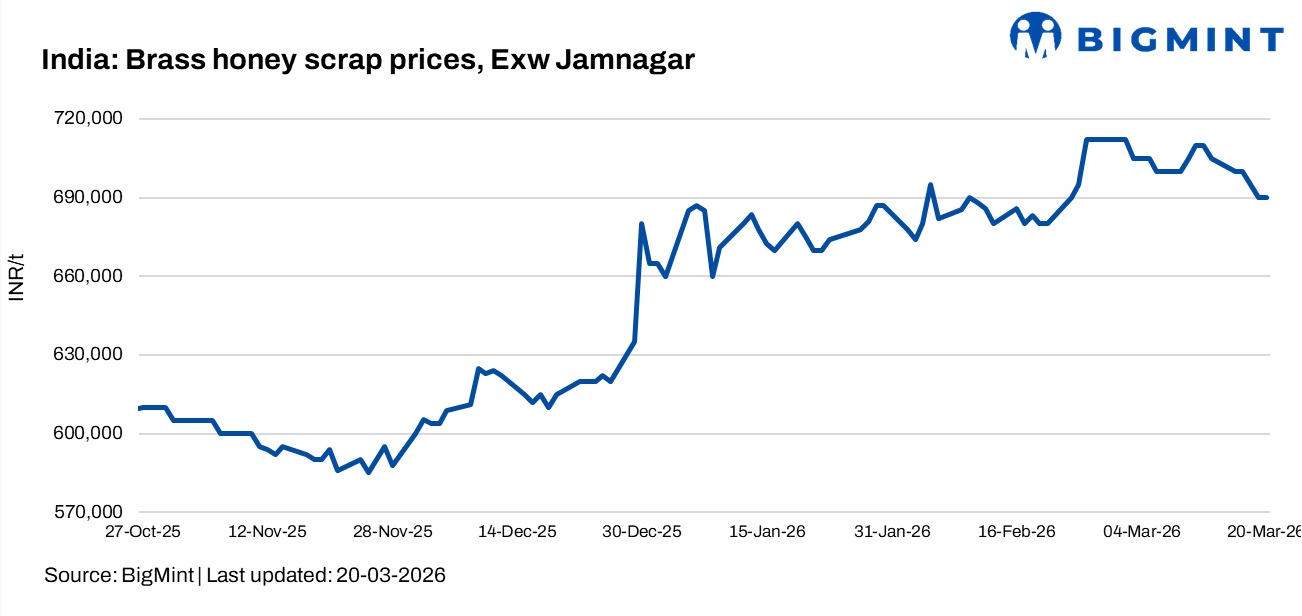
Domestic brass honey scrap prices in India edged lower marginally on a w-o-w basis, reflecting a continued balance between constrained supply and cautious buying sentiment. BigMint assessed brass honey scrap, ex-works Jamnagar, Gujarat, at INR 690,000/t on 20 March, down by 2.12% from INR 705,000/t in the previous week. Prices witnessed moderate fluctuations through the week. Market participants attributed the limited downside to tight material availability, which was partly offset by restrained purchasing activity amid ongoing volatility in global copper prices.
Brass honey scrap prices softened w-o-w as the market corrected after the strong rally seen in mid-February and early March. Demand has clearly cooled, with buyers stepping back following aggressive destocking earlier, leading to weaker spot activity.
Market sentiment has also turned bearish due to rising global uncertainty linked to the Middle East conflict. While the impact is indirect, it has reduced buying confidence and slowed trading momentum across the value chain.
On the international front, China’s brass ingot demand remains subdued, limiting export pull. As a result, suppliers who were earlier focused on exports are now diverting material to domestic markets, often at discounted levels to clear inventory.
In terms of pricing, Europe-origin brass honey scrap has been heard around 54.5% CIF Nhava Sheva, indicating softer import parity. Domestically, brass honey scrap is trading in the range of ₹680–685/kg, reflecting both ample availability and cautious buying.
Overall, the market is currently supply-heavy with limited demand support. Unless downstream brass consumption improves or export demand picks up, prices are likely to remain under pressure in the near term.
India: Brass honey scrap imports
Brass honey scrap imports saw a sharp decline in February 2026, falling to 4,665 tonnes from 8,477 tonnes in January 2026 , indicating a drop of nearly 45% m-o-m. This steep correction reflects weaker domestic demand after aggressive buying in the previous months, along with cautious sentiment in the market. Importers have slowed fresh bookings amid ample local availability and falling prices, while global uncertainty has further discouraged large-volume purchases.
Outlook
The near-term outlook for brass honey scrap prices remains slightly weak, weighed by ample supply and muted buying interest. Market participants are likely to continue need-based procurement amid cautious sentiment. However, any improvement in downstream demand could offer some support, while prices may remain range-bound in the near term.
Leave a Reply