- Bid-offer disparities, monsoon disruptions keep bookings limited
- Domestic scrap continues to attract buyers due to competitive prices
India’s stainless steel scrap market remained firm during the week ended 17 July, supported by higher London Metal Exchange (LME) nickel prices and firmer imported offers. However, buying activity remained largely need-based as mills stayed cautious amid nickel price volatility, a stronger US dollar against the Indian rupee, monsoon-related disruptions, and regional festivals. Domestic scrap continued to dominate procurement owing to its ready availability, competitive pricing and more favourable credit terms compared with imported material.
According to BigMint’s assessment, 304-grade stainless steel scrap remained unchanged w-o-w at INR 135,000/t DAP Delhi, while 316-grade scrap was also steady at INR 272,000/t DAP Delhi.
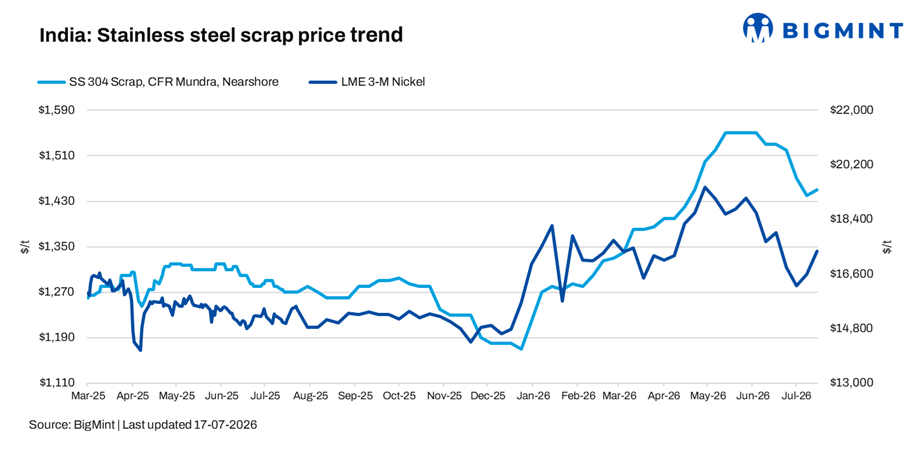
In contrast, imported 304-grade nearshore scrap increased by $10/t w-o-w to $1,450/t CFR Mundra, while 316-grade nearshore scrap rose $30/t to $2,850/t CFR Mundra. Imported 430-grade and 201-grade scrap also increased by $5/t and $10/t, respectively, to $625/t and $690/t CFR Mundra.
Domestic market retains pricing advantage
Domestic scrap remained the preferred procurement option during the week. Imported 304-grade scrap at $1,450/t CFR Mundra translated to approximately INR 139,200/t, excluding port handling, customs clearance and inland transportation costs, compared with the domestic benchmark of INR 135,000/t DAP Delhi. The pricing advantage, coupled with immediate availability and better credit terms, encouraged mills to continue sourcing locally instead of booking imported cargoes.
Market participants also noted limited interest in imports as buyers preferred to avoid exchange-rate risks amid the firm US dollar.
Bid-offer disparity restricts fresh trades
Trading activity remained subdued as suppliers and buyers struggled to agree on workable price levels.
A leading stainless steel producer was heard bidding around INR 139,000/t for 304-grade scrap and INR 274,000/t for 316-grade scrap on 90-day payment terms. Another major mill was bidding around INR 137,500/t for 304-grade scrap and INR 270,000/t for 316-grade scrap on 30-day terms. However, suppliers indicated that these bids remained below acceptable selling levels, resulting in a persistent bid-offer gap and limited deal closures.
Similarly, imported 304-grade scrap offers were heard at $1,450-1,460/t CFR, while buyer indications remained around $1,410-1,420/t CFR, making fresh bookings commercially unviable.
Alloy costs support imported offers
Although domestic 304-grade scrap prices remained range-bound, imported offers firmed following gains in nickel and alloy markets.
Three-month LME nickel prices increased by around 4.6% w-o-w to $17,360/t on 17 July from $16,600/t a week earlier. Meanwhile, LME nickel inventories remained broadly stable at 274,848 t, compared with 274,704 t a week earlier, indicating little change in physical availability.
India’s ferro molybdenum (Mo:60%) prices also increased by INR 15,000/t w-o-w to INR 4,160,000/t ex-works, providing additional cost support to 316-grade stainless steel scrap, which outperformed 304-grade material during the week.
Global market update
In China, East China 304-grade stainless steel off-cut scrap prices increased to RMB 10,200-10,300/t, while Foshan prices were reported at RMB 10,100-10,400/t. Scrap maintained a cost advantage over high-grade nickel pig iron (NPI) despite weaker NPI prices. Firmer stainless steel futures and spot prices supported scrap values, although seasonal demand weakness and tax invoice constraints continued to limit buying activity.
Outlook
Indian stainless steel scrap prices are expected to remain firm over the coming weeks as mills gradually resume procurement for upcoming production schedules and anticipated festive-season demand. However, buying is likely to remain measured, with mills closely monitoring movements in the rupee, the US dollar and LME nickel before committing to larger-volume purchases.
Leave a Reply