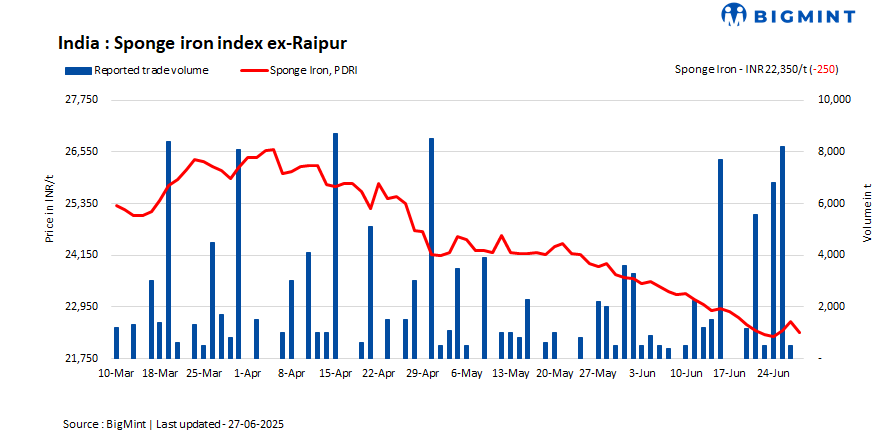
- Trades remain weak, buyers show price resistance
- Alternative raw material prices remain stable d-o-d
Indian sponge iron prices decreased by INR 100-300/tonne (t) d-o-d across key locations today. However, prices in Bellary and Chennai were up slightly by INR 50-100/t.
PDRI prices were assessed at INR 21,300-26,200/t at the close of trading, while CDRI tags stood at INR 23,900-29,000/t.
The market witnessed subdued activity today, as most buyers adopted a cautious approach amid prevailing higher prices. With the recent surge in procurement activity over the past few days, many buyers have already fulfilled their immediate requirements. As a result, fresh inquiries in the market were limited.
Transactions for approximately 4,650 t of sponge iron were recorded today. The overall sentiment was one of wait-and-watch, with participants reluctant to enter into new deals at current price points, expecting possible price corrections or stabilisation in the near term.
Alternative raw material price updates (DAP Raipur)
• Melting scrap (HMS 80:20): INR 31,100/t
• End-cutting scrap: INR 33,100/t
• Pig iron (steel grade): INR 32,550/t
In the Raipur market, alternative raw material prices remained stable d-o-d amid sustained demand from steelmakers. Melting scrap (HMS 80:20) was traded at approximately INR 31,100/t, while end-cutting was priced higher at around INR 33,100/t. Meanwhile, steel-grade pig iron was assessed at INR 32,550/t. The market showed limited volatility over this week, with prices largely range-bound due to persistent buying interest from the secondary steel sector.
Rourkela market overview
The sponge iron market in Rourkela remained stable d-o-d amid moderate demand for finished steel. Local mills faced difficulty in liquidating material within the region. As a result, offers were diverted to southern markets. Demand from Bihar and Uttar Pradesh weakened as buyers procured from nearby sponge hubs. Buying activity was further subdued due to the Rath Yatra holiday.
Rationale
Prices have been derived based on transactions, offers, bids, and indicative price data sets. Transactions are considered as T1 and given a weightage of 50%, whereas other data sets are considered as T2 and given a weightage of the balance 50%.
Click here for detailed methodology



Leave a Reply