- Port inventories declined as cargo evacuations exceeded arrivals
- Sponge P-DRI prices rise w-o-w in eastern India
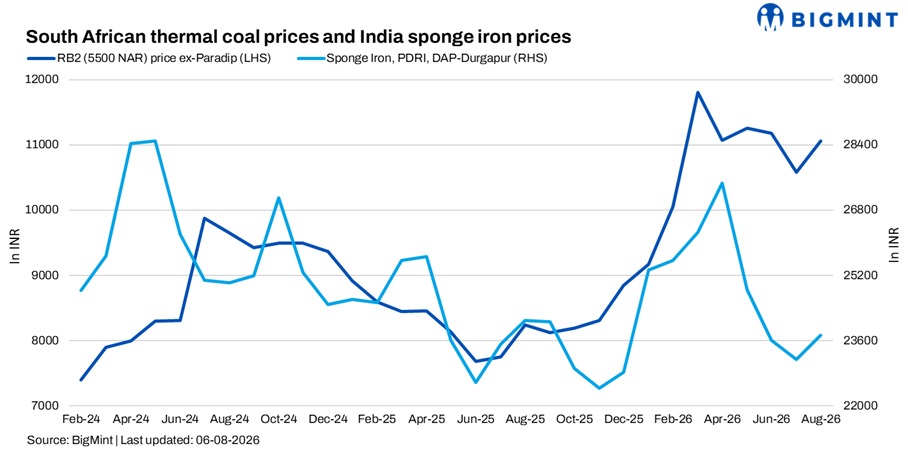
South African thermal coal prices at Indian ports increased further as on 06 Aug’26, supported by firmer FOB offers, higher replacement costs and steady freight levels. However, buying interest remained subdued, with most consumers continuing to procure only against immediate requirements as competitively priced domestic coal remained the preferred fuel. Market participants said import offers strengthened in line with global market sentiment, although higher prices failed to trigger meaningful buying activity.
As per BigMint’s assessment, RB2 (5,500 NAR) ex-Paradip increased by INR 150/t w-o-w to INR 11,150/t, while RB2 ex-Vizag rose by INR 100/t to INR 10,700/t. Meanwhile, RB3 (4,800 NAR) increased to INR 9,200/t at both Paradip and Vizag, up by INR 100-150/t w-o-w.
India’s thermal coal inventories at major ports declined by 2.46% w-o-w to 13.86 mnt from 14.21 mnt, as inventory drawdowns across Vizag, Karaikal, Tuticorin, Hazira and other ports outweighed replenishment at Kandla, Mundra, Dhamra, Navlakhi, Dahej and Paradip. The decline reflected cargo evacuations marginally exceeding fresh arrivals, although domestic coal availability continued to reduce dependence on imports.
Global trades support offers despite limited Indian buying
South African exporters maintained firm offer levels after several cargoes were concluded to South Korea and Sri Lanka, providing support to international prices. Market participants also reported a confirmed RB3 (4,800 NAR) cargo to India for August Panamax loading at around $87.5/t FOB, while suppliers continued offering 5,500 NAR coal at around $88-91/t FOB RBCT for September shipments, around $1/t higher w-o-w.
Buying interest from India remained limited. Indian importers were largely bidding below prevailing offer levels, while suppliers showed little willingness to negotiate following recent export deals. Market participants also reported active enquiries for 4,800 NAR coal for September shipment, with bids around $68-69/t FOB against offers of $70-71/t FOB, indicating a continued bid-offer gap.
At the Indian portside market, trading activity remained selective. A cargo at Dhamra was heard sold at an average of around INR 11,400/t, while another deal for 10,000 t of RB2 was concluded at Krishnapatnam around INR 11,000/t. However, most consumers continued delaying bulk purchases, expecting softer international prices.
Domestic coal rally limits import demand
Domestic coal prices strengthened sharply during the week, further widening the gap with imported South African coal. BigMint assessed 5,000 GCV coal at INR 6,500/t ex-works Bilaspur, up INR 800/t w-o-w, while 4,500 GCV coal increased by INR 700/t to INR 5,000/t as on 04 Aug’26. Aggressive bidding in recent SECL spot e-auctions, coupled with lower monsoon dispatches and constrained availability from preferred mines, continued lifting replacement costs and limiting the availability of quality ROM coal.
The sponge iron market showed mixed trends. PDRI ex-works Raipur increased by INR 250/t w-o-w to INR 25,450/t, while PDRI DAP Durgapur rose by INR 500/t to INR 23,800/t as on 06 Aug’26. Despite the price improvement, overall demand remained subdued as weak finished steel consumption and the ongoing monsoon continued to restrict procurement. Higher pellet and coal costs further squeezed producer margins, prompting most buyers to continue purchasing only against immediate production requirements rather than rebuilding inventories.
Outlook
Market participants expect imported South African coal demand to remain largely requirement-based in the near term. Although firm FOB offers, export bookings to alternative destinations and higher replacement costs are supporting international prices, Indian consumers are likely to continue favouring domestic coal because of its pricing advantage and comfortable availability. Unless steel demand improves materially or international prices correct, import activity is expected to remain selective despite gradually declining port inventories.
Leave a Reply