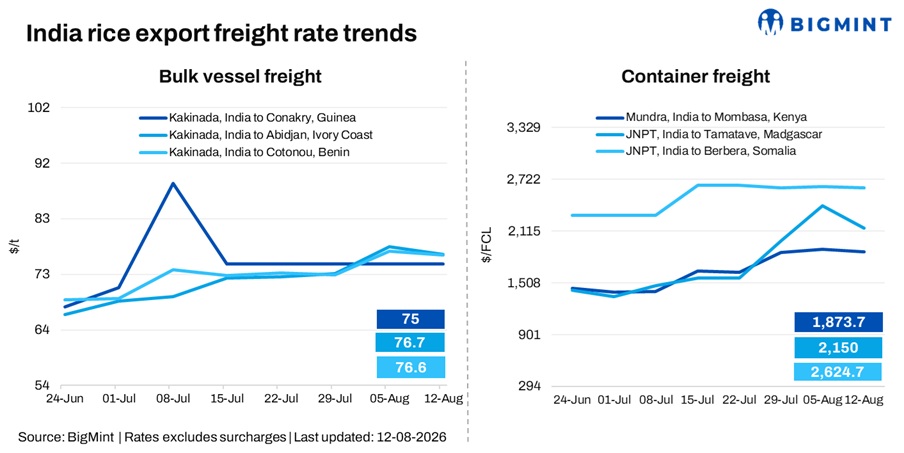
- West Africa bulk freights stay resilient on fresh fixtures
- JNPT-Berbera container freight slips to around two-week low
India’s rice export freight market showed mixed movements in the week ended 12 August 2026. Bulk freights to West Africa remained relatively firm, supported by fresh fixtures and persistent congestion at discharge ports, while container rates softened as space availability improved marginally. However, vessel berthing delays and landside congestion at key Indian ports continued to add volatility.
A shipbroker told BigMint, “Buyer activity is strong today, with quite a handful of enquiries coming into the market.” Another market participant described the container segment as “volatile”, citing container shortages, elevated freights, and vessel berthing delays.
West Africa bulk freights remain supported
Bulk freights to West Africa maintained a firm tone, with fixtures heard on the Abidjan and Cotonou routes supporting market levels. Conakry rates remained stable as congestion at the discharge end offset relatively comfortable vessel availability.
At Kakinada, vessel berthing activity remained healthy, while enquiry levels varied across destinations. A rice trader said, “Kakinada is seeing good vessel berthing activity, while enquiry levels have also picked up, indicating healthier cargo movement.”
Despite improving vessel availability, owners continued to hold firm on some routes due to fresh fixtures and congestion-related delays at West African ports.

Container freights soften amid easing space pressure
Container freights declined across the assessed routes, although space remained relatively tight in some corridors. Market participants attributed the recent softening to a gradual improvement in space availability rather than a significant deterioration in cargo demand.
The JNPT-Berbera route also slipped to around a two-week low, reflecting the broader easing in container freight indications.
At Mundra, vessel schedule instability and yard congestion continued to cause delays, while weather-related disruptions remained an additional risk. JNPT also faced gate turnaround issues, yard congestion and landside bottlenecks, affecting cargo movement.
A charterer noted that shipping lines had implemented a general rate increase (GRI) of around $500/twenty-foot equivalent unit (TEU), providing some support to freight levels despite the recent correction.
A shipbroker said, “Container freights are expected to ease, as the current firmness is mainly due to a shortage of space rather than strong fundamentals.”
Rice export prices remain firm
BigMint’s assessment for non-basmati parboiled rice (IR-64 5% PB), FOB Kakinada, increased by $3/tonne (t) w-o-w to $369/t, supported by firm domestic paddy values and weather-related supply concerns.
Improved monsoon conditions have eased some immediate crop concerns, although the strengthening El Nino outlook continues to keep supply risks in focus.
Outlook
Rice bulk freights are likely to remain relatively supported in the coming weeks, with fresh fixtures and congestion at West African discharge ports providing a floor despite improving vessel availability.
Container freights could face further downside if space availability continues to improve. However, tight capacity on selected services, ongoing congestion at Mundra and JNPT, and expected GRI could limit the pace of correction. The JNPT-Berbera route may remain under pressure following its recent move to around a two-week low.
Leave a Reply