- LME copper breaks above $14,200/t as exchange inventories plunge 12%
- DRC concentrate export ban adds fresh bullish thrust to copper market
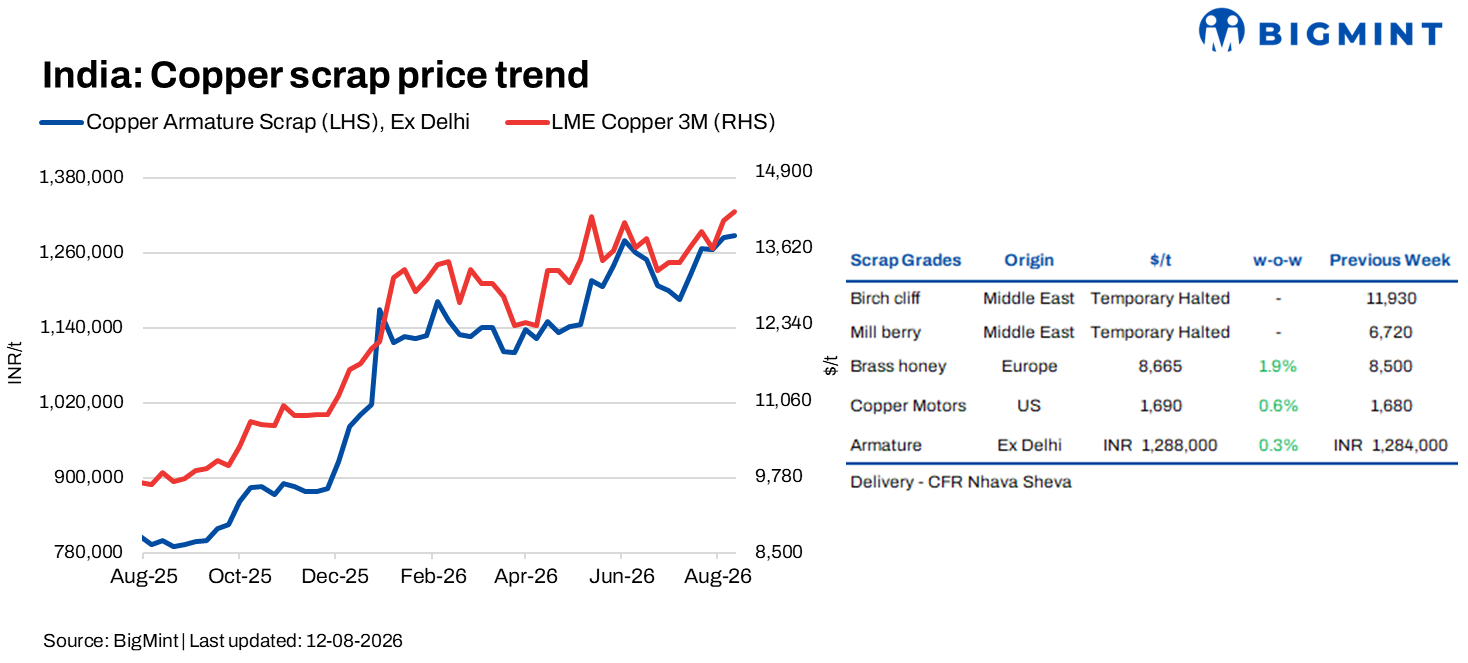
Domestic copper scrap prices in India remained firm during the week ended on 12 August, supported by a sharp rally in LME copper prices, a steep decline in global exchange inventories and continued tightness in the availability of imported scrap. Fresh supply-side concerns following the Democratic Republic of Congo’s (DRC) decision to ban exports of copper concentrates further strengthened bullish sentiment across the copper market.
As per BigMint’s assessment, copper armature scrap, ex-Delhi, increased by around 0.3% w-o-w to INR 1,288,000/t from INR 1,284,000/t in the previous week. The domestic market tracked continued strength in international copper prices, with LME copper trading at around $14,217/t, after moving above the $14,200/t mark and reaching fresh record-high levels during the week.
Market scenario
The Indian copper scrap market remained well supported during the week as the continued rally in LME copper prices reinforced bullish sentiment across the physical market. LME copper inventories declined by around 12% w-o-w to 214,550 t, extending the sharp drawdown in exchange stocks and highlighting the tightening availability of readily deliverable metal.
Against this backdrop, availability of imported high-grade copper scrap in India remained constrained. Elevated international copper prices continued to encourage overseas recyclers and traders to hold material in anticipation of further price gains, limiting spot availability and keeping replacement costs elevated for Indian buyers.
Meanwhile, physical copper demand remained subdued, with downstream buyers continuing to procure largely on a need-based basis. Widening backwardation has increased suppliers’ willingness to release spot material, while some copper continued to move into warrants ahead of delivery. The resulting increase in spot availability, coupled with weak end-use demand, kept physical copper prices under pressure and provided a counterweight to the broader bullish sentiment.
The price differential between primary and secondary copper products widened further during the week, as primary copper prices increased at a faster pace than secondary material amid continued tightening of copper stocks across regions outside the US.
The wider spread improved the relative cost competitiveness of secondary copper rod, particularly for price-sensitive downstream consumers in the wire and cable segment.
Meanwhile, domestic trading activity remained seasonally subdued due to the ongoing monsoon, which continued to weigh on construction-related demand across several regions.
Global supply disruptions tighten imported scrap availability
Imported copper scrap availability remained tight amid subdued scrap generation in key European markets, while recent disruptions at some processing facilities further limited exportable volumes.
Higher container freight rates, up by around $450/container, also raised landed costs for Indian buyers. Meanwhile, renewed shipping risks in the Red Sea added uncertainty to supply chains.
Competition from Far East Asian markets and Pakistan, where buyers offered better realizations, continued to divert cargoes away from India, keeping replacement costs elevated and procurement options limited for domestic recyclers.
DRC concentrate export ban adds to bullish sentiment
The DRC’s immediate ban on copper and cobalt concentrate exports has added fresh bullish sentiment to an already tight global copper market. However, the near-term impact on physical supply is expected to be limited, as the DRC already processes most of its copper domestically. In Q1 2026, the country exported around 696,725 t of refined copper cathodes, compared with just 53,926 t of concentrates, containing around 18,863 t of copper metal.
The ban is therefore largely sentiment-driven in the short term but could become more significant over the medium term as mine output expands and the country seeks greater domestic processing.
Outlook
The Indian copper scrap market is expected to remain firm in the near term, supported by record-high LME copper prices, rapidly declining exchange inventories and constrained availability of imported scrap.
For Indian recyclers, continued competition for imported scrap from other Asian markets is likely to keep replacement costs and premiums elevated. At the same time, India’s growing share of US copper scrap exports highlights the country’s increasing role in the global secondary copper trade.
Beyond the immediate supply tightness, the long-term demand outlook for copper remains increasingly constructive. Investments in AI-driven data centres, power transmission infrastructure, renewable energy, grid expansion and electrification are expected to drive sustained copper consumption over the coming years.

Leave a Reply