- New mandate focuses on quality compliance of input material
- Respective Indian Standards for raw materials specified
In a significant move to uphold quality standards within the nation’s burgeoning steel industry, the Ministry of Steel, Government of India, has issued a new order effective 16 June 2025, mandating adherence to Indian Standards for input materials used in imported steel and steel products. This directive aims to ensure that all steel products requiring mandatory registration on the Steel Import Monitoring System (SIMS) portal comply with specified Indian Standards.
This notification clarifies and reinforces the existing Quality Control Order (QCO), 2024, for steel and steel products. It states that any steel and steel products imported into India, which are already covered under the QCO and require mandatory registration on the SIMS portal, must now also ensure that their input materials comply with the specified Indian Standards.
What’s new?
Previously, 151 Indian Standards were incorporated into the Steel and Steel Products (Quality Control) Order, 2024, primarily focusing on the final steel products falling under chapters 72 and 73 of the Indian Trade Classification (Harmonised System) (ITC-HS) codes. While these finished products required adherence to Indian Standards, the explicit mandatory compliance for their raw or input materials was not as rigorously enforced for imports.
Now, the critical change is the mandatory adherence to Indian Standards for the input materials of these steel and steel products. The government has mapped the respective Indian Standards for the input materials against the defined steel and steel products, and this mapping is enclosed within the order. This step ensures a more comprehensive quality control mechanism, tracing the quality from the foundational input materials through to the final imported steel products.
Examples of steel products, input material standards
The order provides a comprehensive list of steel products and their corresponding input material specifications, some of which include:
- Plain hard-drawn steel wire for pre-stressed concrete (IS 1785 Part 1 and 2: 1983): Requires “high-carbon steel wire rods specification” (IS 7904: 2018) as input.
- Galvanised steel sheets (plain and corrugated) (IS 277: 2018): Inputs can include “cold-reduced carbon steel sheets and strip: part 1 cold forming and drawing purpose” (IS 513 Part 1: 2016), “cold reduced low carbon steel sheets and strip: part 2 high tensile and multi-phase steel” (IS 513 Part 2: 2016), “hot rolled carbon steel sheet, plate and strip” (IS 1079: 2017), “hot rolled medium and high tensile structural steel except for bars and rods of diameter or thickness less than 6 mm and structurals below 50 mm x 50 mm x 6 mm” (IS 2062: 2011), “hot-rolled steel sheet, plate and strip for forming and flanging purposes” (IS 5986: 2017).
- Steel plates for pressure vessels (IS 2002: 2024, IS 2041: 2024): These products require “carbon steel-cast billets, ingots, blooms, and slabs for re-rolling purposes – specification” (IS 14650: 2023).
- High-strength deformed steel bars and wires for concrete reinforcement (IS 1786: 2008): Requires “carbon steel-cast billets, ingots, blooms, and slabs for re-rolling purposes – specification” (IS 14650: 2023) as input.
- Stainless steel sheets and strips for utensils (IS 5522: 2014): Producers can use “carbon steel-cast billets, ingots, blooms, and slabs for re-rolling purposes – specification” (IS 14650: 2023) for hot-rolled products, “stainless steel sheets and strips for utensils – specification” (IS 5522: 2014) for cold-rolled ones, and “stainless steel plates, sheets, and strips – specification” (IS 6911: 2017) for cold-rolled ones.
This new mandate is a critical step towards enhancing the overall quality and reliability of steel and steel products imported into India, reinforcing the government’s commitment to robust quality control within the industry.
India’s steel imports drop in Jan-Apr’25
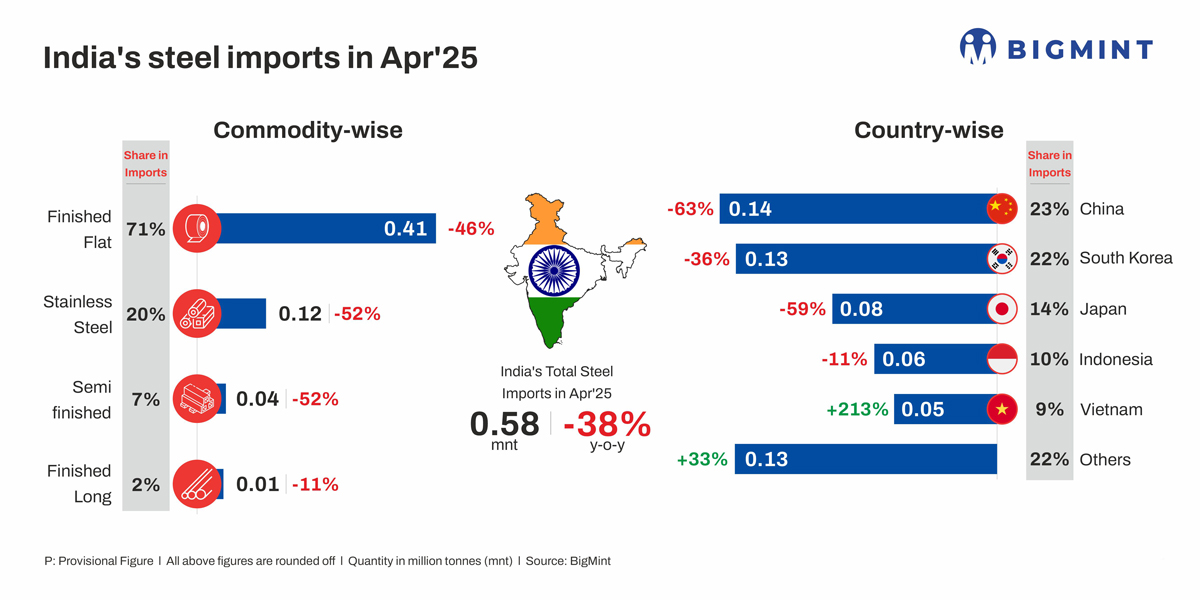
India’s steel imports (including stainless steel) dropped 21% y-o-y in January-April 2025 to 2.85 million tonnes (mnt), precipitated by a sharp decline in the arrival of flat products amid the imposition of the safeguard duty.
Meanwhile, in April, India’s steel imports totalled 0.58 mnt, down 22% m-o-m and 38% y-o-y.
Outlook
This new quality mandate could further influence import trends. The enhanced quality control measures, by potentially increasing compliance requirements, may lead to an initial adjustment period for importers, potentially impacting short-term import volumes. However, in the long term, this focus on quality is expected to strengthen India’s domestic steel industry and ensure the availability of higher-quality products in the market.
Leave a Reply