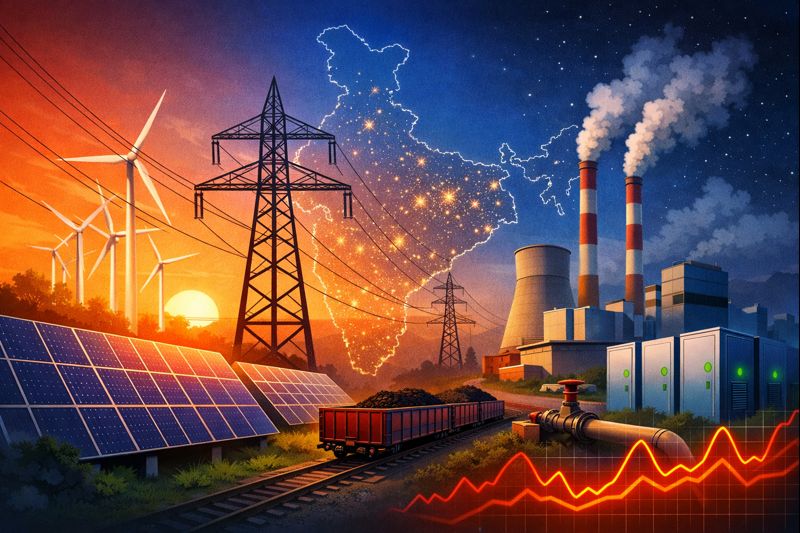
- Flexibility is the system’s key constraint.
Grid bottlenecks are driving volatility.
December 2025 stands out as a defining moment for India’s power sector. In a single month, the system recorded its highest-ever December electricity demand, highest December renewable generation, and highest December spot power price on the Indian Energy Exchange (IEX). These records, while impressive in isolation, collectively revealed deeper structural stresses in India’s rapidly evolving power system.
What unfolded was not a coincidence of extremes but the convergence of rising demand, accelerating renewable penetration, and insufficient system flexibility. December 2025 was both a warning and a preview of the pressures that will increasingly shape India’s grid.
A Month Where Records Collided
The defining feature of December 2025 was the simultaneity of extremes.
Peak demand reached 241,201 MW on 31 December, the highest ever recorded for the month. This was not a brief spike: demand remained above 230,000 MW for an entire week, placing sustained stress on generation and grid operations.
At the same time, renewable energy generation-mainly solar and wind-hit a record 20,672 million units (MU) for December, up 27.8% year-on-year, reflecting the massive commissioning of renewable capacity through 2025.
Yet the system’s breaking point came in the evening. As solar generation collapsed after sunset and demand peaked, spot prices on IEX surged to ₹5,448/MWh, the highest December price ever recorded.
The monthly generation mix highlights the underlying imbalance:

Renewables met daytime demand efficiently, but the system lacked enough flexible, dispatchable capacity to handle evening peaks.
What changed from last year-and from last month
Year-on-Year: Faster Transition, Higher Fragility
Compared with December 2024, total generation rose 13.8%, confirming strong demand growth. However, supply composition shifted sharply.
Renewables grew the fastest, while coal output rose more slowly than demand, reducing its share. Nuclear output declined, weakening baseload stability, while gas generation jumped nearly 30%, underscoring its role as a last-resort balancing fuel.
This transition is positive for decarbonization but increases dependence on flexibility-precisely where the system remains weakest.
Month-on-Month: A Sudden Market Tightening
Conditions deteriorated rapidly from November to December

The critical signal was the collapse in sell bids, even as prices rose. This points directly to transmission congestion, which prevented surplus power in renewable-rich states from reaching deficit regions.
Why it happened: Three interlocking drivers
Demand-side pressures: December demand strength reflected multiple forces: a year-end economic rebound, a structurally steeper evening load profile, and uneven regional growth, with states like Gujarat and Bihar showing above-average demand increases.
The renewable integration paradox: India added 44.5 GW of renewable capacity in 2025, but this created a paradox. Renewables displaced fossil generation during the day, yet also displaced the very flexible capacity needed for evening ramp-up.
Coal plants are not designed for steep cycling, hydro output fell about 15% from November, and nuclear outages reduced baseload availability. The result was a system rich in energy but poor in flexibility.
Infrastructure and market bottlenecks: Transmission congestion proved decisive. As ICRA had warned, corridors from renewable-heavy states such as Rajasthan, Gujarat, and Karnataka frequently saturated, stranding power. Meanwhile, India’s spot market-only 7-8% of total electricity-was too thin to absorb system shocks. Most critically, market design continues to reward energy, not flexibility, discouraging investment in fast-ramping resources such as gas, pumped hydro, and batteries.
Near-Term Outlook: Tight and Volatile H1 2026
December was a stress test, not an outlier. The drivers of tightness remain firmly in place.
Demand growth is likely to moderate, but seasonal peaks will remain strong. Renewable additions will continue, but without commensurate transmission and storage, evening deficits could worsen. Coal logistics remain a swing factor, while gas will stay expensive and marginal.
Spot prices are likely to average 15-25% higher year-on-year, with extreme intra-day volatility and widening regional spreads due to congestion. Liquidity will remain tight as more power stays locked into long-term contracts.
H1 2026 will manage, not resolve, these pressures. True stability will come only through accelerated investment in storage, flexible capacity, and transmission modernisation. Key risks to monitor include low coal stock levels, early heatwaves, rising renewable curtailment, and financial stress at distribution companies.
Leave a Reply