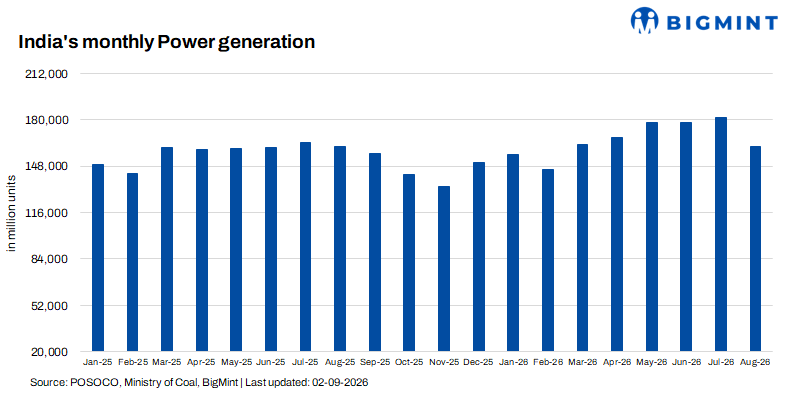
- Coal-fired generation rises 11% despite 42% surge in renewable output
- Coal burn outpaces receipts, driving plant inventories 23% lower m-o-m
India’s electricity system tightened sharply in August 2026 as strong power demand coincided with weaker hydro generation, forcing greater reliance on thermal generation even as renewable output surged. The resulting increase in coal burn outpaced deliveries to power stations, drawing down inventories and pushing a growing number of plants into critical-stock territory.
Total electricity generation increased 11.6% year-on-year (y-o-y) to 179.97 TWh in August, from 161.25 TWh a year earlier. Coal-fired generation rose 11.2% to 113.68 TWh, despite renewable generation surging 42.1% to 35.15 TWh.
The underlying driver was unusually strong electricity demand combined with substantially weaker hydro generation. Average daily maximum demand increased approximately 13.1% y-o-y to 243.5 GW, from 215.3 GW in August 2025, while the month’s highest demand reached 258.3 GW, compared with 229.7 GW a year earlier.
Meanwhile, hydro generation fell 16.7% y-o-y to 21.52 TWh, from 25.85 TWh.
Renewables surge but coal generation still rises 11%
The generation mix provides perhaps the clearest indication of the pressure on India’s power system.

Renewable generation increased by more than 10.4 TWh y-o-y, lifting its share of total generation to approximately 19.5% from 15.3%.
Yet coal’s share barely changed, remaining at approximately 63%.
The explanation lies largely in hydro. Its share of generation fell from around 16% to 12%, removing more than 4.3 TWh of low-carbon generation from the system just as overall electricity requirements were rising rapidly.
The August experience therefore illustrates an important feature of India’s changing generation mix: rapid renewable additions can substantially increase daytime electricity supply, but when hydro availability weakens and demand rises strongly, coal remains the principal source capable of supplying the residual requirement.
Weak monsoon affects both demand, supply
Weather contributed to the tightening from several directions.
August 2026 rainfall was around 16% below normal, compared with August 2025 when rainfall was above the long-period average.
The weaker and less widespread rainfall likely helped sustain higher temperatures and cooling demand across several major consuming regions, consistent with the approximately 13% increase in average daily maximum electricity demand.
However, the national rainfall deficit concealed significant regional variations. Periods of heavy rainfall affected important coal-producing regions in eastern and central India, disrupting mining and transportation.
This created an unfavourable combination for the power sector: insufficient widespread rainfall to suppress electricity demand and restore hydro availability, but sufficient concentrated rainfall in coal-producing areas to interfere with coal supply.
Coal India’s August figures provide some evidence of this disruption. CIL production fell 5.7% y-o-y to 47.5 mnt, although dispatches remained resilient at 60.6 mnt, up 5.5% y-o-y, as the miner drew on inventories to support deliveries.
The more important power-sector question, however, is what actually reached generating stations.
Power plants burn 8.5 mnt more coal than they receive
CEA daily coal-stock reports show a sustained imbalance throughout August.
Power stations began the month with approximately 37.83 mnt of coal and 30 plants classified as critical. Across August, power plants received approximately 70.88 mnt of coal but consumed approximately 79.35 mnt.
That left a cumulative 8.47 mnt deficit between receipts and consumption. Receipts were below consumption on 30 of the month’s 31 days.
By 31 August, power-plant inventories had fallen to approximately 29.12 mnt, a decline of around 8.7 mnt or 23% during the month, while the number of critical-stock plants increased to 51.

The close relationship between the 8.47 Mnt receipt-consumption deficit and the approximately 8.7 mnt inventory decline shows that August’s stock deterioration was principally the result of a sustained supply-versus-burn imbalance.
Northern, central plants emerge as pressure points
The deterioration was geographically widespread, but northern and central India emerged as important areas of stress.
By month-end, Uttar Pradesh had eight critical plants representing more than 10 GW of capacity, Rajasthan eight and Madhya Pradesh six. Maharashtra and Andhra Pradesh also had multiple critical stations.
Rajasthan deteriorated particularly sharply during the second half of August.
By 25 August, Chhabra-II held only 21% of normative stocks, Chhabra-I Phase 2 and Kalisindh were at 22%, and Suratgarh TPS was at 23%. Several remained at around 18-24% of normative stocks towards month-end.
The CEA reports repeatedly called for increased captive-mine loading, road movement and improved coal supplies, suggesting the problem was increasingly one of getting sufficient coal to the plants rather than simply aggregate domestic coal availability.
IEX reflects a tighter but volatile power market
The Indian Energy Exchange’s Day-Ahead Market also reflected the changing power balance.
BigMint’s analysis of daily IEX data indicates an August 2026 average market clearing price of approximately INR 4.41/kWh, compared with around INR 4/kWh in August 2025.
But the more revealing feature was the sharp variation in the relationship between purchase and sell bids.
On tighter days, purchase bids substantially exceeded available sell-side volumes and prices strengthened. On other days, stronger renewable availability and softer demand produced large increases in sell-side liquidity and substantially lower prices.
This volatility highlights an increasingly important feature of India’s electricity market: rapid renewable growth can create periods of abundant electricity while the system can still become tight when renewable output falls, and dispatchable generation is required.
Hydro therefore assumes greater importance as a balancing resource.
Hydro weakness could persist into Sep’26
India enters September with reservoir storage substantially below the corresponding period of 2025, particularly across parts of northern and southern India.
That is already visible in August generation, when hydro output fell 16.7% y-o-y despite overall electricity generation increasing 11.6%. The September rainfall outlook is therefore important.
IMD expects September rainfall to remain below normal, at less than 91% of the long-period average. A weaker final month of the monsoon would limit the potential for reservoirs to close their substantial year-on-year storage deficit quickly.
Hydro generation could still improve seasonally if rainfall strengthens over major catchments, but replicating last year’s hydro contribution appears increasingly difficult without a significant improvement in reservoir inflows.
A relatively dry September could also keep temperatures and electricity demand elevated.
Coal logistics becomes key September variable
August’s central message is not simply that India lacked coal. CIL dispatches actually increased y-o-y, while renewable generation surged by more than 40%. The problem was that electricity demand and coal burn increased faster than the power-sector supply chain could replenish coal at generating stations, while weak hydro removed an important source of dispatchable electricity.
India consequently enters September with power-plant coal inventories approximately 23% lower than at the beginning of August and 51 plants classified as critical.
The crucial indicator now is whether daily coal receipts begin consistently exceeding consumption. If coal production recovers as monsoon conditions ease, railway movement improves and hydro generation strengthens, power stations should begin rebuilding inventories. If hydro remains weak and electricity demand stays elevated, however, utilities could face the more difficult task of rebuilding coal stocks while simultaneously maintaining high coal-fired generation.
That would place increasing importance on railway capacity and coal evacuation from domestic mines, particularly for long-distance consumers in northern, western and southern India. For coastal plants far from India’s principal coalfields, prolonged logistics pressure could also begin changing the economics of domestic versus imported coal.
August therefore provides an early warning for the post-monsoon power market: India’s challenge may be shifting from whether sufficient coal exists in the domestic system to whether it can be delivered to power stations quickly enough to meet rising electricity demand while rebuilding depleted inventories.
Leave a Reply