- Limited prompt stocks support higher portside offers
- Higher import costs lead suppliers to keep offers firm
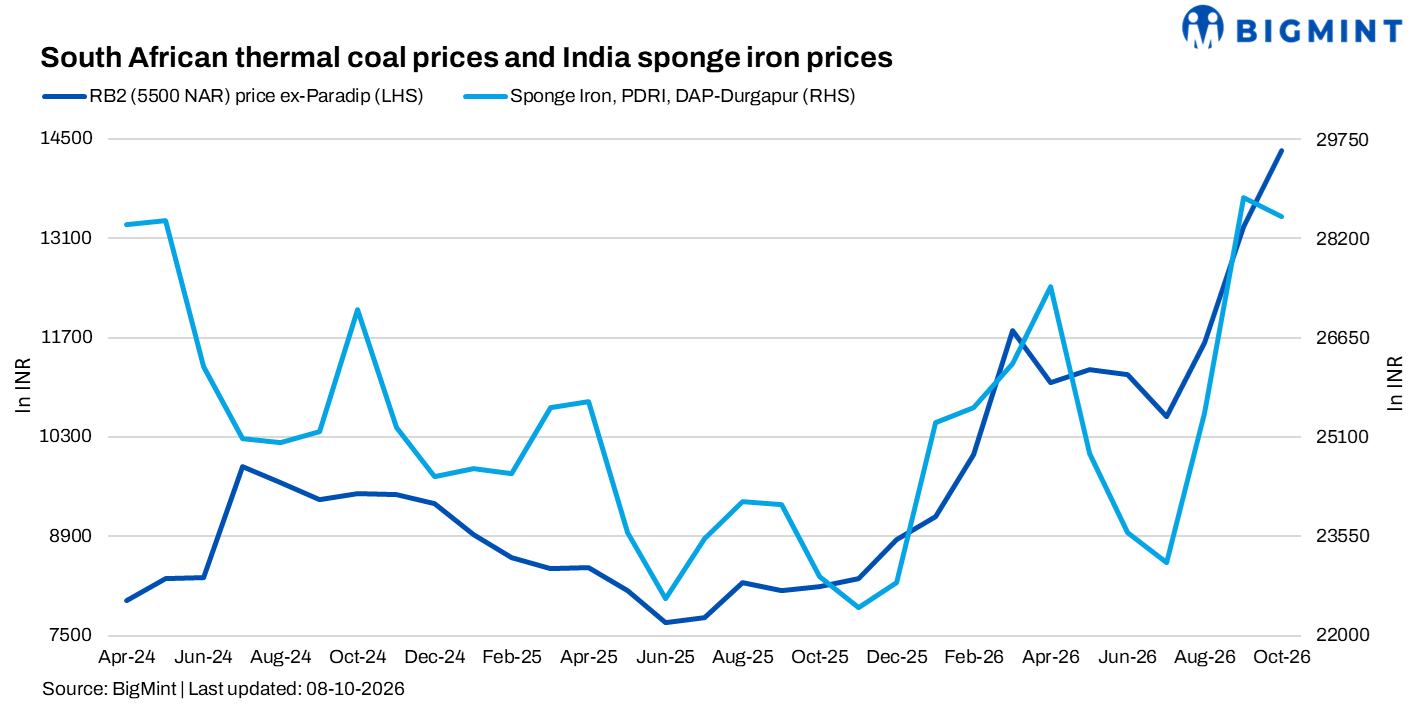
South African thermal coal prices at Indian ports strengthened further in the assessment week ended 8 October 2026, supported by higher import replacement costs, limited prompt availability, and firm demand for selected cargoes. Ex-Paradip RB2 (5,500 NAR) increased INR 200/t w-o-w to INR 14,300/t, while RB3 (4,800 NAR) rose INR 200/t to INR 12,300/t. Ex-Vizag, RB2 increased INR 300/t to INR 14,300/t, while RB3 gained INR 250/t to INR 12,250/t.
Higher import costs support portside prices
Import offers strengthened during the week, with 5,500 NAR RB2 around $135-136/t and 4,800 NAR RB3 around $115-116/t. The increase in replacement costs encouraged suppliers to raise portside offers.
Prompt availability remained limited at key ports. No RB2 stock was reportedly available at Vizag, while limited RB3 stocks were also reported at some locations. Market participants indicated that upcoming RB3 vessels had already been sold, keeping prompt availability tight.
A transaction for around 20,000 t of 5,500 NAR RB2 was reported at INR 14,700/t ex-Vizag, while another buyer was heard to have concluded a deal for around 20,000-30,000 t of RB2 at INR 14,300/t against offers around INR 14,500/t.
At Mangalore, RB2 offers were around INR 14,200/t, while RB3 was heard around INR 12,100-12,200/t. Buyers at smaller plants were largely booking material on a hand-to-mouth basis, while larger consumers remained relatively quiet.
Port inventories remain broadly stable
Coal inventories at Indian ports covered by BigMint’s Week 40 assessment increased 0.09 mnt to 18.44 mnt during 27 September-3 October. Non-coking coal stocks rose 0.2% to 13.07 mnt, while coking coal inventories increased 1.3% to 5.37 mnt.
However, the overall increase masked sharp movements between ports. Mundra stocks increased 0.63 mnt, while inventories across the remaining covered ports declined by around 0.53 mnt.
The national stock position therefore did not indicate broad-based accumulation. Instead, replenishment remained concentrated at selected ports, while stocks continued to decline elsewhere. The limited RB2 availability at Vizag remained a more direct factor for South African coal pricing.
Domestic coal remains elevated
Domestic coal prices remained unchanged but at high levels. Ex-Bilaspur 4,500 GCV coal stayed at INR 7,000/t, while 5,000 GCV coal remained at INR 9,000/t as of 6 October.
Recent ECL and MCL auctions continued to record premiums of around 200-300% for selected grades, keeping domestic procurement costs elevated. However, the high auction premiums had not resulted in stronger buying across all downstream sectors, with consumers remaining price-sensitive.
The elevated domestic price environment nevertheless maintained a relatively high replacement-cost floor against imported coal, particularly as South African cargo costs increased further.
Weaker sponge iron demand limits buying
Sponge iron prices weakened during the week, with PDRI ex-Raipur declining INR 450/t w-o-w to INR 29,100/t, while PDRI ex-Durgapur fell INR 1,200/t to INR 27,950/t.
Market sentiment weakened as finished steel demand remained subdued and buyer participation was limited. Sellers reduced offers, but buyers continued to adopt a wait-and-watch approach and largely restricted purchases to immediate requirements. Trade activity also remained weak, with no strong bulk buying momentum.
The softer sponge iron market limited broader coal demand, although higher import replacement costs and tight South African availability continued to support portside prices.
Market sentiment remains firm but selective
South African coal prices remained supported by higher replacement costs and limited prompt availability, particularly for RB2 at Vizag and selected RB3 cargoes. However, buying remained uneven, with smaller plants covering immediate requirements while larger consumers stayed cautious.
The market was therefore firm rather than broadly active. Further price movement was likely to depend on new vessel availability, international coal costs and whether downstream steel demand improved enough to support larger fresh bookings.
Leave a Reply