- Rising freights, supply disruptions support replacement costs
- Weak enquiries, improving domestic coal supplies limit price gains
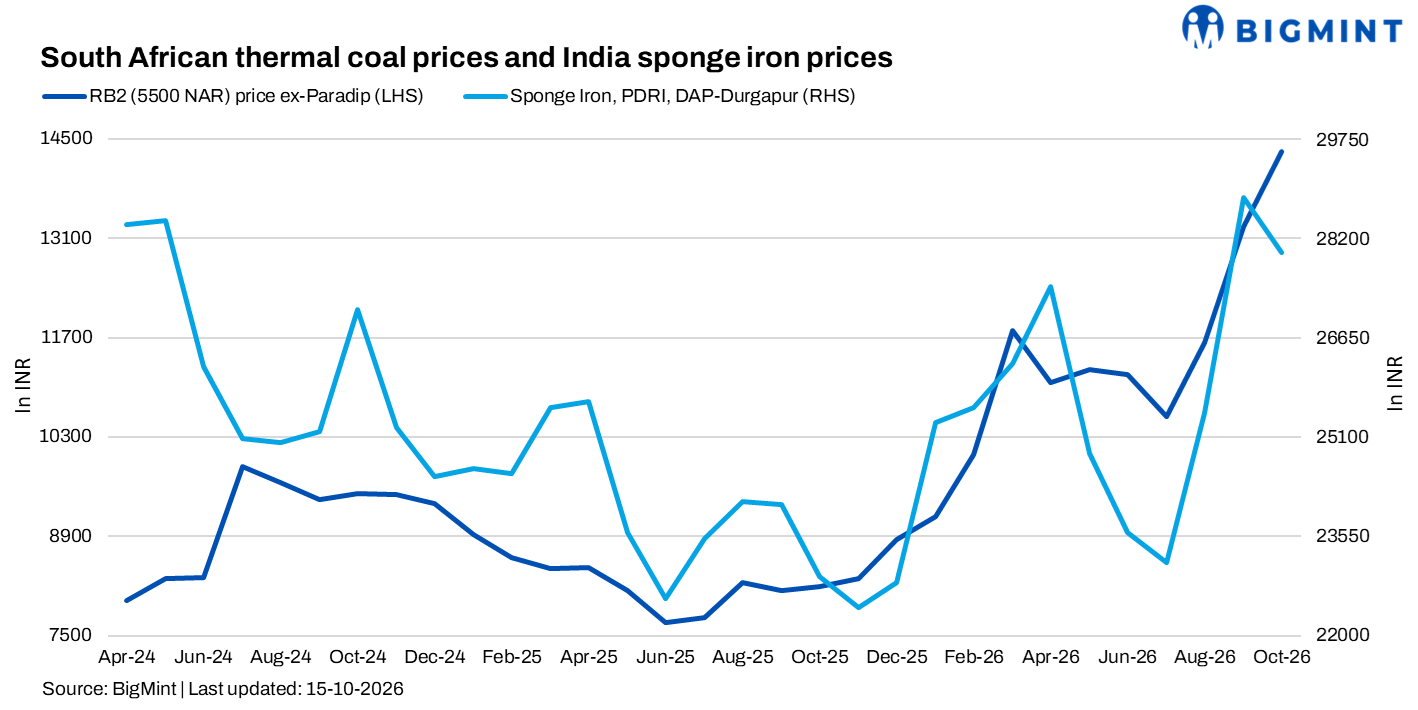
South African thermal coal prices remained largely stable w-o-w at Indian ports as of 15 October 2026, supported by firm export offers, rising freight costs and concerns over supply disruptions. However, buying interest remained selective, with sponge iron manufacturers largely procuring on a need basis amid weak downstream demand and falling coal prices in the domestic market. Improved domestic coal production and supplies offered some relief, but delivery timelines and limited trader inventories continued to influence procurement decisions.
Portside prices remain stable
Ex-Paradip RB2 (5,500 NAR) remained unchanged w-o-w at INR 14,300/t, while RB3 (4,800 NAR) held at INR 12,300/t. At Vizag, RB2 declined INR 50/t to INR 14,250/t, while RB3 remained stable at INR 12,300/t.
At Mangalore, RB2 offers were reported at INR 14,300-14,400/t, while RB3 was indicated at around INR 12,200/t. Market participants reported enquiries for November and December South African cargoes, although purchases remained largely need-based.
Export offers remained firm amid higher freight costs and concerns over supply disruptions at Richards Bay Coal Terminal (RBCT). However, market participants indicated that firm offers were not translating into strong buying across the market, with some consumers reluctant to commit to fresh cargoes at current levels.
Rail disruption raises supply concerns
A power failure affecting South Africa’s coal railway between Halfgewonnen C and Hamelfontein disrupted rail operations during 10-11 October. Services to Richards Bay Coal Terminal resumed on 11 October, and the associated force majeure was lifted.
The disruption affected 21 export trains, equivalent to approximately 174,300 t of interrupted rail movement. However, this represented delayed scheduled deliveries rather than confirmed permanent export losses.
South African exports had increased to 1.62 mnt during 3-9 October from 1.02 mnt in the preceding week. India received around 0.48 mnt, while Pakistan accounted for approximately 0.39 mnt. The shipment data indicated that exports had strengthened before the rail disruption.
The immediate impact on coal availability will depend on the recovery of rail movements, terminal inventories and vessel schedules. While the incident highlights logistical risks, the brief interruption alone does not establish a prolonged shortage of export supply.
Freight, replacement costs support offers
South African 5,500 NAR coal was assessed at $112.05/t FOB Richards Bay on 13 October, up $0.80/t from the previous day. Richards Bay-western India Panamax freight stood at around $23.05/t, adding significantly to landed replacement costs.
Rising freight and firm export offers continued to support Indian portside prices. However, the impact of higher replacement costs remained constrained by weak spot demand. Market participants indicated that prices could face downward pressure if sponge iron demand remained subdued, particularly through the festive period.
Port inventories increase despite lower imports
Coal inventories at Indian ports covered by BigMint’s Week 41 assessment rose by 0.24 mnt, or 1.3%, to 18.68 mnt during 4-10 October.
Non-coking coal stocks increased by 0.32 mnt, or 2.4%, to 13.39 mnt, while coking coal inventories declined by 0.08 mnt, or 1.6%, to 5.28 mnt.
The increase in total inventories, despite lower imports during the latest week, indicated that port offtake remained subdued. Stock replenishment was spread across several ports, although availability varied by location and coal type. The higher headline inventory therefore did not necessarily indicate that all grades were readily available to buyers.
This divergence between firm import offers and rising port inventories highlighted the gap between supply-side pricing and actual consumption. Unless buying improves, suppliers may find it difficult to sustain higher offers solely on the basis of replacement costs.
Domestic coal supply improves, but buyers remain cautious
Domestic coal production and supplies improved, with daily rake availability rising over two weeks. However, consumers remained watchful about actual availability and delivery timelines.
Ex-Bilaspur domestic coal prices had weakened sharply earlier in the week, with 4,500 GCV coal falling to INR 6,200/t and 5,000 GCV coal declining to INR 8,700/t. Participants who had secured coal at high premiums in previous SECL auctions were reportedly reluctant to lift material as spot prices declined, with some defaulting on earnest money deposits.
The latest ECL and SECL auctions attracted healthy participation, but auction bookings may take time to translate into physical deliveries. Traders in central India were also reported to be carrying limited stocks. These factors could keep some consumers dependent on imported coal in the near term, even as domestic availability improves.
Sponge iron demand remains uneven
Sponge iron market sentiment remained mixed. Some regional prices recovered on the back of healthy bookings and higher raw material costs, while South India continued to face weaker conditions.
High coal and pellet costs had squeezed sponge iron margins, while finished steel demand remained subdued. Some mills in Goa and Andhra Pradesh had temporarily shut down because of power shortages or scheduled maintenance, reducing their immediate coal requirements. Certain producers were also using scrap to manage costs.
Although buying interest improved in some regions after prices adjusted, the broader market remained cautious. Sponge iron manufacturers continued to prioritise immediate requirements rather than build inventories, limiting the scope for sustained growth in imported coal demand.
Leave a Reply