- Tight power plant stocks, supply disruptions support prices
- Benchmark prices strengthen, higher freights lift landed costs
Indian portside prices of Indonesian thermal coal remained largely stable during the week ended 14 August 2026, as seasonal monsoon conditions, continued preference for domestic coal, and subdued spot buying kept market activity muted.
Buyers remained cautious, largely procuring imported coal on a need-based basis, while relatively stable supply and freight conditions limited significant price movement.
Portside prices: Market remains largely stable
Indonesian thermal coal prices across major grades remained broadly unchanged, reflecting weak spot demand and balanced availability for mid- and high-GAR coal. Premium 5,000 GAR coal was assessed at around INR 10,500/t at Kandla and INR 10,400/t at Vizag, while 4,200 GAR coal remained steady at approximately INR 8,700/t and INR 8,600/t, respectively. Meanwhile, 3,400 GAR coal declined by INR 150/t w-o-w to INR 6,850/t at Navlakhi.
Despite subdued demand, supply-side concerns emerged from Indonesia, with market participants reporting that heavy rainfall at the MIFA mine has disrupted operations for around 8-10 days. The disruption could provide some short-term support to Indonesian coal prices if supply tightness persists.
Monsoon dampens demand; post-monsoon recovery in focus
Market activity remained subdued as industrial consumers continued to prioritise domestic coal over imports, while monsoon-related disruptions limited fresh procurement. Buyers are largely adopting a “procure-as-needed” strategy, avoiding significant inventory accumulation amid uncertain near-term consumption.
However, market participants expect demand to improve following the monsoon season, supported by a seasonal recovery in industrial activity and coal consumption. The extent of the recovery will depend on the relative economics of imported versus domestic coal and the availability of domestic supplies.
Freight costs: Moderate increase adds to landed cost
Supramax freight rates on the East Kalimantan-Navlakhi route increased by $1.7/t w-o-w to around $21.2/t, raising the delivered cost of Indonesian coal into India. If freights remain elevated alongside firmer international coal benchmarks, the increase could marginally reduce the competitiveness of imported coal against domestic alternatives.
Port inventories decline as existing cargoes are evacuated
India’s thermal coal inventories at major ports declined by around 15% w-o-w to 11.79 mnt as of 9 August, from 13.86 mnt in the previous week, as cargo evacuation exceeded fresh arrivals across several major ports.
The inventory drawdown indicates stronger evacuation of previously imported cargoes rather than a broad-based recovery in import demand. With buyers continuing to favour domestic coal and limiting imports to immediate requirements, fresh booking activity remained subdued.
Power plant stocks under pressure as critical units increase
Coal inventories at Indian thermal power plants declined by around 5% w-o-w to 35.23 mnt as of 13 August, equivalent to approximately 11 days of consumption. The continued drawdown highlights increasing pressure on coal availability at vulnerable generating units. As many as 34 power plants reported critical inventory levels, with localised logistics bottlenecks and uneven coal distribution contributing to the tightness.
Global benchmarks edge higher on supply-side support
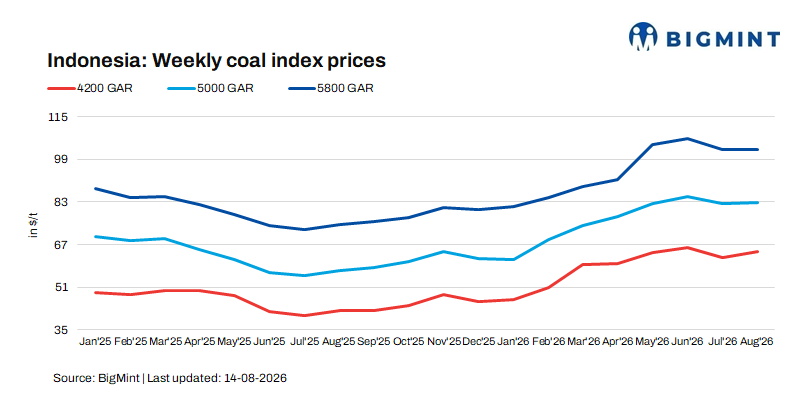
International Indonesian thermal coal benchmarks strengthened modestly during the week. Prices increased by around $0.5-0.8/t for 5,800 GAR, $0.5-1/t for 4,200 GAR and $0.1-0.5/t for 3,400 GAR coal. The marginal gains were supported by supply-side concerns, including weather-related disruptions, although subdued downstream demand continued to limit the upside.
Outlook
Indian portside Indonesian thermal coal prices are expected to remain stable to moderately firm in the near term, with monsoon-led demand weakness, domestic coal preference and cautious procurement limiting upside. However, declining power-plant stocks, Indonesian supply disruptions, higher freight costs and the upcoming 1 September export-policy transition could provide price support.
Post-monsoon demand recovery remains the key catalyst, with stronger industrial consumption and tighter domestic coal availability potentially driving higher import demand. Overall, prices are likely to remain range-bound in the short term, with a mild-to-moderate upside bias post-monsoon.

Leave a Reply