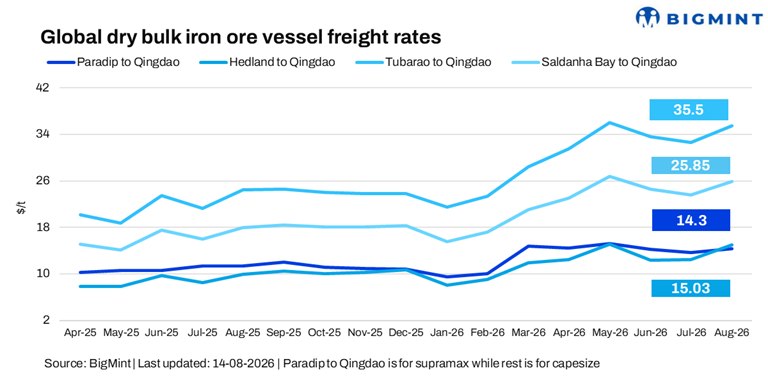
- Capesize freight comes under pressure amid rising vessel availability
- India-China Supramax trade remains comparatively resilient
Dry bulk iron ore freight rates on major export routes showed a mixed-to-weaker trend during the week, with the broader market losing momentum as rising vessel availability and softer chartering activity weighed on Capesize rates. The decline in the Baltic Dry Index (BDI), led by a sharp correction in the Capesize segment, further reflected the weaker freight environment.
Capesize rates came under pressure across key iron ore corridors. Softer offers and lower fixtures in the Pacific, alongside limited fixing activity and slow bid refreshes in the South Atlantic, weighed on sentiment. Meanwhile, Supramax rates remained comparatively resilient, supported by steady Indian iron ore enquiries and regional cargo activity.
The broader market was also influenced by softer DCE iron ore futures, which declined w-o-w amid cautious mill restocking and pressure on steel margins. Although bunker prices eased during the week, ongoing shipping disruptions and elevated marine fuel costs continued to keep voyage economics relatively firm. Higher Brent crude prices added to cost uncertainty, while geopolitical risks remained a source of volatility.
Route-wise update

Factors influencing freight rates
- Baltic Dry Index falls w-o-w: The Baltic Dry Index (BDI) declined 7% w-o-w to 2,844 on 13 August, led by a 12% drop in the Baltic Capesize Index (BCI) to 4,469 as softer freight momentum and rising vessel availability weighed on the larger vessel segment. The Baltic Supramax Index (BSI) remained broadly stable, easing 0.1% to 1,613, indicating comparatively resilient conditions in the smaller vessel market.
- Bunker prices ease w-o-w: Bunker fuel prices declined to $821/tonne (t) on 14 August, from $830/t a week earlier, as softer crude values outweighed persistent supply tightness and elevated marine fuel demand. Ongoing shipping disruptions continued to keep bunker costs relatively firm.
- DCE iron ore futures weaken w-o-w: The benchmark DCE iron ore contract declined to RMB 710.5/t ($105/t) on 14 August, from RMB 716.5/t a week earlier, as softer steel demand and margin pressure tempered buying interest. The decline also reflects a more cautious market tone, with Chinese mills remaining selective on restocking amid subdued downstream demand.
- Brent crude prices rise w-o-w: Brent crude futures climbed to $87.07/barrel (bbl) on 14 August, from $81.88/bbl a week earlier, supported by heightened geopolitical risks and concerns over disruptions to oil flows through the Strait of Hormuz. However, weaker global demand expectations and rising inventories continued to cap the upside.

Outlook
Dry bulk iron ore freight rates are likely to remain under pressure in the near term, particularly across Capesize routes, as rising vessel availability and cautious chartering activity weigh on market sentiment. Softer DCE iron ore prices and subdued steel margins could also limit fresh cargo demand from China.
Supramax rates may remain comparatively stable, supported by Indian iron ore enquiries and balanced tonnage availability. However, sustained weakness in Capesize freight and any slowdown in iron ore loading programmes could limit upside across the broader market.

Leave a Reply