- India’s import dependence projected to rebound to 33% by FY31
- Capacity additions lag demand growth despite growing project pipeline
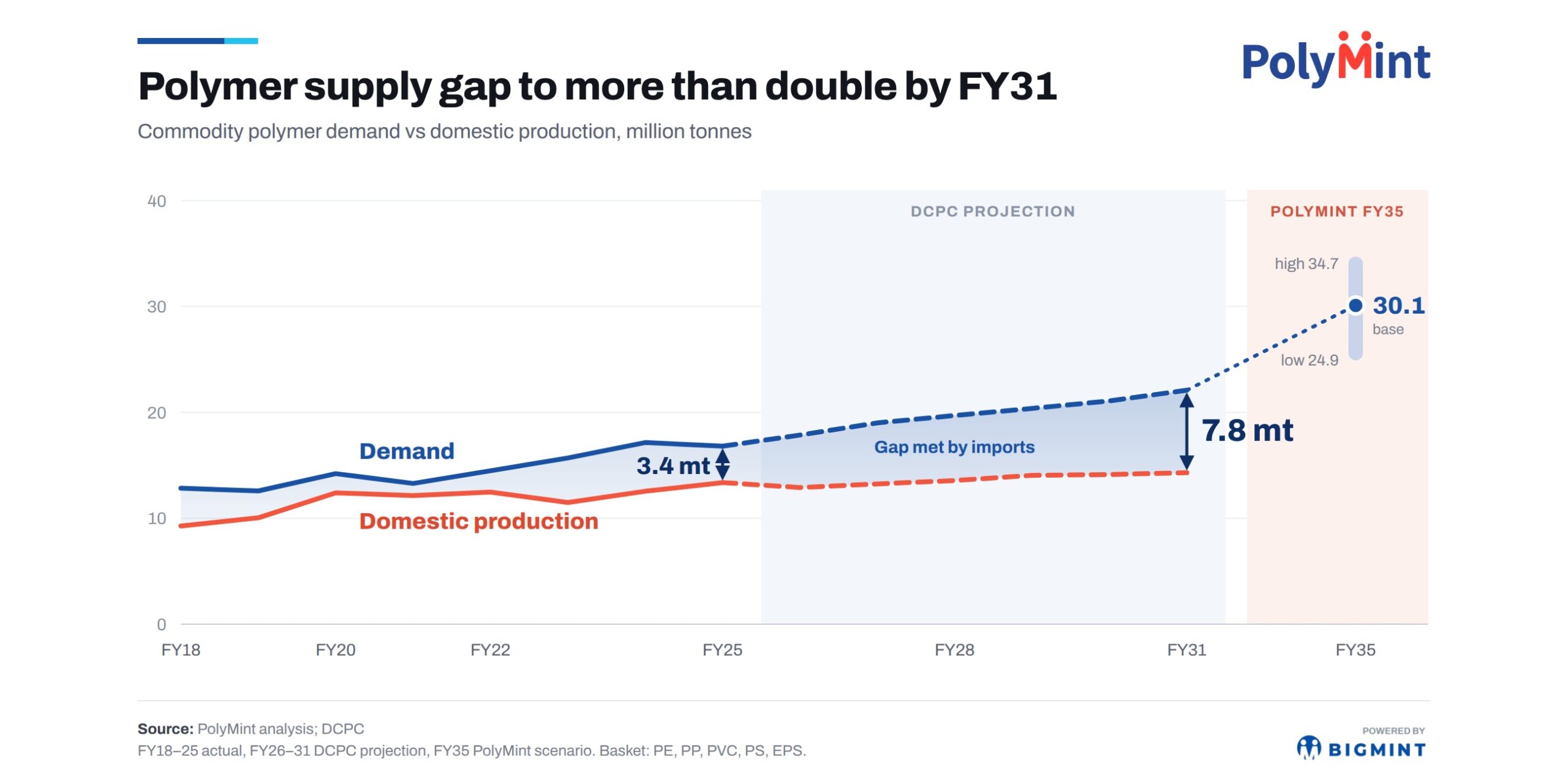
India consumed 16.8 million tonnes (mnt) of commodity polymers in Financial Year (FY) 2025, against domestic production of 13.4 mnt. Imports of 4.2 mnt, net of 0.7 mnt of exports, closed the 3.4 mnt gap.
The Department of Chemicals and Petrochemicals (DCPC) projects demand to reach 22.1 mnt by FY31, while production rises to only 14.3 mnt. If this plays out, imports would account for roughly a third of India’s polymer demand—the highest share since FY18.
The Pipeline the Projection Leaves Out
In January 2026, Bharat Petroleum Corporation Limited (BPCL) awarded Engineering, Procurement, Construction and Commissioning (EPCC) contracts for a 1.15 mnt/year High-Density Polyethylene (HDPE)/Linear Low-Density Polyethylene (LLDPE) complex and a 550,000 tonnes/year Polypropylene (PP) unit at its Bina refinery in Madhya Pradesh.
Hindustan Petroleum Corporation Limited (HPCL)’s Barmer refinery-cum-petrochemical complex in Rajasthan, with 2.4 mnt/year of petrochemical output, including PP and a Polyethylene (PE) swing unit, received approval for its revised INR 79,459 crore cost in April 2026.
GAIL (India) Limited commissioned a 60,000 tonnes/year PP unit at Pata earlier this year.
None of these projects is reflected in the DCPC’s trend model, which increases installed polymer capacity by just 2% to 13.2 mnt by FY31.
The real question is therefore timing: how much of the announced pipeline comes on stream before demand moves further ahead?
Commodity polymer demand grew from 12.8 mnt in FY18 to 16.8 mnt in FY25, while production increased from 9.3 mnt to 13.4 mnt. The gap narrowed to 1.2 mnt in FY21 as new capacity came on stream, but widened again as demand recovered faster than domestic output.
On the DCPC projection, the gap reaches 7.8 mnt by FY31.
PolyMint’s own scenarios, which grow demand at the FY21–FY25 run-rate of 6% annually, put FY35 demand at 30.1 mnt in the base case, within a range of 24.9–34.7 mnt.
A Decade of Import Substitution at Risk

It climbed back to 31% in FY23–FY24 when domestic output dipped, before easing to 25% in FY25 as production reached a record 13.4 mnt.
DCPC’s projection takes import dependence to 29% in FY26 and 33% by FY31, above FY19 levels.
However, the model is a mechanical trend extrapolation that holds capacity broadly flat. It is therefore better read as a warning of what could happen if new projects are delayed, rather than as a forecast of the industry’s actual trajectory.
Why this matters in Ahmedabad
Where is polymer supply heading — and what could it mean for PP, PE, and PVC prices, sourcing, and margins?
At PLAST.CONNECT 2026 — West India, PolyMint will bring together industry leaders to discuss upcoming capacities, evolving supply gaps, resin sourcing, import parity, domestic prices and converter margins.
With West India at the centre of imported resin flows and converting activity, this is a conversation that can shape 2027 sourcing and business plans.
Join us on 22 October in Ahmedabad and be part of the conversation shaping the polymer market.

Leave a Reply