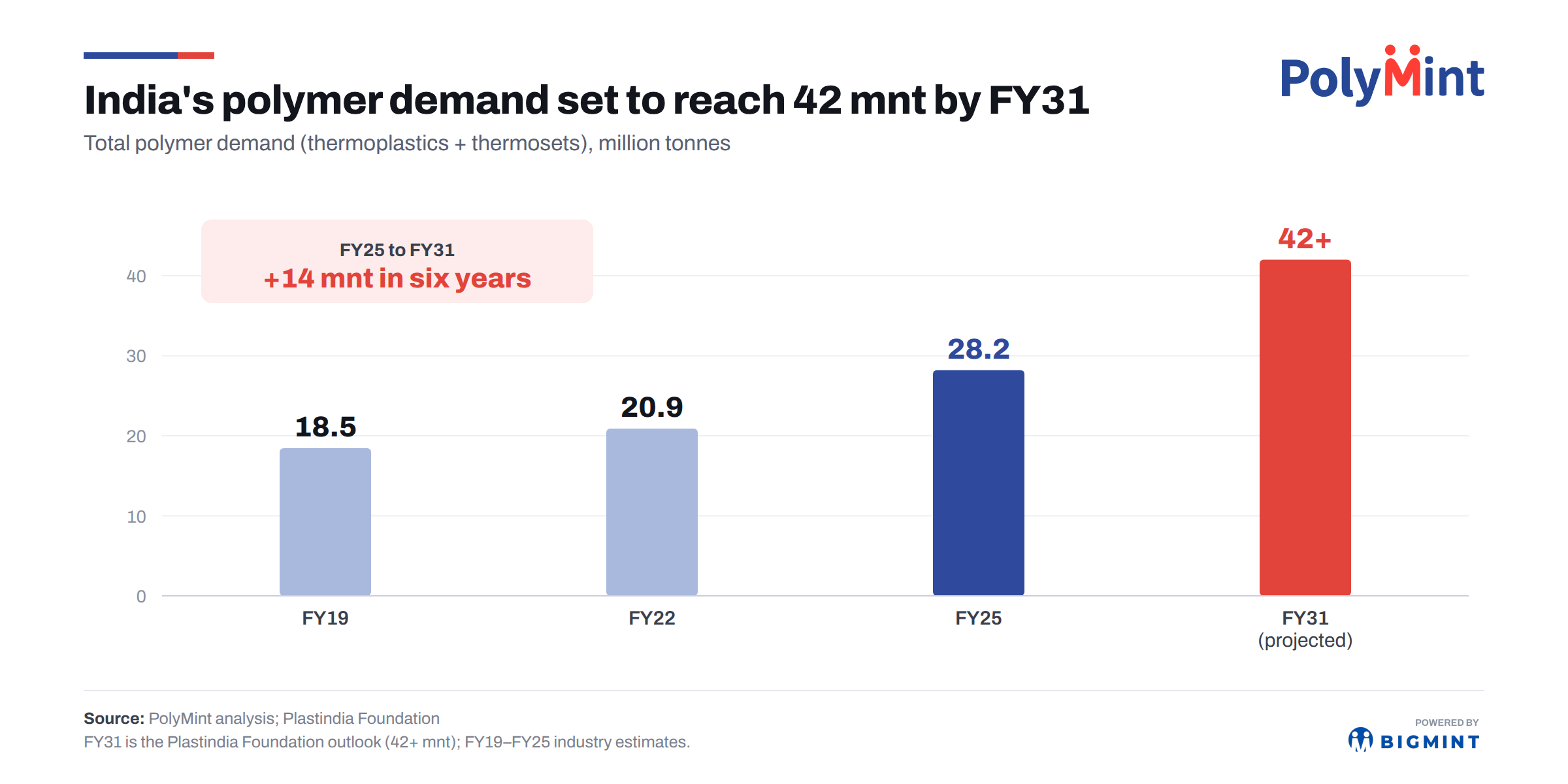
- Total polymer demand reaches 28.2 mnt in FY’25, growing 7.3% a year since FY’19
- India accounts for 7.6% of global commodity polymer demand but only 4.8% of capacity
India consumed 28.2 million tonnes (mnt) of polymers in Financial Year 2024-25 (FY25), according to the Plastindia Foundation’s Plastics Industry Status Report FY25. Demand has grown from 18.5 mnt in FY19, an average of 7.3% a year, and the Foundation expects it to cross 42 mnt by FY31. That implies adding about 14 mnt of demand in six years, more than India’s entire polyethylene and polypropylene consumption today.
Commodity plastics make up 24.4 mnt, or 87% of the total. Thermosets such as polyurethanes, phenolic and epoxy resins add 2.5 mnt, while engineering, high-performance and specialty polymers account for 1.2 mnt and bioplastics a small 40,000 tonnes.
Three polymers carry the volume

Polyethylene (PE) is the largest commodity polymer at 8.2 mnt, followed by polypropylene (PP) at 7.6 mnt and polyvinyl chloride (PVC) at 4.6 mnt. Together they make up 84% of commodity plastics demand. PP demand grew 8.2% in FY25, led by raffia and injection moulding, while PVC grew 10.9% on the back of pipes. PE demand eased 2.4% as film and pipe applications slowed.

Demand outruns domestic capacity
India accounts for about 7.6% of global commodity polymer demand but only 4.8% of global capacity. The mismatch is sharpest in PVC, where installed capacity of 1.5 mnt covers about a third of demand, and it is also visible in PE and PP, where capacity trails consumption.
The drivers of demand are broad. India’s packaged food market grew from $76 billion in FY19 to $127 billion in FY25 and is expected to reach $216 billion by FY29, supporting film and rigid packaging. Water supply, housing and agriculture schemes support pipes, while automotive, appliances, electronics and renewable energy lift demand for engineering plastics and compounds.
Sustaining 7% annual demand growth will require new polymer capacity, investment in converting, and a recycling system able to supply rising recycled-content obligations.
Why this matters in Ahmedabad
Where will the next 14 mnt of demand come from, and who will supply it?
At PLAST.CONNECT 2026 – West India, these challenges will take centre stage, with inaugural keynotes connecting the industry’s growth outlook with the practical demands of building a more competitive and circular plastics value chain.
Rakesh Patkar, Director at JP Extrusion Pvt. Ltd., will focus on recycling technologies, EPR implementation, stakeholder responsibilities and end-user expectations for recycled materials.
Krunal Yeware, Consultant at Quesrow, will examine India’s plastics demand and recycling outlook to 2030, including virgin versus recycled polymer demand, investment opportunities and India’s potential in global recycled plastics trade.
Join us on 22 October 2026 at Le Meridien, Ahmedabad, as industry leaders discuss who will supply India’s growing plastics market – and how the value chain can prepare.

Leave a Reply