- US strengthens dominance despite lower shipments
- Rising prices change cement sector’s buying behaviour
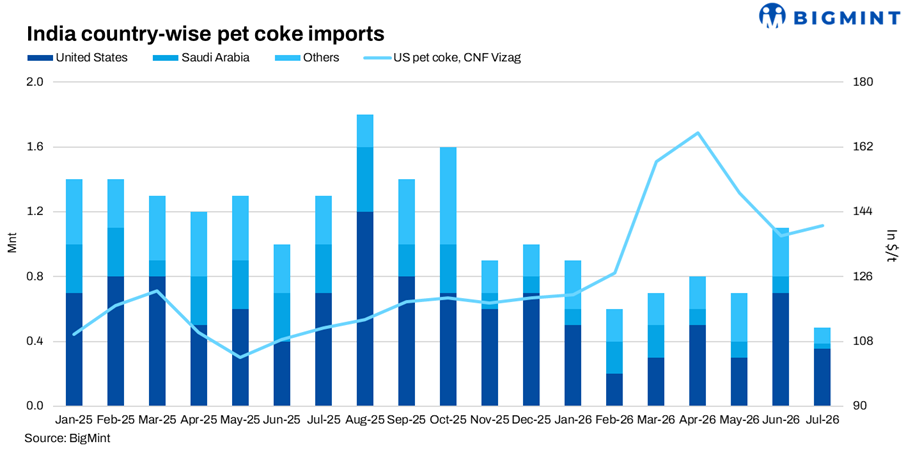
India’s petcoke imports declined 40.9% y-o-y to 5.17 million tonnes (mnt) in January-July 2026 from 8.75 mnt in the corresponding period of 2025. The downtrend was most evident in July, when imports fell to just 0.50 mnt, the lowest monthly volume recorded during the January 2025-July 2026 period and 60.6% lower than July 2025.
The decline reflects more than simply lower import availability. Global petcoke supplies began tightening during the final quarter of 2025 and became progressively more constrained following disruptions to Middle Eastern refinery exports. At the same time, rising international petcoke prices prompted many Indian cement producers to reassess fuel procurement strategies, increasingly substituting domestic coal and imported US North Appalachian (NAPP) coal where economics proved more attractive.
However, aggregate import statistics should be interpreted carefully. India’s petcoke imports comprise fuel-grade petcoke for permitted industrial users, green petcoke used in calcining to manufacture calcined petroleum coke (CPC), and petcoke imported as gasification feedstock. Consequently, the headline decline does not represent a uniform reduction across all end-use sectors.
Imports contract sharply throughout 2026
Following relatively strong import volumes through most of 2025, India’s petcoke market weakened substantially during 2026.
India petcoke imports

Imports weakened in six of the first seven months of 2026, with June proving the only month broadly matching the previous year’s levels. July then marked a sharp reversal, with imports more than halving from June’s 1.05 mnt.
The pattern indicates that June represented a temporary replenishment of cargoes rather than the beginning of a sustained recovery.
Supply tightens from late 2025
Import data show that market conditions began changing during the final quarter of 2025.
After reaching 1.8 mnt in August and 1.6 mnt in October, imports fell sharply to 0.9 mnt in November before recovering only modestly to 1.1 mnt in December.
Market intelligence indicates that international petcoke availability began tightening during this period as export supplies from several refining centres became increasingly constrained. Following the escalation of conflict in the Middle East, supplies from Middle Eastern refineries tightened further, reducing one of India’s traditional sources of imported petcoke.
The result has been a structurally tighter global market entering 2026.
Rising prices change cement-sector buying behaviour
Tighter global supply coincided with a sharp increase in international petcoke prices.
Rather than competing aggressively for increasingly expensive cargoes, many Indian cement producers adopted more flexible fuel procurement strategies.
BigMint’s regular market surveys throughout 2026 consistently indicated that numerous cement manufacturers increasingly favoured domestic coal or US NAPP coal when imported petcoke became uneconomic. Several buyers also delayed purchases while drawing down inventories accumulated earlier in the year.
Consequently, weaker imports should not be interpreted simply as weaker industrial activity.
Instead, they reflect increasingly selective purchasing decisions as buyers optimised fuel costs across multiple competing fuels.
US consolidates its position as India’s dominant supplier
Although shipments declined in absolute terms, the United States further strengthened its position within India’s import market.
Major supplying countries (Jan-Jul)

US exports declined by roughly one-third compared with 2025 but still accounted for approximately 56% of India’s total imports during January-July 2026, compared with about 49% a year earlier.
Saudi Arabian shipments declined much more sharply, while Venezuelan exports also contracted significantly. Consequently, the US increased its relative market share despite supplying fewer tonnes.
Import trends differ across end-use sectors
The aggregate import statistics mask important differences between individual consumers.
Fuel-grade petcoke imported by cement producers weakened considerably during 2026 as buyers increasingly substituted alternative fuels where economics allowed.
UltraTech Cement remained India’s largest importer but reduced purchases from approximately 2.1 mnt during January-July 2025 to 1.5 mnt during the corresponding period of 2026.
By contrast, imports by Reliance Industries increased from around 0.8 mnt to 1.1 mnt, reflecting procurement for refinery gasification rather than industrial fuel consumption.
Similarly, Rain CII and Sanvira Industries maintained relatively resilient import programmes, reflecting demand linked to calcining and carbon-product manufacturing rather than fuel substitution.
These contrasting trends reinforce the importance of distinguishing between fuel-grade consumption and industrial feedstock demand when interpreting India’s petcoke import statistics.
Port flows also shift
The geographical distribution of imports changed noticeably during 2026.
Kandla experienced one of the largest declines, with January-July imports falling from approximately 2.0 mnt to 0.9 mnt.
By contrast, Visakhapatnam handled around 1.4 mnt, broadly unchanged from the previous year, making it India’s largest receiving port during the first seven months of 2026.
Bedi also increased its share of total imports, reflecting the changing distribution of buyers and cargo origins.
July highlights market’s new equilibrium
July represented the clearest illustration of how the market has evolved.
Imports fell to just 0.50 mnt, with Saudi Arabian shipments effectively disappearing during the month and overall activity becoming concentrated among relatively few buyers and ports.
Rather than signalling a collapse in industrial demand, July reflects a market where tighter global supply, elevated prices and greater fuel flexibility have fundamentally altered procurement behaviour.
Leave a Reply