- Price drivers now extend beyond physical fundamentals
- Indian buyers increasingly need broader price benchmarks
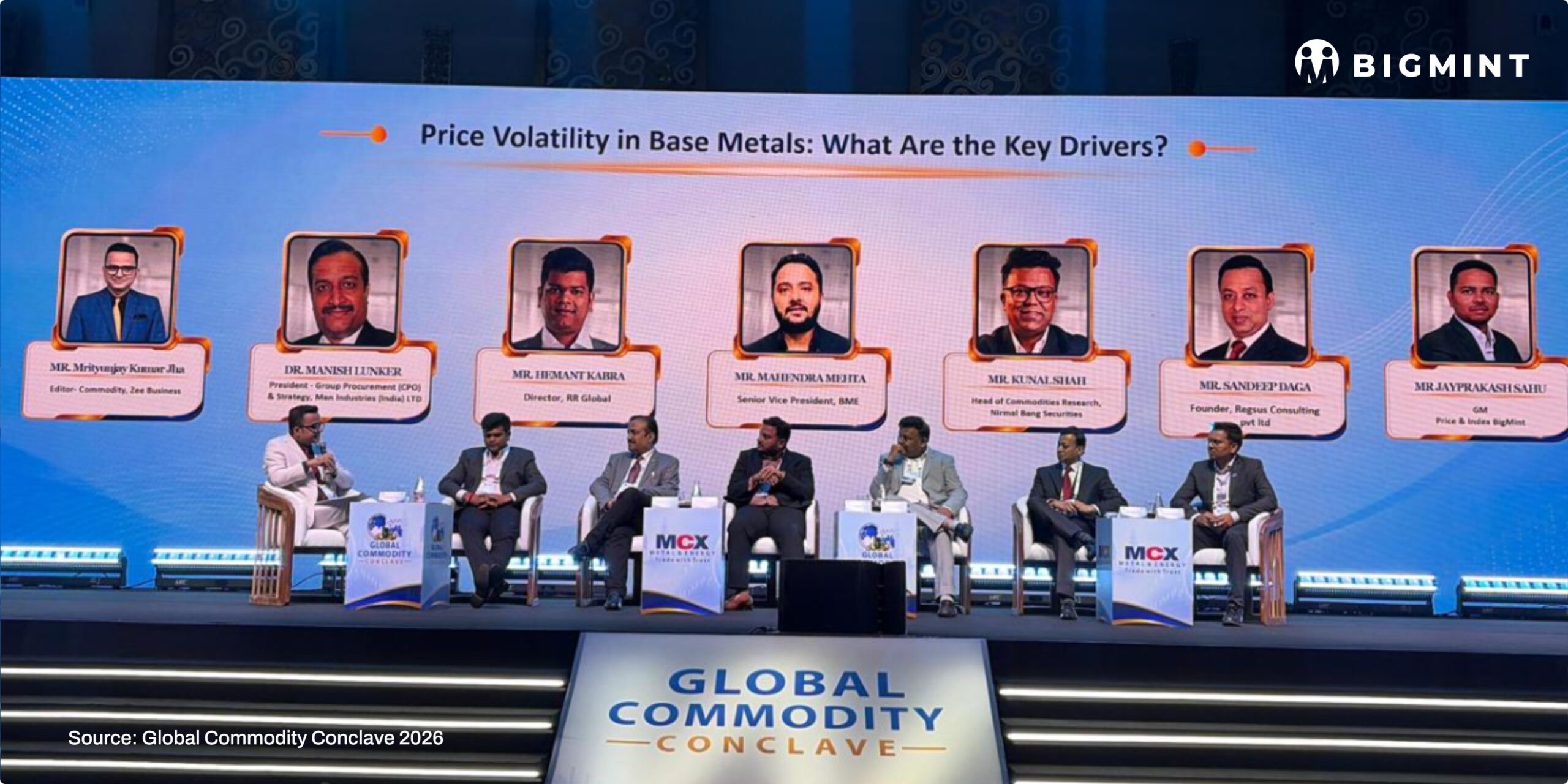
The Global Commodity Conclave (GCC) 2026, hosted by MCX with BigMint as the Event Partner, is being held from 12-14 August 2026 at the Jio World Convention Centre, Mumbai. Speaking at the session “Price volatility in base metals: What are the key drivers?”, panelists highlighted that base-metal markets are entering a structurally more volatile phase, with prices increasingly influenced by physical fundamentals, geopolitics, trade policies, currency movements, investor flows and market sentiment.
Multiple forces drive price formation
Panelists noted that markets are no longer driven primarily by physical demand, supply and inventory levels. US policies, tariffs, monetary policy, geopolitical developments, investor positioning and market sentiment now play a much larger role. Consequently, prices can react sharply to policy announcements or changes in expectations even without an immediate shift in physical supply-demand fundamentals.
Copper emerged as a particularly strong fundamental story, with tight concentrate markets, limited mine-supply growth and declining output from mature mines keeping the medium-term market structurally constrained. Despite higher prices, the response from new mine supply has remained limited, while electrification and emerging technologies are expected to support demand.
However, panelists cautioned against assuming a new broad-based commodity supercycle. China’s infrastructure-led demand expansion, which drove the previous cycle, has largely matured. While AI, data centres, electrification and energy-transition applications could become major demand drivers, it remains uncertain whether they can replicate China’s earlier scale of commodity consumption.
Indian buyers need to look beyond LME
For Indian consumers, the panel highlighted that LME prices alone are insufficient to assess aluminium procurement costs. Regional premiums, USD/INR movements, freight, import duties and domestic physical prices can move independently of LME. Therefore, even a stable LME price may not result in stable landed costs.
The discussion emphasized the need to monitor the complete landed-cost equation, particularly as currency and freight volatility can materially change import economics. Panelists also noted that physical and futures prices can temporarily diverge. While physical markets reflect prevailing supply-demand conditions, futures incorporate expectations, sentiment and anticipated risks. Understanding this distinction is important when interpreting market signals.
Procurement shifts towards risk management
Another key takeaway was that the lowest quoted price does not necessarily represent the lowest procurement cost. Consumers increasingly need to consider price, availability, landed-cost volatility and supply continuity together. This is particularly important for import-dependent markets such as India, where changes in currency, premiums, freight and duties can significantly alter purchase economics.
Panelists also stressed the need for greater discipline in inventory management. Buying during every price correction may not be optimal, as carrying costs, interest rates and uncertainty over future prices can make excessive inventory expensive. Inventory should instead be aligned with actual consumption and supply-risk requirements.
The panel also highlighted that natural hedging does not eliminate basis risk. LME, MCX, regional premiums and physical prices can move in different directions, leaving companies exposed even when they appear naturally hedged. Businesses therefore need to identify the benchmark that most closely reflects their actual procurement and selling exposure.
Procurement becomes intelligence-driven
With multiple variables influencing commodity prices, businesses will increasingly need to monitor prices, currencies, regional premiums, inventories, freight, policy developments and supply disruptions together. Overall, the panel concluded that base-metal volatility is no longer simply a commodity-cycle phenomenon. For Indian industry, the focus is shifting from forecasting the next price move towards managing risk across sourcing, inventory, landed costs, hedging and supply continuity.
In an increasingly volatile commodity environment, the ability to identify multiple market signals and respond quickly could become as important as accurately predicting price direction.
The Global Commodity Conclave (GCC) 2026, hosted by MCX and partnered by BigMint

Leave a Reply