- Mills’ preference for DRCLO weighs on pellet demand
- Sellers keep quotes firm amid lack of counter-offers
Pellet prices in the Raipur region remained largely stable over the last couple of days as market activity continued to stay muted. According to market players, demand for pellets remained subdued, with buyers showing limited interest in fresh procurement. Most sellers kept their offers unchanged, citing a lack of counter-bids from buyers.
Price movements, trades
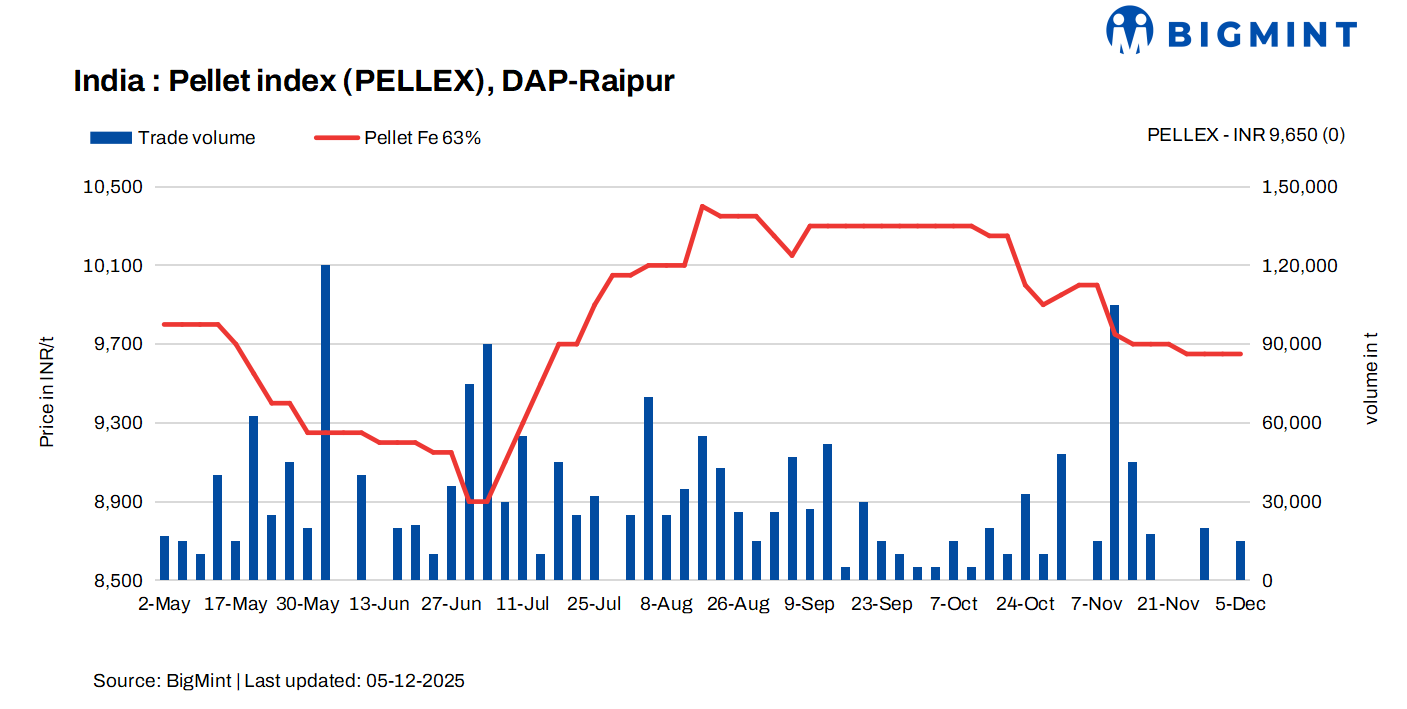
PELLEX, BigMint’s bi-weekly domestic pellet (Fe63%) index for Raipur, remained stable at INR 9,650/t ($107/t) DAP on 5 December compared to the previous assessment on 2 December. Demand was limited in the last couple of days; however, around 15,000 t of pellets (Fe 62.5-63%) were sold by local suppliers at INR 9,500-9,900/t exw Raipur.
Raipur-based producers kept their offers for 63% (+/-0.5%) stable at INR 9,500-9,600/t ($106-107/t) exw recently. Meanwhile, a prominent seller quoted low-phosphorus pellets (Fe 62.5%) at INR 9,900/t exw Raipur. Some Odisha-based sellers offered material in Raipur at INR 9,700-10,100/t DAP.
Market scenario
A market participant noted, “There is no significant improvement in inquiries. Buyers are taking a cautious approach, and since counter-offers are missing, sellers are not revising prices. This cautious sentiment has been observed across the market.”
One major reason behind the slowdown is the shift in raw material preferences. A market participant stated that a large number of steelmakers in the region are currently opting for DRCLO as their preferred feedstock, reducing pellet consumption. “Maximum buyers have shifted to DRCLO because it is currently more workable in their cost structure. Pellet prices from Odisha-based suppliers are high and not viable for Raipur buyers,” he added.
In terms of downstream products, sponge iron and billet prices increased w-o-w. The slight w-o-w uptick in these two commodities provided some support to the overall market, though it did not translate into increased pellet buying.
Meanwhile, a few prominent Raipur-based pellet sellers began offering fresh lots for sales, indicating expectations of improved demand in the coming days. Steelmakers believe that buying activities may pick up gradually starting next week.
In NMDC’s 22,900-t iron ore auction from Chhattisgarh on 4 December, 14,900 t were booked. 12,900 t of DRCLO (10-40 mm, Fe 67%, base INR 6,300/t) were sold at an 8.5% premium. Out of the 10,000 t offered, only 2,000-t ROM (10-150 mm, Fe 65.5%) were booked at a base price of INR 5,500/t. Prices were on FOR basis, including royalty, DMF, and NMEDT.
Rationale
- PELLEX has been derived using data points, i.e., trades, offers, and bids. To download the detailed methodology, click here.
- Two (2) deals were recorded in this publishing window, with one (1) taken for calculation. Thus, the T1 trade category was accorded 50% weightage.
- Twelve (12) firm offers, bids, and indicative prices were heard. Eleven (11) were taken for price calculation and given a balance of 50% weightage.

Key market drivers
- Sponge iron prices inch up w-o-w: Sponge iron prices rose by INR 100/t ($1/t) w-o-w on 5 December to INR 23,850/t ($265/t) exw-Raipur. However, prices dropped by INR 200/t ($2/t) d-o-d. Prices fell due to limited buyer interest. Sellers were largely occupied with dispatches, as the last two trading sessions saw healthy bookings. This led to fewer enquiries and a quieter market, prompting sellers to reduce offers. In the southern market, prices remained largely stable with no major corrections, but buying activity stayed muted, and overall demand remained limited.
- Billet prices increase w-o-w: BigMint’s billet index increased by INR 850/t ($9/t) w-o-w, settling at INR 37,000/t ($411/t) exw-Raipur on 5 December. Prices fell by INR 250/t ($3/t) d-o-d. Market sentiment remained weak throughout the trading session, as trading activity remained subdued.
Outlook
Pellet prices may remain under pressure in the near term, driven by fluctuating buying interest and the ongoing shift in preferences among steelmakers. However, participants noted that any improvement in sponge iron production and steel trade could revive pellet demand.
Leave a Reply