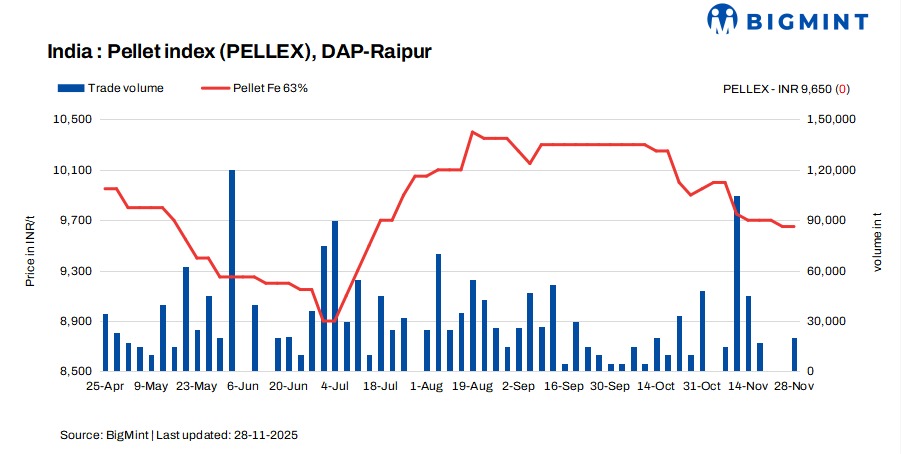
- Buyers stay away amid price uncertainty, adequate inventories
- Competitive local offers keep Odisha sellers away from Raipur
Pellet prices in Raipur remained largely stable over the past couple of days, although small pockets of trades were heard at lower levels, as some suppliers chose to offload material amid weak buying sentiment. Market participants noted that demand softened, with buyers refraining from fresh bookings due to uncertainty around price direction and adequate inventories from recent purchases.
Price movements, trades
PELLEX, BigMint’s bi-weekly domestic pellet (Fe63%) index for Raipur, remained stable at INR 9,650/t ($108/t) DAP on 28 November 2025 compared to the previous assessment on 25 November. Demand was limited in the last couple of days, with local pellet suppliers concluding deals for around 20,000 t in Raipur at INR 9,400-9,600/t exw.
Raipur-based pellet producers kept their offers for 63% (+/-0.5%) material stable at INR 9,500-9,600/t ($107-108/t) exw recently. Meanwhile, one prominent plant kept pellet sales closed. Some Odisha-based pellet sellers offered material in Raipur at INR 9,600-10,000/t DAP.
Market scenario
A market participant informed BigMint, “Buyers are in no hurry to make fresh bookings at current prices. Most of them have sufficient material from previous bookings and are closely monitoring price trends before making fresh commitments.”
A pellet supplier stated, “Inquiries have been limited, and buyers are consistently countering offers, even those at lower levels, making it challenging for suppliers to achieve their targeted prices.”
A few sources also highlighted that while suppliers continued to quote higher prices, some were compelled to conclude deals at lower levels due to sluggish demand.
A steel producer said, “There is a clear mismatch between offers and tradeable levels. A few sellers eventually sold material at lower prices to maintain liquidity.”
Similarly, Odisha-based pellet producers highlighted a slowdown in inquiries from Raipur buyers. With competitive offers available from local suppliers and subdued sponge iron demand, outstation material found limited traction. A pellet supplier added, “Raipur buyers are not actively seeking Odisha material as local prices are more competitive, and overall consumption remains weak.”
Major buyers, including sponge iron units, are reportedly utilising previously booked material and are avoiding new purchases until market fundamentals stabilise.
Rationale
- PELLEX has been derived using data points, i.e., trades, offers, and bids. To download the detailed methodology, click here.
- Two (2) deals were recorded in this publishing window, both taken under calculations, and thus, this category was considered for calculation. Thus, the T1 trade category was accorded 50% weightage.
- Nine (9) firm offers, bids, and indicative prices were heard. Seven (7) were taken for price calculation and given a balance of 100% weightage.

Key market drivers
- Sponge iron prices fall d-o-d: Sponge iron prices dropped by INR 100/t ($1/t) d-o-d on 28 November 2025 to INR 23,750/t ($265/t) exw-Raipur. However, prices rose by INR 200/t ($2/t) w-o-w. Most buyers continued to adopt a cautious stance, expecting further price corrections before committing to bulk purchases. Transactions were largely need-based, and no significant sizeable bookings were heard across major markets during the day.
- Billet prices drop d-o-d: BigMint’s billet index decreased by INR 200/t ($2/t) d-o-d, settling at INR 36,150/t ($404/t) exw-Raipur on 28 November. Prices rose by INR 550/t ($6/t) w-o-w. Market activity stayed largely sluggish throughout the session. Buyers refrained from aggressive procurement amid continued uncertainty, while negative signals from northern and adjoining markets further pressured spot offers. Although a few deals were concluded at discounted levels, the soft demand environment limited any meaningful recovery in trading activity.
Outlook
Pellet prices in Raipur are expected to remain volatile next week as buyers reassess inventory levels and suppliers adjust offers in line with demand sentiment.
Leave a Reply