- Suppliers keep offers unchanged despite cautious buying
- Drop in sponge iron, billet prices w-o-w weighs on trade
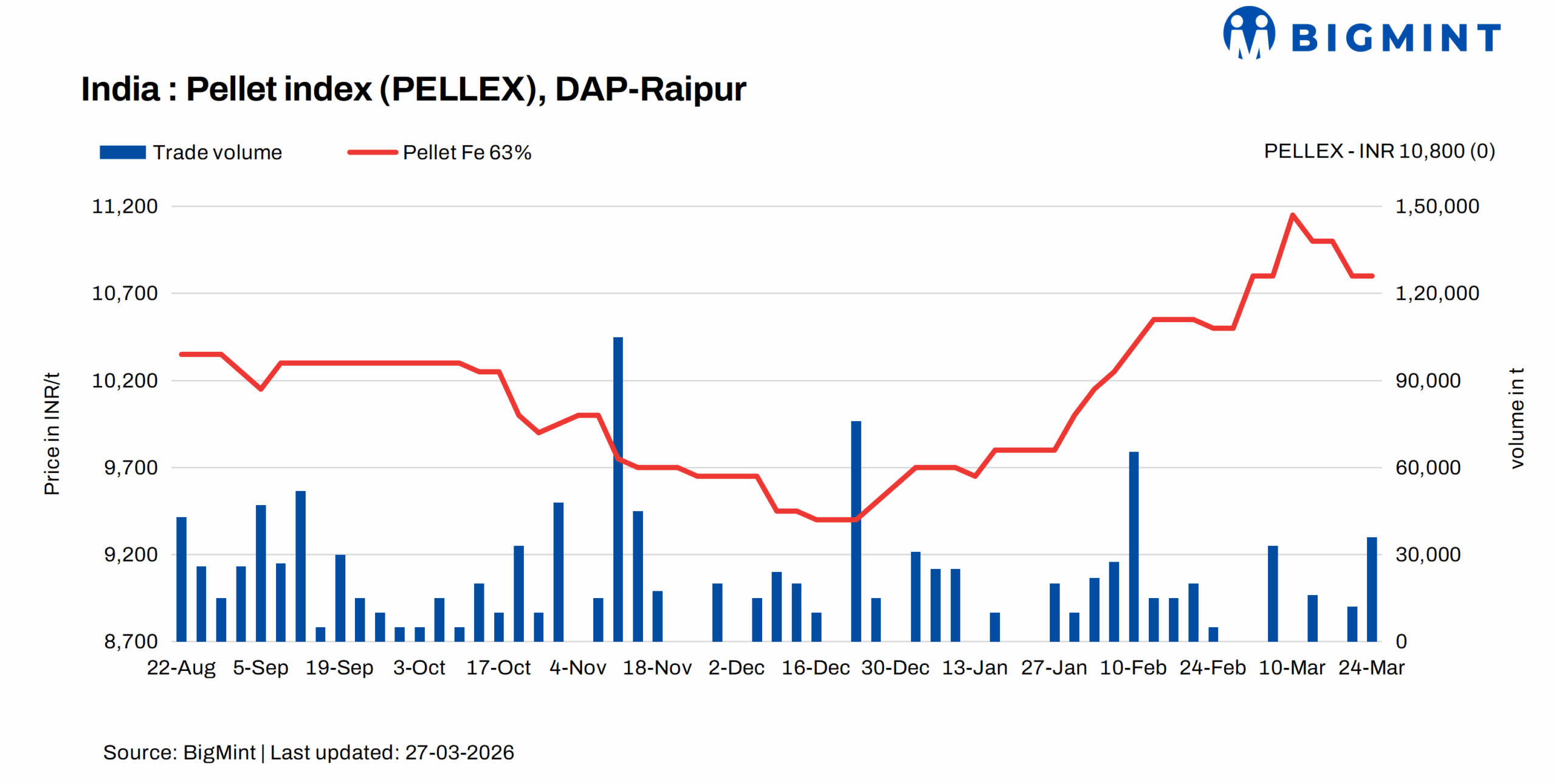
Pellet prices in the Raipur region remained largely stable during the week ended 27 March 2026. A limited number of transactions were concluded by local steel producers amid the fiscal year-end. Despite sellers keeping offers steady, some deals were finalised at slightly lower levels following negotiations, reflecting a cautious approach from buyers.
Trades and price movements
PELLEX, BigMint’s bi-weekly domestic pellet (Fe 63%) index for Raipur, remained stable at INR 10,800/t DAP on Friday, compared to Tuesday, reflecting softer market conditions. BigMint recorded deals for around 30,000 t concluded at INR 10,600-10,700/t exw Raipur by local pellet producers.
Offers for Fe 62.5-63% (+/-0.5%) grade pellets were heard lower at INR 10,600-10,700/t exw Raipur, translating to around INR 10,750-10,850/t DAP.
Market dynamics
Market participants highlighted that procurement activity was strictly need-based, with most plants refraining from aggressive or bulk bookings. “We are only lifting material as per immediate requirements. There is no urgency to build inventory at current price levels,” said a Raipur-based sponge iron manufacturer.
This sentiment was widely echoed across the market, as buyers continued to monitor downstream price trends before committing to larger volumes.
On the supply side, pellet producers maintained stable offers, indicating their intent to hold realisations despite subdued demand. However, some competitive offers were heard from neighboring regions, although these did not translate into significant transactions. Notably, Odisha-based plants were offering pellets in the Raipur market at around INR 10,300-10,500/DAP Raipur.
A market participant commented, “We did receive offers from Odisha, but logistical factors and price alignment issues restricted deal closures.”
The overall market remains under pressure due to the recent decline in sponge iron and billet prices, which has directly impacted buying appetite.
Another market participant stated, “With sponge iron and billet prices correcting, pellet buyers are becoming more cautious. Margins are tight, so mills are avoiding bulk purchases.”
Additionally, adequate raw material inventory levels at several plants have further reduced immediate buying requirements. “Most of the plants are comfortably stocked for now, so procurement is being delayed unless necessary,” noted another steelmaker.
Market participants anticipate that any significant shift in sponge iron or billet trends could trigger corresponding changes in pellet pricing in the coming weeks.
Rationale
- PELLEX has been derived using data points, i.e., trades, offers, and bids. To download the detailed methodology, click here.
- Four (4) deals were recorded in this publishing window, and taken for calculation. Thus, the T1 trade category was accorded 50% weightage.
- Ten (10) firm offers, bids, and indicative prices were heard and seven (7) were taken for price calculation and given balance 50% weightage.

Key market drivers
- Sponge iron prices decline w-o-w: Sponge PDRI prices fell by INR 500/t w-o-w to INR 25,800/t exw Raipur, reflecting weak buying interest and cautious sentiment. Sponge iron prices in Raipur rose by INR 150/t d-o-d, with better booking activity aiding stronger offers and supporting the cost structure for billet producers.
- Billet prices drop w-o-w: BigMint’s billet index in Raipur dipped by INR 600/t w-o-w; however, despite slower response from buyers, prices rose by INR 300/t d-o-d to INR 40,950/t ex-works on 27 March. Trading activity remained subdued initially but gained traction as the session progressed, with buyers re-entering the market after recent price corrections. Market participants reported that improved bookings in both sponge iron and finished steel segments helped restore confidence. As sentiment strengthened towards the close, sellers responded by raising spot offers, reinforcing the day’s upward price movement.
Outlook
Prices will remain under pressure next week as trading activity slows due to the fiscal year-end.
Leave a Reply