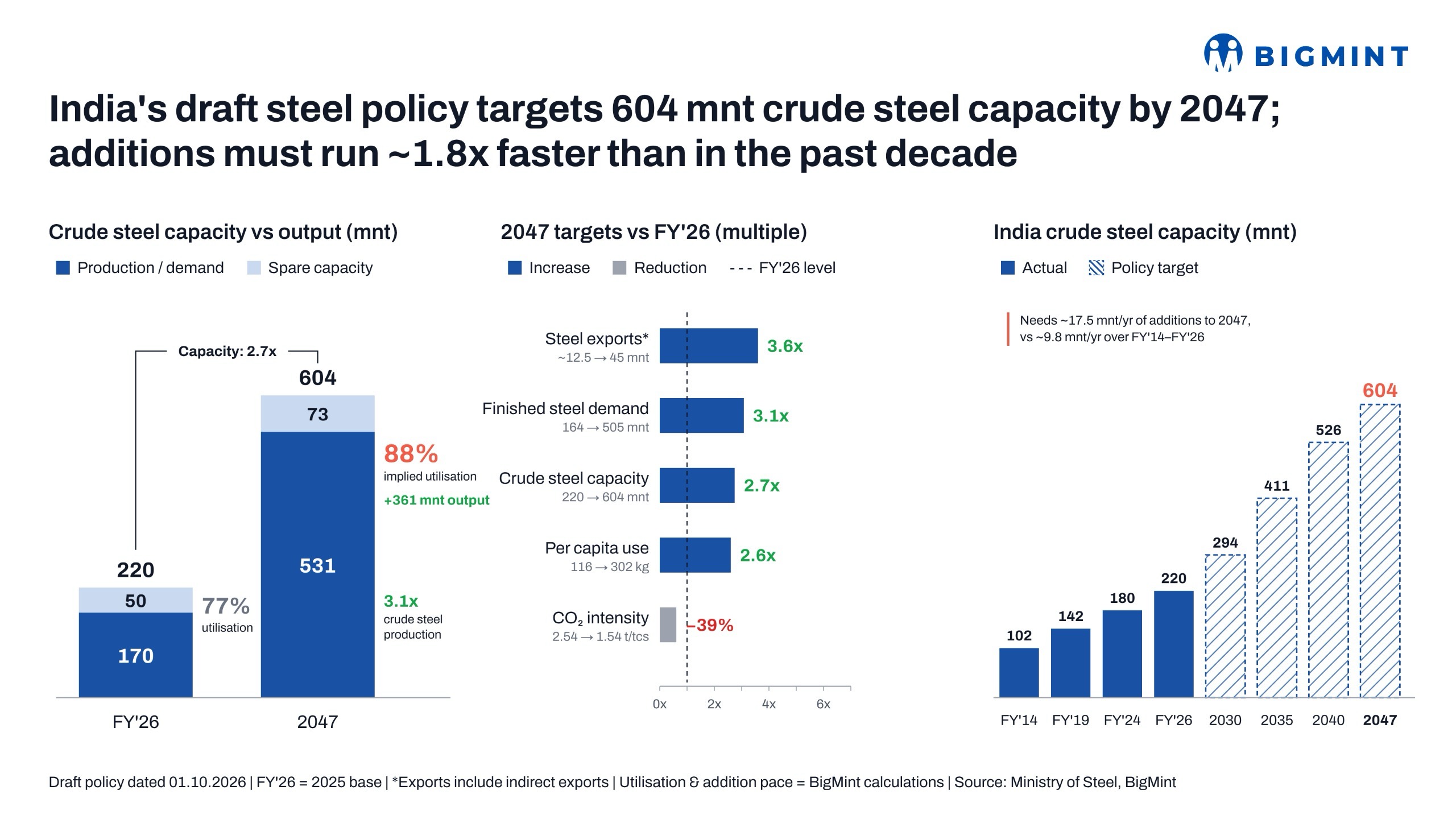
- Finished steel demand projected to reach 505 mnt by 2047
- Iron ore demand may rise to 772 mnt, while scrap use targets 123 mnt
- Policy aims to cut carbon intensity and strengthen raw material security
India’s proposed National Steel Policy – Vision 2047 envisages crude steel capacity of 604 million tonnes (mnt) and finished steel demand of 505 mnt by 2047, alongside per capita steel consumption of 302 kg and exports of 45 mnt (including indirect steel exports). The roadmap focuses on capacity expansion, raw material security, decarbonisation and higher-value steel production to support India’s manufacturing ambitions.
India’s crude steel production rose to around 170 mnt in FY’26 from 89 mnt in FY’15, while finished steel consumption increased to 164 mnt from 77 mnt. Installed steelmaking capacity currently stands at around 220 mnt per annum (MTPA).
Raw material demand to rise sharply
The policy projects iron ore demand at 772 mnt by 2047, up from 299 mnt in 2025. Coking coal demand is expected to increase to 236 mnt from 72 mnt, while pulverised coal injection (PCI) coal demand may rise to 48 mnt from 17 mnt.

Manganese ore demand is projected to reach 34 mnt by 2047, compared with 11 mnt in 2025. Limestone and dolomite requirements are estimated at 77 mnt and 51 mnt, respectively.
Raw materials account for an estimated 65-70% of steelmaking costs. While India is self-sufficient in iron ore, it imports around 92% of its coking coal requirements, leaving steelmakers exposed to international prices and supply disruptions.
Scrap use and recycling to gain importance
Steel scrap consumption is projected to rise to 123 mnt by 2047 from 36 mnt in FY’26, equivalent to around 21% of projected crude steel production, according to the policy estimates.
Domestic scrap availability stood at 28 mnt in FY’26, while imports accounted for 8 mnt. The proposed framework seeks to expand vehicle and ship recycling, introduce extended producer responsibility (EPR) for end-of-life vehicles and other waste streams, and formalise the scrap collection and processing ecosystem.
Decarbonisation becomes a strategic priority
The steel sector accounts for an estimated 10-12% of India’s carbon dioxide emissions. The country’s steel emissions intensity is estimated at 2.54 tonnes of CO2 per tonne of crude steel, against a global average of 1.92 tonnes.

The policy targets a reduction in emissions intensity to 1.54 tonnes of CO2 per tonne of crude steel by 2047, in line with India’s broader net-zero emissions target for 2070.
Measures for 2026-30 include energy-efficiency improvements, renewable energy adoption and greater scrap use. Subsequent phases are expected to focus on best available technologies, coal gasification, hydrogen-based direct reduced iron (DRI) and carbon capture, utilisation and storage (CCUS).
Logistics and secondary steel sector in focus
The roadmap targets a 49% share for rail in iron ore transportation by 2047, while reducing road transport’s share to 9%. Slurry pipeline capacity is also envisaged to exceed 299 MTPA, supporting more efficient raw material movement.
India’s secondary steel industry comprises around 2,550 units and accounts for 47% of crude steel capacity. The policy proposes support for technology upgrades, raw material access, workforce skills and workplace safety. It also emphasises downstream clusters, service centres and stronger participation by micro, small and medium enterprises (MSMEs).
Export ambitions and quality standards
India was a net exporter of finished steel in FY’26, with exports of 6.6 mnt marginally exceeding imports of 6.5 mnt. Total steel exports, including indirect exports, stood at 12.5 mnt in FY’26. The policy targets total exports of 45 mnt by 2047, including indirect steel exports, with a focus on cost competitiveness, improved market access, and value-added and low-carbon steel products.
The proposed framework also prioritises quality standards, AI-based import monitoring and measures to curb substandard steel imports, alongside the development of specialty steel.
Achieving the 2047 targets will require coordinated investment across steelmaking capacity, raw materials, recycling, logistics and low-carbon technologies. The scale of projected demand growth also makes cost competitiveness, reliable input supplies and implementation of decarbonisation measures central to the sector’s expansion strategy.
Leave a Reply