- Paddy support stays firm; coarse cereals see sharper gains
- Procurement, MSP payments surge over last decade
India has approved higher minimum support prices (MSPs) for 14 kharif crops for the 2025-26 marketing season, continuing its strategy of ensuring farmer incomes while nudging cropping patterns towards diversification. The Cabinet Committee on Economic Affairs, chaired by Prime Minister Narendra Modi, cleared the revisions, with the sharpest gains allocated to oilseeds and millets rather than rice and wheat.
Paddy remains anchor
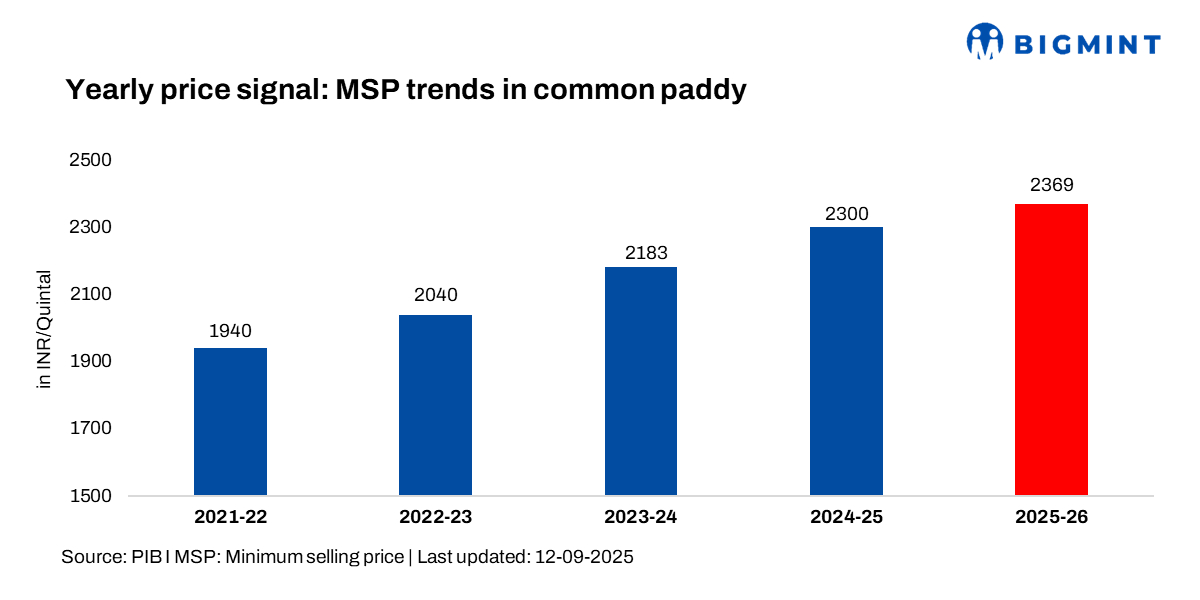
Paddy, the country’s most procured kharif grain and a mainstay of the public distribution system, saw only a modest hike. The MSP for paddy (common) has been fixed at INR 2,369 per quintal, up INR 69 from last year, while Grade A paddy will fetch INR 2,389. The increase, though limited, still leaves paddy support prices more than 80% higher than a decade ago.
By keeping paddy hikes restrained, the government seeks to protect consumers from inflationary pressures while continuing to assure farmers of procurement support. With rice output projected at a record 145 million tonnes (mnt) in 2024-25, modest MSP gains reflect the crop’s central but stabilising role in India’s food security architecture.
Coarse cereals see sharper gains
Coarse cereals saw sharper MSP adjustments, underscoring the government’s push toward millets and climate-resilient crops. Jowar hybrid was raised to INR 3,699 per quintal and Maldandi jowar to INR 3,749, both up INR 328. Bajra rose by INR 150 to INR 2,775, while ragi registered one of the steepest hikes of INR 596, taking it to INR 4,886 per quintal. Maize was fixed at INR 2,400, up INR 175. These increases, particularly for bajra and ragi, offer higher returns over cost and reflect policy intent to shift farmers away from water-intensive rice towards crops aligned with long-term sustainability and nutritional security.
Aligning with long-term procurement trends
The current hikes build on a decade of elevated procurement and farmer payouts. Between 2014-15 and 2024-25, India procured 760.8 mnt of paddy, up from 459 mnt in the preceding decade. Across all 14 kharif crops, procurement reached 787.1 mnt versus 467.9 mnt earlier.
Payments to farmers rose sharply alongside procurement. Paddy growers alone received INR 14.16 trillion in MSP support over the last decade, compared with INR 4.44 trillion between 2004-14. Overall, kharif crop producers were paid INR 16.35 trillion, nearly four times the amount disbursed in the previous decade.
Consolidating policy direction
The calibrated MSP revisions reflect a dual objective: securing farmer profitability and keeping food prices stable for consumers. By channeling higher incentives toward millets, oilseeds, and pulses, the government is positioning MSP not just as a price safety net but as a lever to reshape cropping patterns.
With paddy remaining the anchor of procurement and food security and coarse cereals gaining larger incentives, the 2025-26 MSP structure reinforces India’s shift towards diversification, resilience, and long-term sustainability in agriculture.
Leave a Reply