- Centre highlights Odisha’s heavy financial losses in 2022
- Export curbs risk production curtailment, says govt official
The Ministry of Mines has ruled out any consideration of imposing export duty on low-grade iron ore. Speaking at a ministry meeting, Union Minister , Piyush Goyal said, “The issue of export duty was discussed in detail in August, and as of now, the Ministry of Mines has no proposal under consideration to impose or recommend any export duty of any kind.”
He was responding to concerns raised by Odisha’s Steel and Mines Minister, Bibhuti Bhushan Jena, on the disproportionate impact such a move would have on a state like Odisha. “We have a large proportion of low-grade iron ore. If export duty is increased, this material will remain unsold because we do not yet have the domestic technology to utilise such quantities of low-grade ore. In 2022, the state lost nearly INR 12,000 crore over a period of about 6 months because of export duty imposed on low-grade ore,” the minister said.
The concern was reiterated by Odisha’s Additional Chief Secretary, Steel and Mines, Surender Kumar. “I am saying this with full responsibility. If we continue to impose export duty on low-grade fines, one or two years down the line, mines will get clogged for lack of evacuation space. Production will have to be curtailed because it will no longer make economic sense to operate the mines,” said Kumar.
Kumar added that he was puzzled by lobbying from sponge iron manufacturers – who typically use lumpy ore or pellets – in favour of export duty on low-grade fines. On examining the data, he realised that increasing the share of low-grade fines in the market mix depresses the average sale price (ASP) of mines. However, a sustained fall in ASP ultimately makes mining less viable, reduces production, and adversely impacts state revenues.
Looking ahead, Kumar noted that if India is to meet its target of producing 300 million tonnes (mnt) of steel by 2030, the country will require approximately 420-430 mnt of iron ore annually. Odisha alone, he estimated, would need to contribute at least 300 mnt for this target to be achievable.
In December 2025, the Chhattisgarh Sponge Iron Manufacturers Association (CG SIMA) had submitted a formal request to the Prime Minister’s Office (PMO), reiterating concerns affecting the sponge iron and steel sector and seeking policy-level intervention. Key issues highlighted included the high cost of iron ore for units without captive mines, tight availability of iron ore lumps, and rising dependence on pellets amid elevated prices. They also sought a review of export policies for domestically usable iron ore and pellets, rationalisation of iron ore pricing to ensure a level playing field for producers with and without captive mines, and incentives for auctioned mines capable of producing beyond their committed volumes, provided additional material is supplied to the domestic market.
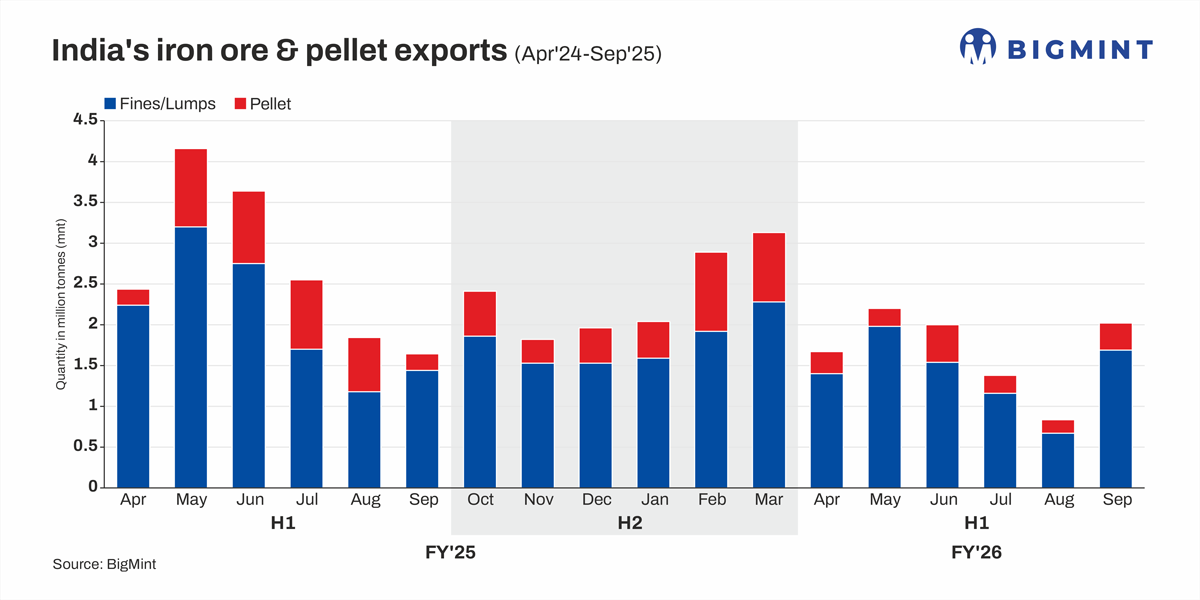
In CY’25, India’s iron ore exports (including pellets) fell 30% y-o-y to 27 mnt, as per data maintained with BigMint.
Leave a Reply