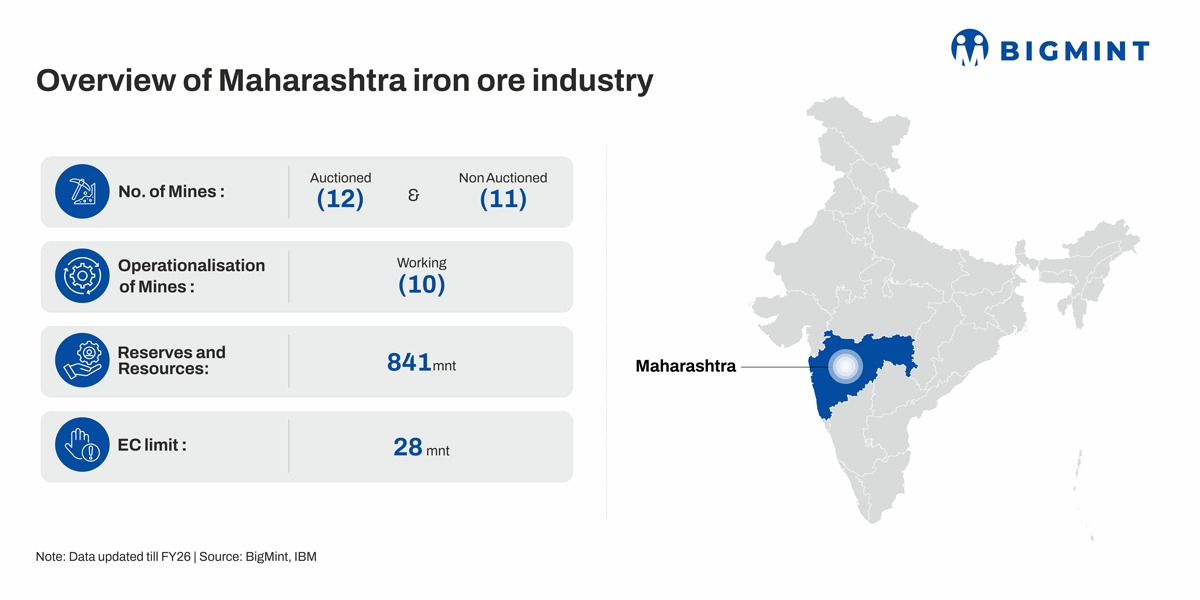
- Maharashtra iron ore output rises sharply since FY’21
- 2,000-ha reservation strengthens state-backed mining development
- Growing ore supply could reshape western India sourcing
India’s Ministry of Mines has approved the reservation of a 20 sq km (2,000 ha) iron ore-bearing area in Maharashtra’s Gadchiroli district in favour of the Maharashtra State Mining Corporation Ltd (MSMC).
While the approval itself pertains to an area carved out from a larger 145 sq km mineralised zone, its significance lies in what it signals for Maharashtra’s rapidly growing role in India’s iron ore and steel value chain.
Over the past five years, Maharashtra has transformed from a marginal iron ore producer into one of the country’s fastest-growing mining states. Iron ore production in the state surged from just 1.25 million tonnes (mnt) in FY’21 to 22.65 mnt in FY’26, according to the Indian Bureau of Mines (IBM) data. This represents a staggering 1,700% increase in output.
Reservation of mining areas for state bodies
The Ministry’s approval under Section 17A (2) of the MMDR Act 1957 allows Maharashtra to reserve the identified area for MSMC rather than offer it through competitive auction. Once the state identifies the exact 20 sq km block and issues the required notification, MSMC can proceed with exploration and eventual mine development activities. According to sources, the lease once identified can be brought to operation within three years at the earliest.
The move strengthens state-backed participation in strategic mineral development with parallels in the past. For example, the Karnataka State Minerals Corporation Ltd. (KSMCL) had a couple of mines at Sandur in Bellary district reserved for it by the Karnataka government for 50 years. The state government also allocated to state-owned KIOCL a mining lease for iron ore and manganese over an extent of 388 ha for a period of 50 years in Devadari Range, Sandur.
The Odisha government, with MoM approval, reserved 24.203 ha of the Rengalbeda (NE) iron ore block in Keonjhar in favour of the Odisha Mineral Exploration Corporation Ltd (OMECL) under Section 17A(2). The reservation was notified on 28 January 2021. An area covering 646.596 ha of Bailadila Deposit-4 was reserved for NMDC-CMDC Ltd (NCL) under Section 17A (1A). The subsequent state action provided for grant of the iron ore mining lease for 50 years.
According to the government’s submission in Parliament in 2023, since the MMDR amendment in 2015 approval of the Central government was conveyed to the various state governments for 16 proposals for reservation of area under Section 17A of the MMDR Act in favour of government companies.

New growth centre for iron ore
Historically, India’s iron ore production has been concentrated in Odisha, Chhattisgarh, Karnataka and Jharkhand. Odisha alone accounted for over 157 mnt of production in FY’26, or roughly half of India’s total output. For Maharashtra, the approval represents another step towards creating an integrated mining-to-steel ecosystem. State leadership has repeatedly emphasised the objective of leveraging the mineral wealth of Maharashtra and attracting downstream investments.
CM Devendra Fadnavis has spoken about investments of about INR 5 lakh crore and steel-making capacity of 50 mnt/y being developed in and around Gadchiroli.
Between FY’21 and FY’26, Maharashtra added over 21 mnt of annual iron ore production, surpassing the absolute growth achieved by several established mining states. In FY’26 alone, the state’s output nearly doubled from 11.36 mnt to 22.65 mnt.
Additional ore supplies from western India can diversify sourcing options, reduce dependence on a handful of mining regions and improve supply chain resilience. For steelmakers in western India, growing production from Maharashtra could translate into improved raw material accessibility and lower logistical risks over time.
Key implications
The approval highlights an increasingly important policy debate surrounding mineral resource allocation.
A welcome step for small and mid-sized steel companies, as access to reserved iron ore resources could allow them to focus capital on expanding steelmaking capacity rather than investing heavily in acquiring captive iron ore mines.
Positive for low-grade iron ore beneficiation projects, as assured access to mineral resources could support investments in beneficiation plants and improve the utilisation of lower-grade ore.
Reservations in favour of state-owned entities effectively remove mineral-bearing areas from the auction pipeline. While such allocations may facilitate faster resource development in some cases, they can also reduce the number of attractive blocks available for competitive bidding.
This could potentially affect participation levels in future mine auctions, particularly if investors perceive that strategically significant deposits are increasingly being earmarked for government-owned companies.
Moreover, increased availability of ore in the market will also weaken the appetite of end-users to participate in auctions and thereby weaken the auction system somewhat. The key aspect to watch will be the linkage policy for the reserved iron ore, particularly whether the mineral will be preferentially allocated to Maharashtra-based steel units and the framework for determining eligibility, allocation and pricing.
Leave a Reply