- Adequate availability weighs on low-grade ore prices
- High-grade ore edges higher amid limited availability
Karnataka’s iron ore market remained largely stable in the week ended 15 October 2026, despite a correction in downstream steel and sponge iron prices. Buying activity remained subdued amid weak demand, while auction activity was limited and adequate availability of low-grade material weighed on market sentiment. In contrast, high-grade iron ore prices remained firm, supported by relatively tight availability of suitable material and continued demand for better-quality ore.
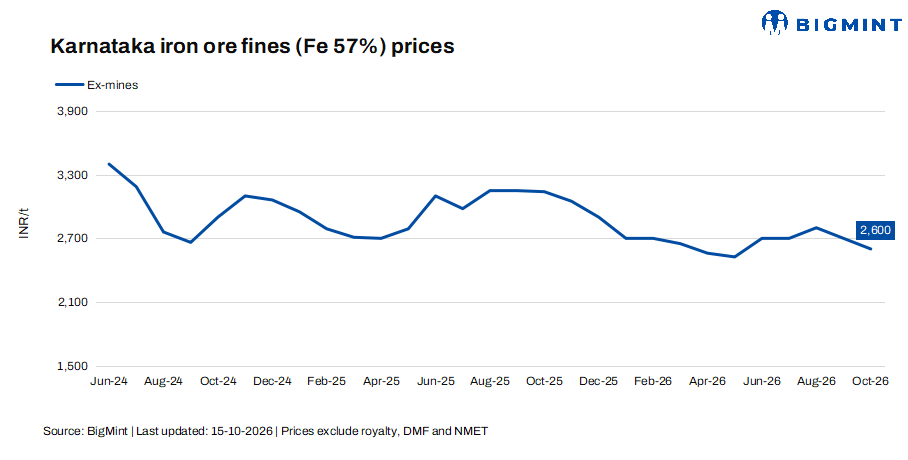
According to BigMint’s latest assessment, Fe 57% iron ore fines prices declined by INR 50/t ($0.5/t) w-o-w to INR 2,600/t ($27/t) ex-mines. Demand for low-grade ore remained weak due to its limited economic viability and high silica content, which restricts its suitability for direct use in steelmaking and increases processing requirements.
Meanwhile, Fe 62% fines prices rose by INR 100/t ($1/t) to INR 5,500/t ($58/t) ex-mines. The availability of suitable high-grade material remained relatively tight, supporting prices despite weakness in the downstream steel sector. However, purchasing interest remained selective, with buyers prioritising material that meets their quality requirements.
Auction activity remained limited during the assessment period, with weak downstream demand resulting in a muted response to available material. Some miners were also focused on dispatching material sold in previous auctions, further limiting fresh auction activity.
The market continues to face structural supply challenges as ore quality deteriorates across parts of Karnataka and several mines remain non-operational. With only a limited number of miners actively supplying the market, the availability of suitable material remains a key concern. Going forward, beneficiation is expected to become increasingly important for improving ore quality and supporting the utilisation of lower-grade resources.
Another seller highlighted the challenges associated with processing low-grade, silica-rich ore, noting that beneficiation yields can be limited. According to the seller, recovery from silica-rich material may be around 45-50%, with a substantial portion ending up as tailings. The limited availability of suitable feedstock further complicates the economics of beneficiation.
A Bellary-based buyer expects high-grade iron ore prices to strengthen further, supported by premiums for quality material, while low- and mid-grade prices are likely to remain stable amid subdued demand.
Rationale
- One (1) trade via e-auction was recorded for Fe 57% in this publishing window and was taken into consideration. Hence, the T1 trade category was accorded 50% weightage.
- Thirteen (13) offers and indicative prices were reported, out of which nine (9) were considered as T2. These were accorded 50% weightage.
Influencing factors
- P-DRI prices fall by INR 800/t ($8/t) w-o-w in Bellary: Pellet-based sponge iron (P-DRI) prices in Bellary fell by INR 800/t ($8/t) w-o-w to INR 29,800/t ($314/t). Trading activity remained subdued, with limited buyer participation and no major bulk bookings reported. Purchases were largely need-based as weakness in the finished steel market continued to weigh on sentiment.
- South African coal prices remain stable amid cautious buying: South African thermal coal prices at Indian ports remained largely stable as of 15 October 2026, supported by firm export offers and rising freight costs. Ex-Paradip RB2 (5,500 NAR) held steady w-o-w at INR 14,300/t, while RB3 (4,800 NAR) remained unchanged at INR 12,300/t. At Vizag, RB2 declined by INR 50/t to INR 14,250/t, while RB3 remained stable at INR 12,300/t. Buying interest remained selective, with sponge iron manufacturers procuring on a need basis amid weak downstream demand and falling domestic coal prices. Improved domestic coal production and availability offered some relief, while concerns over supply disruptions, delivery timelines, and limited trader inventories continued to influence procurement decisions.
Karnataka iron ore sales scenario (9-15 October 2026)

Outlook
Karnataka’s iron ore prices are expected to remain largely stable in the near term amid subdued downstream demand and limited auction activity. Low- and mid-grade prices may remain largely stable, while high-grade material is likely to retain a premium due to limited availability. Over the longer term, the development of auction blocks and the viability of beneficiation are expected to play a crucial role in improving supply availability and addressing quality-related constraints.
Leave a Reply