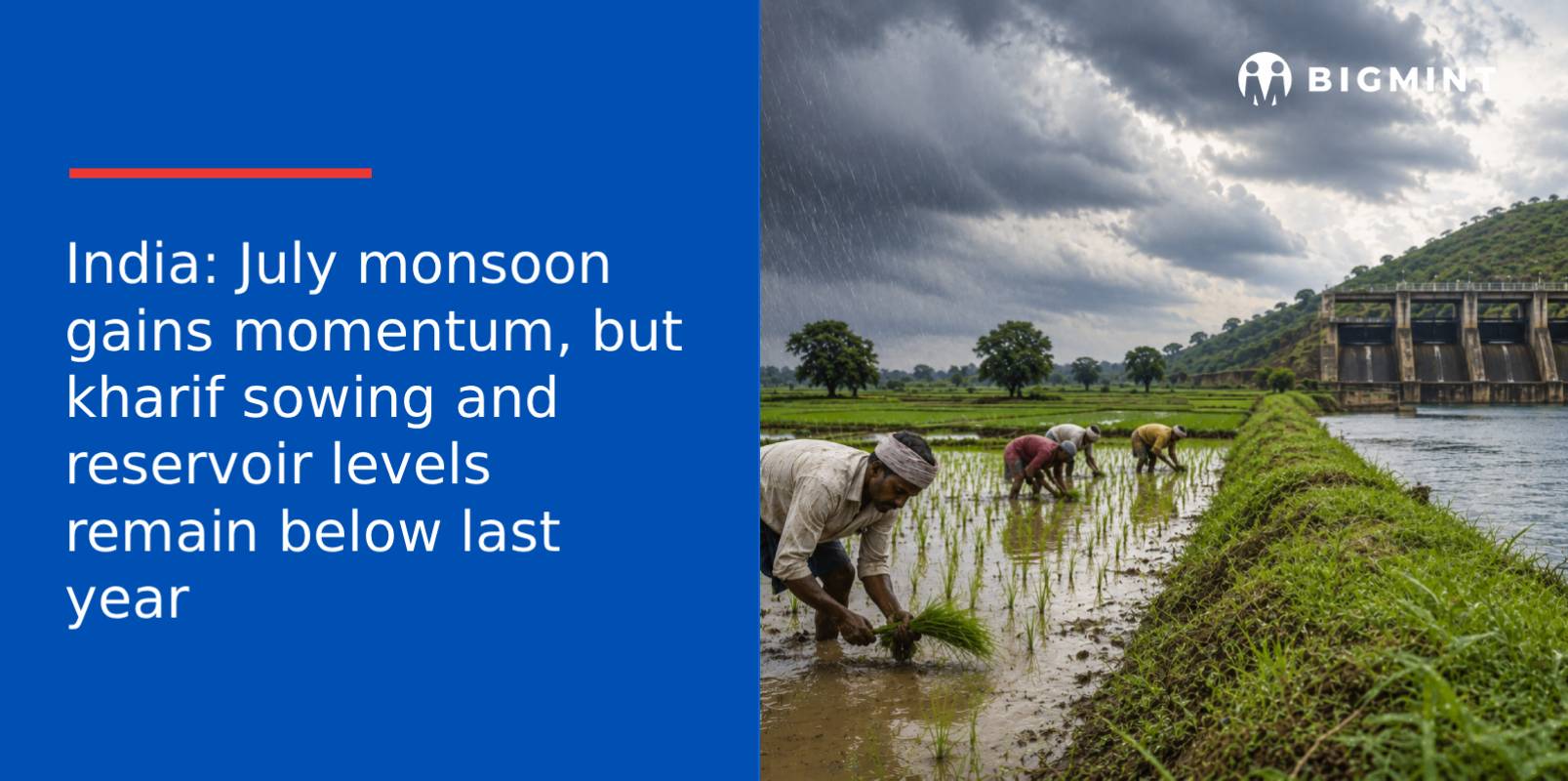
- July monsoon deficit narrows to 16% below LPA, aiding kharif sowing.
- Kharif sowing down 5% YoY, reservoir storage at 38% capacity.
India’s southwest monsoon gained momentum during July, with cumulative rainfall deficit narrowing to 16% below the Long Period Average (LPA) as of 27 July 2026, improving from above-normal deficit levels recorded in the previous week.
Monsoon activity remained normal in central India (4% below LPA) and northwest India (10% below LPA). However, rainfall continued to remain deficient in east India (30% below LPA) and south Peninsula (29% below LPA).
Cumulative rainfall reached 343 mm, against the long-period average. During the week ending 26 July, all-India rainfall stood at 27% above LPA, but rainfall of 84.5 mm during the week, coupled with daily rainfall exceeding the July average between 20 and 24 July, helped narrow the cumulative deficit.
Among the country’s 36 meteorological sub-divisions, 20 received deficient rainfall, 13 recorded normal rainfall, and 3 received excess rainfall.

Rainfall remains uneven across key agricultural states
Despite the overall improvement in July rainfall, the spatial distribution remained uneven across major agricultural regions.
States including Bihar, Andhra Pradesh, Punjab, Telangana, Haryana, Karnataka, Uttar Pradesh, and Chhattisgarh continued to record deficient rainfall. While Tamil Nadu, Madhya Pradesh, Rajasthan, Himachal Pradesh, Maharashtra, West Bengal, Gujarat, and Kerala received normal rainfall.
Overall, nearly 53% of the cultivated area or states experienced rainfall 20% below normal, highlighting continued moisture stress in several crop-growing regions.
Kharif sowing improves but stays below last year’s pace
Improved rainfall during July supported sowing activity, particularly in pulses, oilseeds and cotton, although overall progress remained behind last year’s level. As of 24 July 2026, kharif crops had been sown over 78.7 million hectares (mh), compared with 82.6 mh during the same period last year, representing a 5% y-o-y decline. Total sowing has reached 71.3% of the normal area, compared with 75% during the corresponding period last year.
Kharif sowing reached 78.7 million hectares (mh) as of 24 July, down 4.7% y-o-y. Rice, the largest kharif crop, was sown over 23.43 mh, 2.6% lower than last year. Sowing also declined for pulses (-7.5%), coarse cereals (-11.9%) and cotton (-3.9%), while oilseeds (+2.1%), sugarcane (+1.5%) and jute & mesta (+2.1%) recorded growth. Among coarse cereals, ragi, bajra, jowar and maize registered the sharpest declines, whereas soyabean and urad posted y-o-y gains.
Reservoir storage stood at 70 BCM (38% capacity) as of 23 July, down from 111 BCM a year earlier.
Regional reservoir storage as a share of total capacity was:
- Western region: 51%
- Central region: 39%
- Eastern region: 38%
- Northern region: 36%
- Southern region: 30%
Compared with last year, the sharpest decline was recorded in the southern region. However, relatively higher storage levels in the western, central and northern regions could provide some support for kharif sowing in the coming weeks.

Outlook
Although cumulative rainfall remains below normal and reservoir storage continues to lag last year’s levels, the improvement in July rainfall has supported kharif sowing and helped narrow the rainfall deficit. Sowing activity has accelerated in pulses, oilseeds and cotton, while better reservoir levels in the western, central and northern regions may provide additional support for crop progress in the coming weeks. However, uneven rainfall distribution and strengthening El Niño conditions continue to pose risks to agricultural performance.
Leave a Reply