- FY27 volume growth guidance cut to 4-6% from 7-9% following Q1 disruptions
- EBITDA/t guidance raised to INR 20,000-22,000 on improved earnings expectations
Jindal Stainless Ltd (JSL) has moderated its FY27 sales volume growth outlook while raising its EBITDA per tonne guidance, signalling a greater emphasis on profitability amid an uneven volume recovery. The company reported improved sequential performance in Q2FY27, supported by higher domestic and export sales, after operational disruptions affected the first quarter. However, first-half deliveries remained below the previous year’s level, leaving the pace of H2 recovery critical to achieving the revised annual targets.
Q2 recovery improves financial performance but H1 volumes remain lower
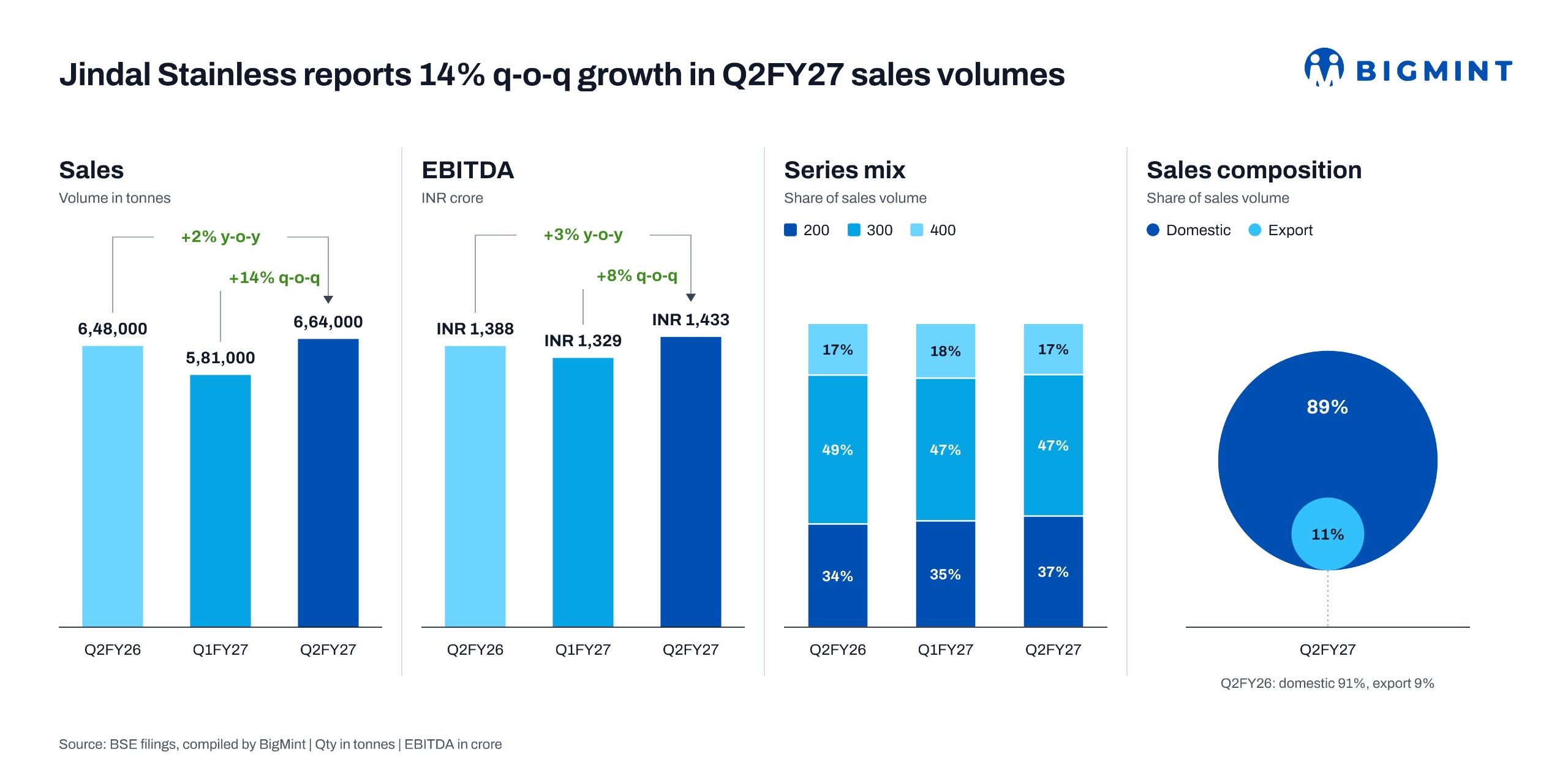
JSL reported consolidated revenue of INR 12,874 crore in Q2FY27, up 18% y-o-y and 14% q-o-q. EBITDA increased 3% y-o-y and 8% q-o-q to INR 1,433 crore, while profit after tax (PAT) rose 11% y-o-y and 17% q-0-q to INR 898 crore.
Sales volumes reached 664,000 t in Q2FY27, increasing 3% y-o-y and 14% q-o-q. The sequential improvement reflected a recovery from the lower Q1 volume of 581,000 t. Domestic volumes rose 14% q-o-q, while exports increased 20% q-o-q and 36% y-o-y.
For H1FY27, deliveries stood at approximately 1.245 mnt, down 2% y-o-y. Revenue rose 14% to INR 24,152 crore, EBITDA increased 2% to INR 2,762 crore and PAT grew 9% to INR 1,666 crore.
The divergence between revenue and EBITDA growth indicates that higher sales value has not translated proportionately into operating earnings. Management attributed realisation related movements partly to product mix, raw material cost lags and market sentiment. EBITDA per tonne was approximately INR 21,600 in Q2, compared with INR 22,900 in Q1FY27.
Revised FY27 guidance reflects a shift towards profitability
JSL lowered its FY27 sales volume growth guidance to 4-6% from the earlier 7-9%, citing the impact of Q1 operational disruptions. At the same time, it raised its EBITDA/t guidance to INR 20,000-22,000 from INR 18,000-20,000.
The revised outlook suggests that management expects improved earnings per tonne even as volume growth remains more moderate. However, the extent to which this can be achieved will depend on product mix, raw material cost movements, market realisations and the recovery in downstream operations.
Management expects stronger performance in H2FY27 as operations normalise and additional downstream capacity becomes available. It reiterated its FY29 annual sales target of 3.5 million tonnes, indicating that the near-term guidance revision has not changed its longer-term growth ambition.
JSL reported net debt of INR 3,121 crore at the end of September 2026, with net debt-to-EBITDA at 0.55x and net debt-to-equity at 0.15x. Capital expenditure stood at INR 895 crore in Q2 and INR 1,555 crore in H1FY27. Management maintained its FY27 capex guidance at INR 2,400-2,600 crore during the earnings call.
Capacity expansion and product development to support H2 growth
The commissioning of downstream facilities is expected to support JSL’s recovery in the second half of FY27. Some cold-rolling mills have begun commissioning, while the HPL line was expected to begin commissioning by late 2026 or early 2027. The company has also commissioned a powder-coating facility at Jajpur to serve metro and infrastructure applications.
Product development remains another part of the company’s strategy to strengthen its position in specialised stainless steel applications. JSL highlighted the development of India’s first high-aluminium stainless steel grade for automotive catalytic converters, along with two new 400-series grades. One of the new grades has opened a market in South Africa.
The company has entered into a paid technical assistance agreement with Japan’s JFE Steel for selected 400-series grades, aimed at strengthening product quality and operational capabilities. Commercial terms were not disclosed.
However, progress on the proposed Maharashtra project has been slower than expected because of delays in land acquisition. Management indicated that another one to two years may be required before clearer plans emerge.
The timing and pace of capacity ramp-up will be important to the H2 outlook. New facilities can support higher sales, but their contribution will depend on commissioning schedules, customer qualification and the pace of demand across end-use sectors.
Domestic demand remains supportive
Management described demand as broadly resilient across automotive, railways, metros, elevators, white goods, pipes and tubes, and infrastructure-related applications. Automotive demand has benefited from festive-season inventory building, while metro and infrastructure activity continues to support selected stainless steel products.
Demand conditions are not uniform across all sectors. Slower tender activity has affected stainless steel demand from railway wagons, while disruptions and geopolitical factors have created headwinds for some oil and gas and power-related applications.
Import competition remains another consideration. Management flagged increased imports, particularly in the 200-series segment, following the suspension of the Quality Control Order (QCO), and said the industry was engaging with the government on safeguards. The anti-dumping investigation into certain cold-rolled stainless steel imports was extended to March 31, 2027. Management expressed hope for progress by December 31, 2026, although the timing and outcome remain uncertain.
The impact of imports on domestic pricing and utilisation will be important to monitor as Indian producers bring additional capacity online.
Export diversification offers support amid tighter European access
Exports accounted for around 11% of JSL’s Q2 sales. Although export volumes improved, management highlighted reduced European Union quota availability, with JSL’s allocation falling from approximately 12,000 tonnes to around 5,500–6,000 tonnes per allocation period.
The company is diversifying shipments towards North America, South Korea, Japan, Brazil, the Middle East, South Africa and Colombia. Management intends to maintain exports at around the current share of sales as overall volumes increase.
Diversification could help reduce dependence on individual markets, but export growth will remain subject to regional demand, trade restrictions, logistics and the company’s ability to compete on delivered costs.
Outlook: H2 execution will determine delivery against revised targets
JSL enters H2FY27 with stronger sequential momentum and higher EBITDA/t guidance, but its revised volume outlook reflects the impact of the weak first quarter. The key variables are the normalisation of operations, commissioning of downstream facilities, demand recovery and the effect of import competition on domestic pricing.
The company’s balance-sheet ratios provide room to continue its planned capital expenditure, while product development and export diversification support its longer-term strategy. Nevertheless, achieving the revised FY27 targets will depend on converting the Q2 recovery into sustained sales growth and maintaining profitability as capacity expands.
Leave a Reply