- Around 500,000 t export deals concluded
- Govt may impose 30% export duty on iron ore
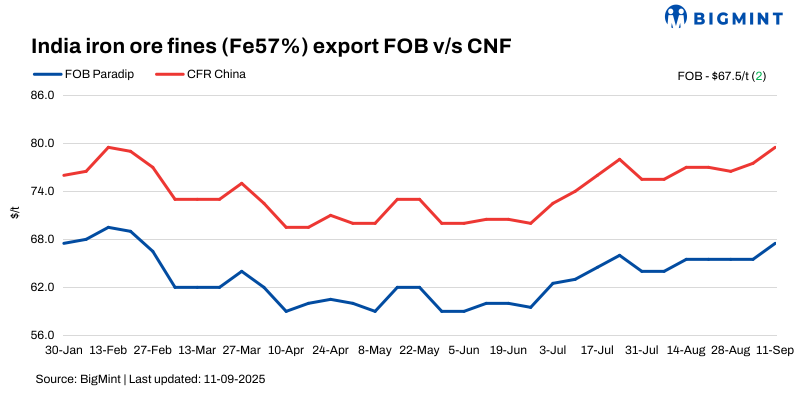
India’s iron ore export market witnessed a surge this week, supported by strong buying interest from Chinese mills and improved macroeconomic sentiments following China’s military parade.
The Indian government may impose duty on low-grade iron ore exports by October to ensure an uninterrupted supply of the key raw material for steel companies, at lower prices, and promote value-added exports.
Prices, deals
BigMint’s bi-weekly Indian low-grade iron ore fines (Fe 57%) export index rose by $2/t w-o-w to $67.5/t FOB east coast on 11 September. Iron ore fines export prices reached their highest level in over six months since the last peak seen at the end of February.
BigMint recorded nearly 525,000 t of export deals concluded by Indian exporters during the recent price rally.
Discounts for Indian-origin Fe 57% fines were at around 17-18% in the overseas market, and deals were largely concluded in a similar range. Meanwhile, the discount for Fe 54-55% deals was heard at 22-23% on global fines prices.
Market scenario
An exporter said, “Chinese buyers were actively booking Indian fines this week, encouraged by strong market sentiment and the revival in steel demand indicators.”
Another market participant said, “We are receiving consistent inquiries, and many cargoes have already been fixed for September-end and early October loading.”
The rally, however, was accompanied by heightened speculation over possible government intervention. Rumours circulated that the Indian government may impose a 30% export duty on low-grade iron ore from October. The potential move is seen as part of efforts to strengthen domestic availability and align with the government’s target of achieving 50 mnt of steel exports in the future.
Some sources noted that fears of a potential duty imposition triggered ‘panic selling’ among a few exporters. However, despite the rush, they secured favourable deals by riding the strong seaborne sentiment.
Iron ore exporters are currently fully confused regarding the next market dynamics and waiting for government decision on export duty.
In contrast, the domestic iron ore market remained sluggish, with steelmakers preferring to delay purchases in anticipation of softer prices. “Buyers in the domestic market are cautious right now and waiting for prices to ease,” a trader noted.
Today’s seaborne iron ore market cooled off, with activity easing after recent gains. The rally is colliding with weak Chinese steel demand, leaving mills under pressure despite the seasonal construction pickup.
Chinese spot prices strengthen w-o-w: Benchmark iron ore fines prices in China increased by $3/t w-o-w to $107/t CFR on 10 September. Prices dropped today as mills, hit by weak margins and high raw material costs, turned to non-mainstream and medium-grade fines, as pricey high-grade ore squeezed profitability. Seasonal demand for sintered products is also expected to pick up soon, once coke tags show a downtrend.
DCE iron ore futures remain firm: Iron ore futures on the Dalian Commodity Exchange (DCE) for the January 2026 contract opened at RMB 795.5/t ($111/t) on 11 September, remain firm w-o-w.
Rationale
- Three (3) deals for Fe 57% were recorded during this publishing window, and hence, two (2) were taken for price calculation. Therefore, T1 trade was given 50% weightage in the index calculation. A few deals were already calculated on the Monday assessment. For the detailed methodology, click here.
- BigMint received twenty-one (21) indicative prices in the current publishing window, and eighteen (18) were considered for price calculation as T2 inputs and given 50% weightage.
Iron ore inventory at Chinese ports rose by 1.11 mnt w-o-w to 131.63 mnt on 11 September, as per SteelHome data.
Outlook
BigMint’s analysis indicates that price volatility is likely to continue, with more export deals expected to be finalized in the coming days, depending on clarity regarding potential export duty.
Leave a Reply