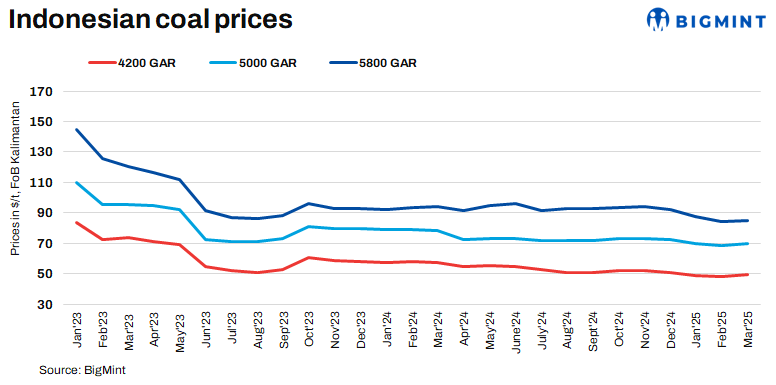
- Indonesian coal prices have experienced a slight increase
- Indian coal freight getting stabilize, with supply strained
Indonesian thermal coal prices at Indian ports have seen a moderate increase, driven by global price hikes, currency depreciation, rising freight rates, and robust domestic demand.
However, the low-calorific value (CV) thermal coal market remains sluggish, as new regulations in Indonesia link seaborne coal sales to the government’s HBA price. As a result, many Chinese traders are holding off on spot trading and contract renegotiations until they gain clarity on these regulations.
In the domestic market, Indian sea freight rates have stabilized, while Chinese domestic coal prices have also found equilibrium. Demand in India is strong within the textile sector, moderate in ceramics, and weaker in the chemical and organic industries, contributing to some supply constraints.
Price movements at key ports
Coal prices have shown positive changes at key Indian ports. At Kandla, the price of 5000 GAR coal increased by INR 100 to INR 7,800 per ton, while at Vizag, it rose by INR 100 to INR 7,700 per ton. The price of 3400 GAR coal at Navlakhi surged by INR 200 to INR 4,700 per ton. Prices for 4200 GAR coal also saw modest increases at Kandla and Vizag, rising by INR 50 to INR 5,900 and INR 5,800 per ton, respectively.
Global coal price trends
Globally, Indonesian coal prices have experienced a slight increase. High-CV 5800 GAR coal up by $0.48/t, now priced at $85.23/t, while mid-CV 4200 GAR coal saw a slight increase of $0.46/t reaching $49.86/t. Meanwhile, low-CV 3400 GAR coal prices rose by $0.44/t, now at $32.03 per tonne. All prices are free-on-board (FOB).
Freight and currency update
Freight rates for coal shipments from East Kalimantan to Paradip have decreased to $12.5 per ton, down by $1.2 per ton week-over-week. The Indian rupee (INR) has slightly depreciated to 86.95 against the USD this week, compared to 87.47 last week.
Market outlook
The Indonesian coal market is set to remain volatile due to regulatory changes and global factors. Demand in India, particularly in textiles, is strong, but supply may be constrained by regulatory uncertainty and rising freight costs. Global price increases could push prices higher at Indian ports, though supply limitations may limit demand. Currency fluctuations will also affect the market.
Leave a Reply