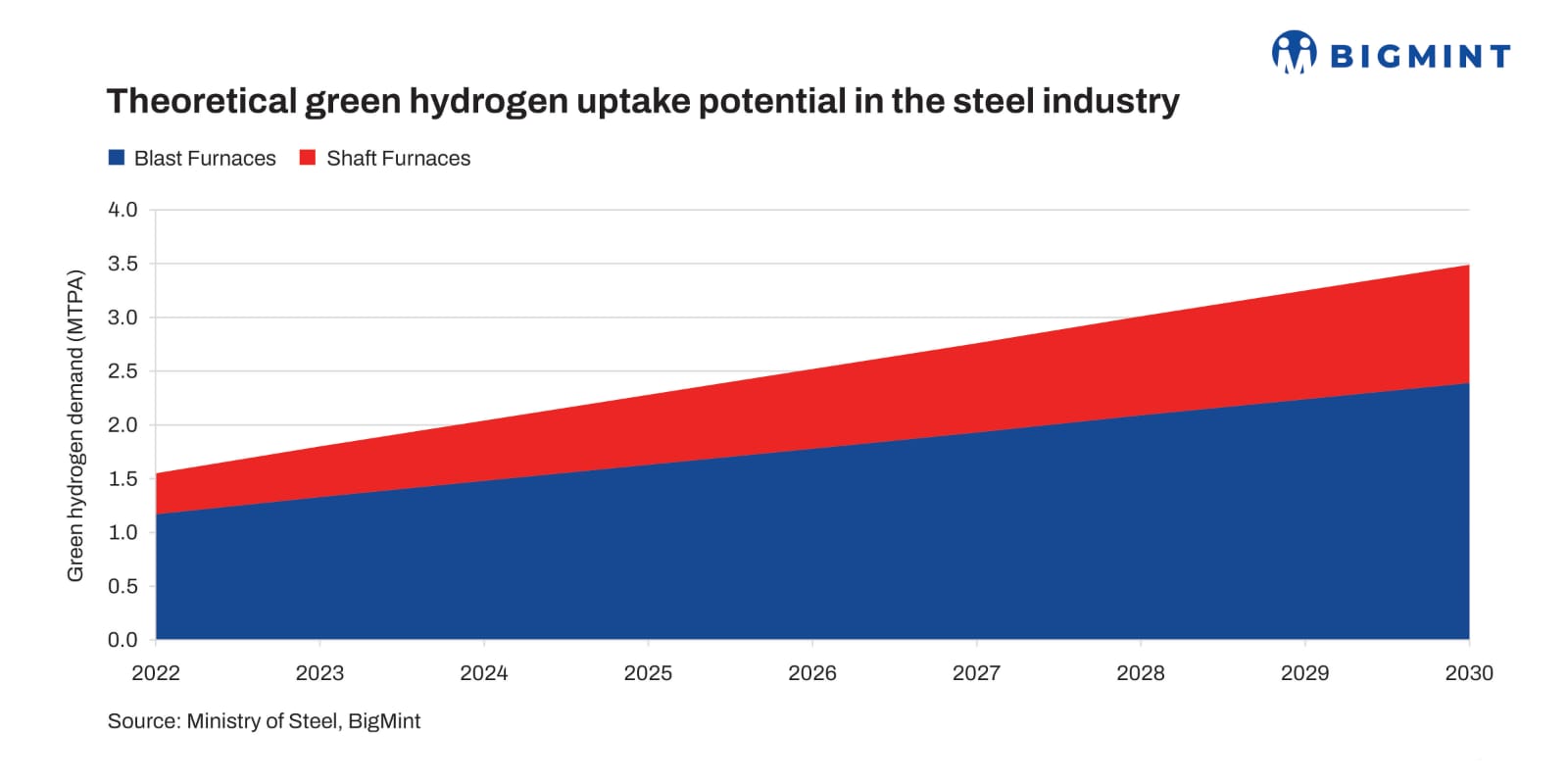
- Technological modifications required for H2 injection in BF
- Around 13-16 kg/tcs of H2 can replace 3-4 kg of coke per kg of H2
- Primary mills might view H2 as an opportunity to reduce coking coal imports
Morning Brief: As steel production volumes through the blast furnace (BF) route increases in India and other parts of Asia, the challenge to decarbonise coal-based steelmaking operations grows manifold. Leading Asian steel producers are experimenting with low-embedded CO2 hydrogen or green hydrogen to reduce emissions in BF iron production.
For example, Nippon Steel is testing hydrogen injection into the BF and has achieved a 43% reduction in emissions at a test facility in the Kimitsu area of Japan. Nippon Steel plans to conduct more tests and aims to reduce the CO2 intensity of steel production from the blast furnace route by 30%.
In India, Tata Steel has successfully injected ~6 kg/thm of hydrogen in BF E in Jamshedpur for four days, resulting in a 10% coke rate reduction and 7-10% CO2 emissions reduction per tonne of crude steel.
Elsewhere, in Europe, Thyssenkrup has successfully conducted tests on hydrogen injection in one of the 28 tuyeres of a blast furnace at the company’s Duisburg facility in Germany. It plans to extend this test to all 28 tuyeres for maximising the uptake of green hydrogen in blast furnaces.
Technical limitations
Injection of hydrogen into the BF is limited by the thermochemical balance needed for iron production. Hydrogen can partially replace both coke and PCI in the BF, although it is taken to replace mainly coke. The hydrogen injection threshold is taken as 15kg/tcs, which replaces 50 kg/tcs of coke.
A result of hydrogen injection in the blast furnace is increased oxygen consumption. However, if we assume a scenario where the large domestic steel mills are using hydrogen as a key element in their operations, of course captive hydrogen production facilities will come up, which can also be prime sources of oxygen.
According to the Ministry of Steel (MoS), hydrogen injection through the shaft of a BF is expected to potentially replace significantly higher coke than injection through tuyeres. However, hydrogen injection in the shaft of a blast furnace has not been demonstrated anywhere in the world.
In its detailed report on the matter, the MoS has highlighted that while hydrogen injection in the shaft might be a better option than tuyere injection, in the absence of any experience related to shaft injection, tuyere injection might be a starting point for hydrogen uptake in the blast furnace. Hydrogen injection in the shaft can be considered as a potential choice in the future with a better understanding of its effect in reducing coke consumption and the capital requirement for modifying the blast furnace.
Modifications needed for H2 integration
According to the MoS, the modifications that would be needed for seamless integration of hydrogen in BF iron production are as follows:
- A dedicated hydrogen injection system must be designed to deliver the required flow rate through multiple tuyeres. Hydrogen causes endothermic reactions in the furnace. It is essential that uniform temperature distribution across the cross-section of the blast furnace is maintained.
- If hydrogen is injected from the upper section of a BF, it has to be heated to a specific temperature, which requires a separate heating system.
- An examination of safety protocols, cost implications, transportation and storage requirements for hydrogen and consequent provisioning, as well as a pressure modulation system for compression and decompression at different stages will be required.
- Seamless integration of the hydrogen pipeline with the tuyere line will require additional engineering adjustments in the pipeline, lance, flowmeter, etc.
- Practical limitations in BF restrict the range to approximately 13-16 kg hydrogen/tcs, equivalent to replacing 3-4 kg of coke per kg of hydrogen, as per the MoS. Any further increase to match the theoretical rates requires additional costly structural modifications.
Outlook
Based on industry inputs, the MoS has calculated that in a blast furnace, the modification cost is INR 135 crore for a 500 m3 unit (1100 tonnes per day x 365 days = 0.4 million tonnes). The feasibility of hydrogen integration in BF operations will, of course, depend on the cost of hydrogen versus the cost of coke and coking coal. The Steel Ministry has conducted detailed base and best case studies to arrive at a breakeven cost considering current and forecasted prices of coking coal.
But considering India’s immense renewable energy potential, domestic hydrogen prices are supposed to fall to a level where imported coking coal may well not seem attractive. Coal dependence will certainly remain but imports can be replaced to an extent by green hydrogen.
At a time of rapid capacity expansion, the primary steel mills might view this as an opportunity to extend the lifetime of their capital-intensive assets.
Leave a Reply