- Global mine disruptions keep refined copper above $10,000/t
- Domestic demand strengthens with festive season-led buying
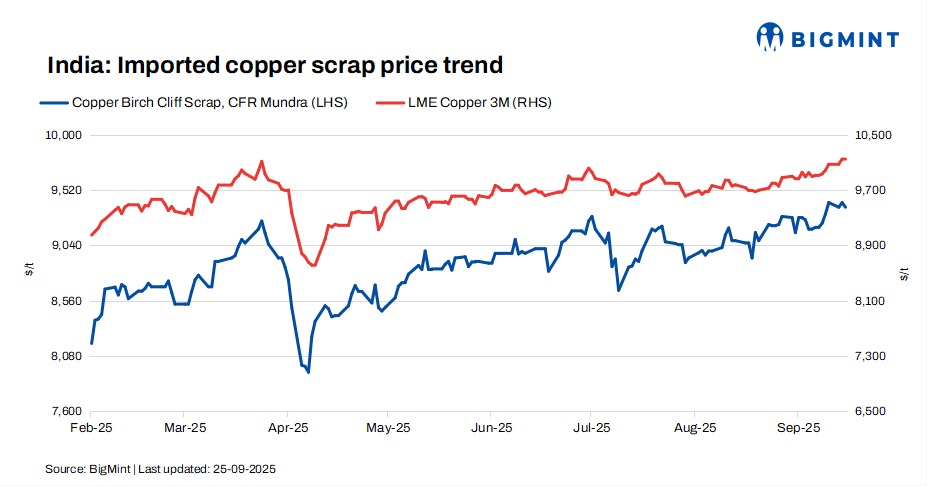
Imported copper scrap prices in India saw an uptrend w-o-w, following a gain in London Metal Exchange (LME) copper futures, which hit a 16-month high. Parallelly, domestic copper scrap prices increased w-o-w.
According to BigMint’s assessment, Birch Cliff scrap was assessed at $9,620/tonne (t), up by $380-400/t w-o-w, while US motors mix stood at $1,200/t (both CFR Mundra), up by $20/t w-o-w.
Indian market scenario
This week, Indian copper secondary markets felt the impact of LME copper prices climbing above $10,300/t, driven largely by ongoing supply disruptions in major global mines such as Freeport’s Grasberg in Indonesia and production constraints in Chile and Peru. Domestic scrap copper prices have rallied by 4-5%.
Higher primary copper prices channelled demand towards secondary sources as industrial consumers sought cost-effective procurement amid constrained refined copper supplies.
Traders in Gujarat and Maharashtra pointed to brisk demand for popular grades such as copper wire scrap and heavy melting scrap, with prices climbing up, in line with imports. Collection activity intensified, as aggregators and kabadi networks responded to higher incentives, improving availability in local yards.
However, secondary smelters noted that margins remained tight because competition for quality scrap pushed up procurement costs. Demand from downstream segments such as wire rod producers and cable manufacturers also picked up ahead of festival-season orders, adding further momentum to domestic trade.
Secondary copper processors, including recycling units and informal aggregators, have witnessed increased buying interest, especially from electrical, construction, and manufacturing sectors looking to hedge against further price rises. This bolstered scrap collection incentives and led to brisker trade volumes in both spot and contract markets.

A trader stated, “End-users are balancing between absorbing higher input costs and passing price increases downstream to maintain margin viability, especially in competitive product segments such as copper wires, rods, and tubes. This creates volatility in downstream pricing but also underlines the significance of domestic recycling infrastructure development to reduce import dependency.”
Overall, the surge above $10,300/t confirms copper’s critical demand-supply tightness globally, reaffirming the secondary market’s pivotal role as both a price buffer and strategic raw material source in India’s copper ecosystem amid evolving global metal dynamics.
Outlook
Market participants expect copper scrap prices in India to remain firm in the coming weeks, as imported offers are unlikely to soften while supply disruptions at mines persist. Domestic scrap availability is improving with higher collection incentives, but demand from fabricators is also strengthening, especially with festival-season production ramping up in sectors such as electricals and construction. As a result, both imported and local scrap prices are likely to hold at elevated levels, with a slight upward bias as long as refined copper hovers above $10,000/t.
Leave a Reply