- Weak demand continues despite tighter global availability
- Domestic scrap remains under pressure even as global prices rise
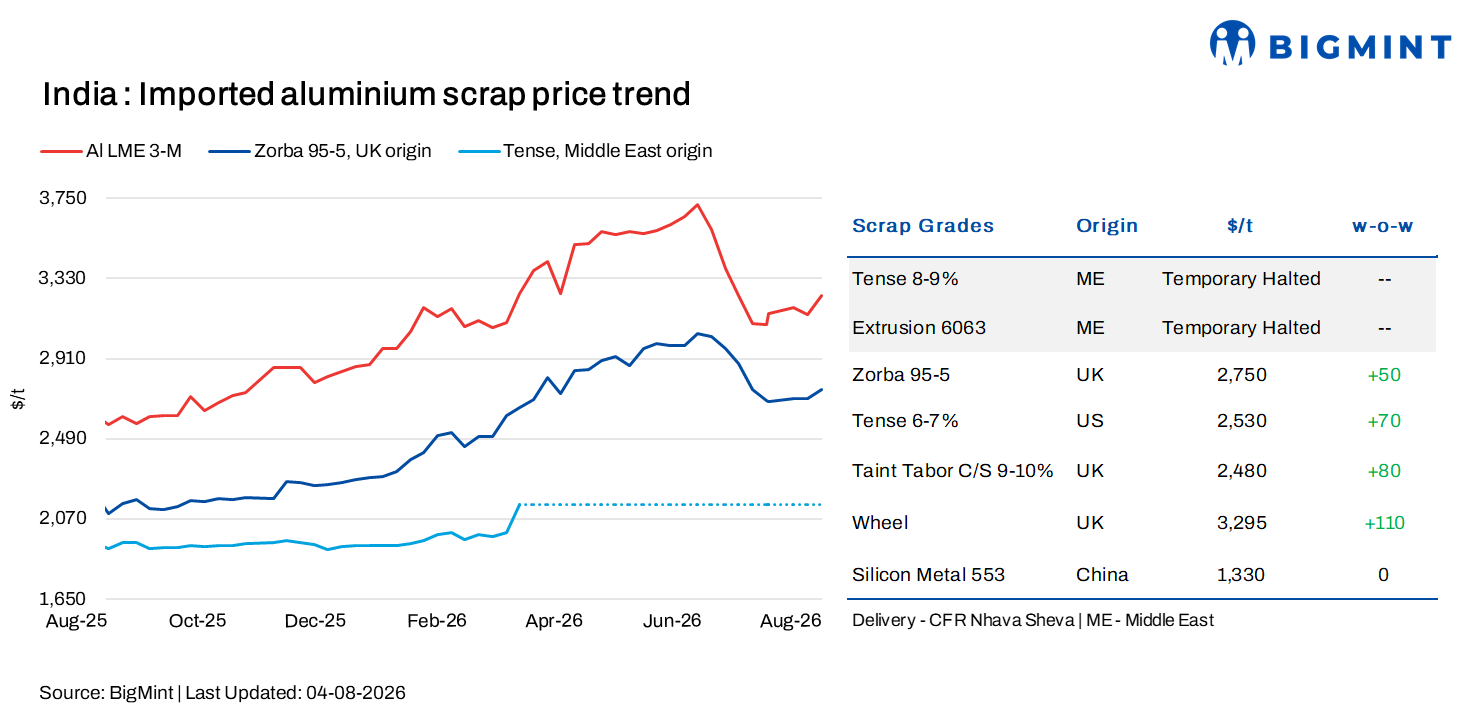
India’s imported aluminium scrap prices increased w-o-w, tracking the rise in LME aluminium prices.
According to BigMint’s latest assessment for CFR Nhava Sheva deliveries, UK-origin Zorba 95-5 scrap prices increased by $50/t w-o-w to $2,750/t, while UK-origin Wheel scrap prices rose by $110/t to $3,295/t.
LME aluminium strengthens amid declining stockpiles
Three-month aluminium prices on the London Metal Exchange (LME) increased w-o-w, closing at $3,240/t on 4 August against $3,143.5/t on 28 July, up by $96.5/t, or 3.1% w-o-w.
Meanwhile, LME aluminium inventories declined by 6,650 t, or 2.5% w-o-w, to 262,650 t on 4 August from 269,300 t on 28 July.
LME aluminium prices strengthened during the week, supported by continued declines in exchange inventories, improving physical market sentiment, and renewed concerns over global supply tightness. Stronger buying interest, coupled with expectations of tighter availability from key exporting regions, also supported prices, although improving production in the Middle East and China continued to cap sharper gains.
Market scenario
The global imported aluminium scrap market remained largely subdued this week, as weak demand continued to offset the impact of tightening supply conditions. According to market participants, it may take another 1-2 days for global prices to fully adjust to the recent supply-side developments. LME aluminium prices moved higher, while global aluminium inventories declined, signalling a gradual drawdown in available stocks. This has improved market sentiment, with participants expecting aluminium prices to strengthen further if the trend persists.
Trading activity remained limited, although UK-origin wheel scrap was heard transacting at $3,280-3,300/t CFR Nhava Sheva, while US-origin Taint Tabor (HRB 2-3%) scrap was reported traded at $2,680-2,720/t CFR Nhava Sheva.
Supply conditions have tightened significantly across the Middle East. Aluminium scrap exports from the region have almost come to a standstill, with US-origin cargoes accounting for most of the active trade. Market participants stated that no vessels are currently calling at Jeddah, leaving substantial cargo volumes and working capital tied up. In addition to export restrictions, ongoing disruptions in the Red Sea have further hindered the movement of scrap from Saudi Arabia, reducing regional availability.
However, demand remains weak globally, preventing any sharp price rally. Buying interest for key grades such as Zorba and Tense has remained limited, resulting in only marginal price movements. Market participants noted that current price support is being driven primarily by constrained supply rather than an improvement in consumption.
Export activity from the Middle East has also been affected by regulatory issues. The suspension of PSIC (Pre-Shipment Inspection Certificate) issuance for UAE-origin aluminium scrap cargoes, coupled with the DGFT’s (Directorate General of Foreign Trade) de-listing of several PSIC agencies, has significantly disrupted shipments from the region. At the same time, local sales have provided little support, as domestic demand remains limited and the market is largely controlled by established secondary smelters, making it difficult for traders to sell material profitably.
Overall, market participants described the Middle East aluminium scrap market as highly depressed. Alongside the UAE’s ongoing scrap export ban, Saudi Arabia is reportedly tightening export regulations, further restricting regional trade. Industry sources also indicated that scrap shipments from Jeddah are temporarily not being accepted due to severe port congestion, although there has been no official confirmation. Collectively, these supply disruptions are tightening global scrap availability and are expected to lend further support to imported aluminium scrap prices once demand begins to recover.

On the domestic front, aluminium scrap prices remained under pressure during the week, with casting-grade and extrusion scrap witnessing declines amid subdued buying activity, while most other scrap categories remained stable to firm. The sharpest correction was recorded in southern India, where casting-grade scrap prices declined significantly, while northern markets also eased due to cautious procurement by secondary alloy producers. Although imported aluminium scrap prices have started strengthening following the recent rise in LME aluminium prices, the uptrend has yet to be reflect in the domestic market. Market participants expect local scrap prices to firm over the next few days as higher import costs gradually filter through to domestic prices.
Chinese silicon prices
According to BigMint’s latest assessment, China-origin Silicon Metal 553 prices remained stable w-o-w at $1,330/t CFR Mundra, as balanced market fundamentals and subdued buying interest offset comfortable supply availability.
Outlook
Imported aluminium scrap prices are expected to remain firm in the near term, supported by higher LME aluminium prices, declining global inventories, and tightening scrap availability from the Middle East. However, weak demand from secondary alloy producers is likely to cap any sharp price increase. In the domestic market, prices may begin to strengthen over the next few days as higher import costs are gradually reflected in local offers, although buying activity is expected to remain cautious.
Leave a Reply