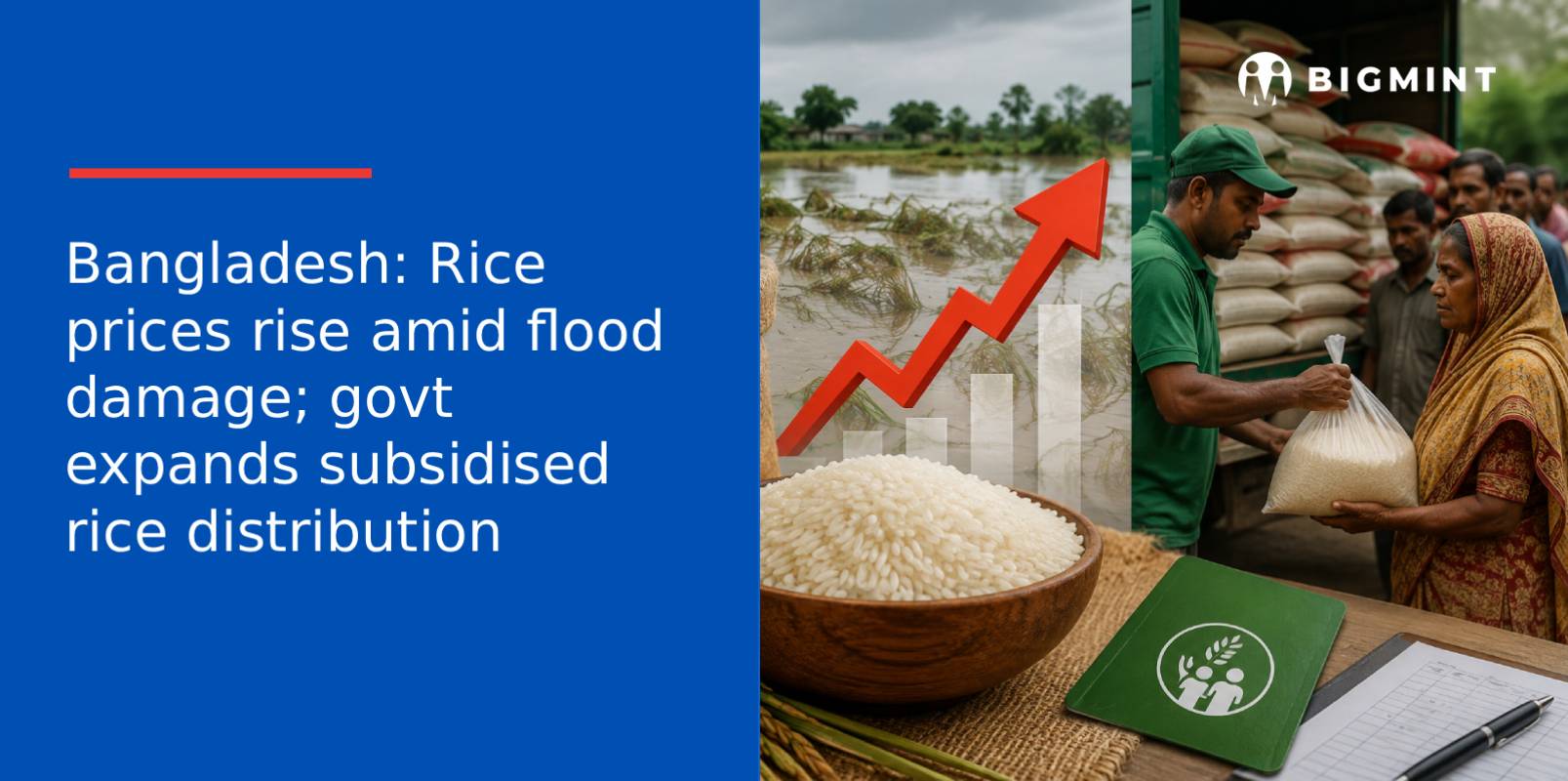
- Higher paddy procurement costs drive up retail rice prices
- 5.5 million families to receive subsidised rice for 6 months
Bangladesh rice prices have continued to rise as flood-related crop damage, higher paddy procurement costs, and uncertainty over rice imports add pressure to the domestic market. Prices of both premium and coarse rice have increased in major cities over the past week, raising concerns over food inflation for consumers. While government grain reserves remain comfortable and market supplies are largely adequate, authorities have stepped up subsidised rice distribution and open market sales to contain further price increases.
Rice prices edge higher across key markets
Retail rice prices have increased across major trading centres, including Dhaka and Chattogram. Premium-quality rice is currently selling at around BDT 72/kg, compared with BDT 70/kg a week earlier, registering an increase of nearly 2.9%. Meanwhile, coarse rice prices have risen from BDT 48/kg to BDT 50/kg, reflecting a w-o-w increase of around 4.2%.
According to traders, the rise in prices is mainly driven by higher paddy procurement costs after recent floods damaged standing crops and Aman seedbeds. Although rice availability in the market remains sufficient, the increase in raw material prices has pushed milling costs higher, which has been reflected in retail prices. Market participants have also pointed to uncertainty over rice imports from India and speculative buying as factors supporting higher prices.
Government expands subsidised rice distribution
To reduce the burden of rising food prices on low-income households, the Ministry of Food launched the latest phase of the Food-Friendly Programme on 1 August across 495 upazilas.
Under the scheme, around 5.5 million cardholder families will receive 30 kg of rice per month at a subsidised rate of BDT 15/kg for six months each year. The programme is implemented in two phases — from August to November and March to April — to support vulnerable families during periods of seasonal unemployment.
In addition, nearly 2.53 million families in 248 upazilas are receiving fortified rice, while around 2.97 million families are supplied with regular rice. The government is also continuing Open Market Sales (OMS) of rice and flour through 1,108 distribution centres and mobile trucks to improve market availability and moderate retail prices.
Comfortable rice stocks support market stability
Despite rising retail prices, Bangladesh continues to maintain comfortable public grain reserves. As of 2 August 2026, government food stocks stood at approximately 2.349 million tonnes (mnt), including:
- Rice: 1.966 mnt
- Wheat: 280,010 t
- Paddy: 152,109 t
Authorities are also procuring paddy and wheat directly from farmers to strengthen domestic supplies and ensure adequate food availability in the coming months.
Production, imports remain key to future price direction
Bangladesh is the world’s third-largest rice producer, with annual production of 37-40 mnt. However, domestic demand is estimated at 38-43 mnt, requiring periodic imports to balance supply.
India remains one of Bangladesh’s key rice suppliers, and uncertainty surrounding import availability has contributed to cautious market sentiment. At the same time, the Ministry of Commerce has approved exports of 8,800 t of aromatic rice through 67 companies, with each shipment limited to 500 t unless additional approval is granted.
Outlook
Bangladesh’s rice market is expected to remain firm in the near term as flood-related crop damage and higher paddy procurement costs continue to support prices. While government rice reserves, subsidised distribution under the Food-Friendly Programme, and ongoing open market sales are helping cushion the impact on consumers, the pace of domestic procurement, the progress of the Aman crop, and import availability will remain key factors influencing price movements. Continued market monitoring and timely intervention will be crucial to preventing excessive price volatility while ensuring stable rice supplies across the country.
Leave a Reply