- ICM compliance mechanism now covers 490 obligated entities
- Emission intensity targets for aluminium industry notified in Oct’25
The Indian government has expanded its Carbon Credit Trading Scheme to include four additional carbon-intensive sectors, including secondary aluminium, bringing the total number of companies required to meet emission reduction targets to 490.
On 13 January 2026, the Ministry of Environment, Forest and Climate Change notified Greenhouse Gas Emission Intensity (GEI) targets for the secondary aluminium industry in adding to petroleum refineries, petrochemicals, and textiles. The Carbon Credit Trading Scheme (CCTS), now extended to these carbon-intensive, will obligate 208 entities across these sectors to meet specified emission intensity reduction targets.
The Carbon Credit Trading Scheme, notified in 2023, requires emission-intensive industries to meet assigned Greenhouse Gas Emission Intensity (GEI) targets. Companies that exceed these targets can sell to obligated entities that fall short of their goals, in the Indian Carbon Market (ICM).
ICM offers a carbon emission trading mechanism, aligning industrial growth with India’s long-term climate objectives and net-zero pathway. It also allows companies that are not covered or obligated to participate by offsetting their emissions.
With this recent expansion, the mechanism now covers 490 obligated entities across India’s most emission-intensive industries. Last October, the GEI targets for aluminium, cement, chlor-alkali, and pulp and paper sectors had brought the first set of 282 entities under the scheme.
Notably, compared to primary aluminium, secondary aluminium is around 95% less emission-intensive because it is produced through scrap recycling. According to government data, recycling saves around 13-14 kilowatt-hour (kWh) of electrical energy per kilogram on average compared to that consumed in primary production.
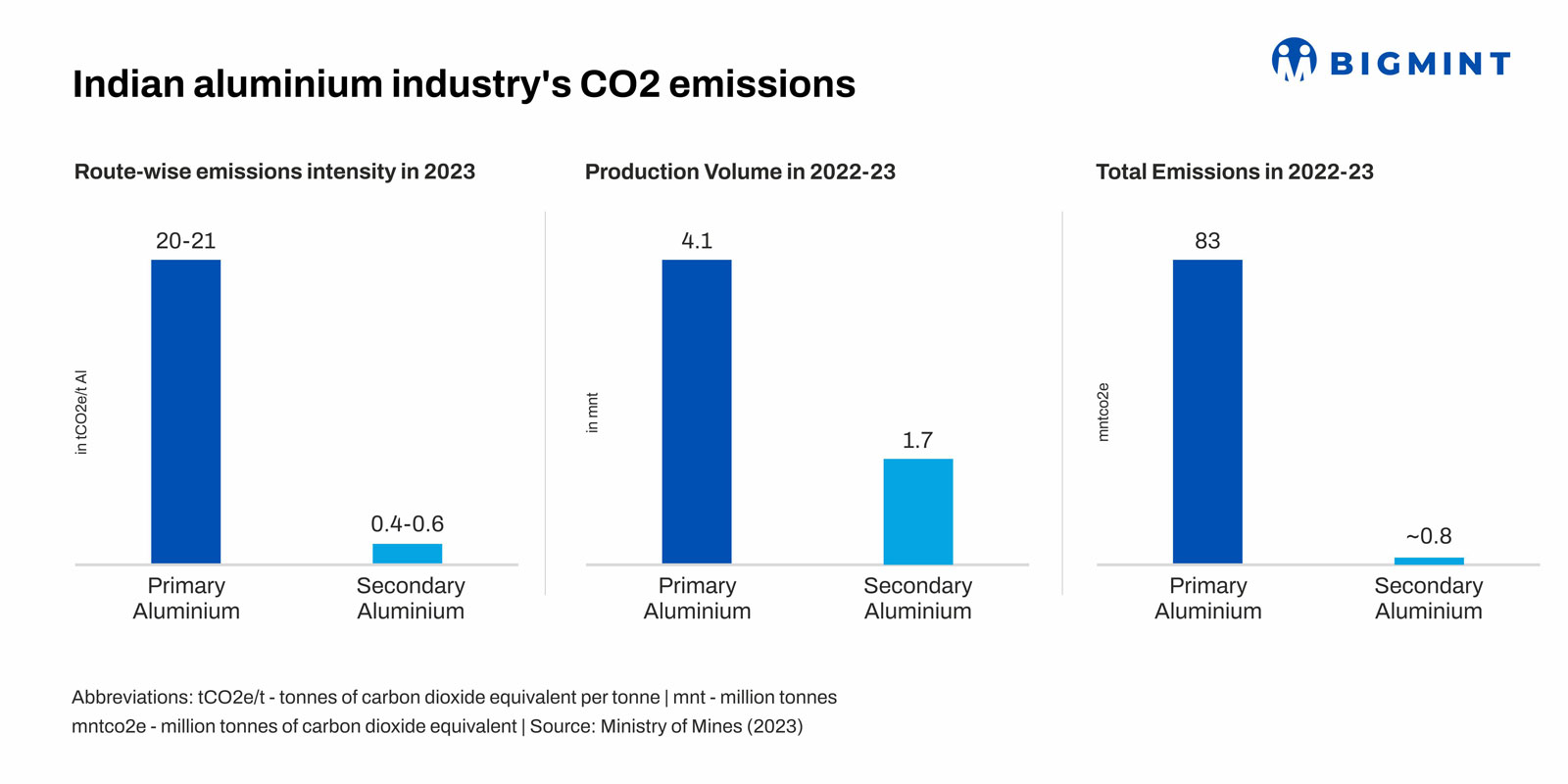
Secondary aluminium’s carbon dioxide emissions intensity also stands at a minuscule 0.4-0.6 tonnes of carbon dioxide equivalent per tonne (tCO2e/t) against primary aluminium production’s 20-21 tCO2e/t. In FY’23, India’s primary aluminium output stood at 4.1 mnt, contributing 83 million tonnes of carbon dioxide equivalent (MTCO2e) emissions, while production from the secondary route totalled 1.7 mnt (including non-regulated share), with emissions of only 0.8 MTCO2e.
Additionally, NITI Aayog has forecast that the share of secondary aluminium in India’s total aluminium supply may rise to 50% from the current 18%.
Leave a Reply