- One 2 mnt pellet plant remains shut as higher iron ore and gas costs hurt operating economics
- Q1 pellet production rises 34% y-o-y, while iron ore output declines on mining constraints
Godawari Power and Ispat Ltd (GPIL), a leading steelmaker in central India, is likely to revise its 4.0 million tonnes (mnt) FY27 pellet production guidance lower after shutting one of its 2.0 mnt pellet plants for around 45 days, management said during the company’s Q1FY27 investor call. The shutdown was triggered by higher market-sourced iron ore costs and a sharp increase in natural gas prices, which made operations commercially unviable at prevailing pellet prices.
Management expects the plant to remain shut through August, with a possible restart from September, subject to improvement in operating economics. A revised production guidance will be communicated after an internal review.
Pellet output rises despite weaker iron ore production
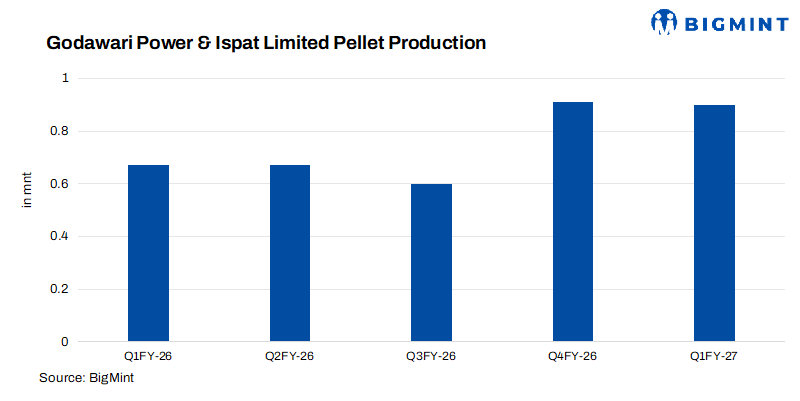
Despite the expected guidance cut, pellet production increased 34% y-o-y to 903,900 t in Q1FY27 from 673,750 t a year earlier and remained broadly stable compared with 911,350 t in Q4FY26. Iron ore production declined 16% y-o-y to 537,832 t from 642,243 t in Q1FY26 and was down 20% q-o-q from 673,452 t in Q4FY26. Management attributed the decline to constraints on overburden dumping at the Ari Dongri mine.
Financial performance
Standalone EBITDA increased marginally to INR 301 crore in Q1FY27 from INR 298 crore a year earlier. Management said higher sales volumes and improved realisations supported earnings, although higher market-sourced iron ore prices and elevated imported coal costs limited profitability improvement.
Standalone profit after tax declined marginally to INR 199 crore from INR 200 crore in Q1FY26. Sequential profitability was affected by greater reliance on merchant iron ore and elevated imported coal prices following the West Asia crisis.
Sales and production outlook
Average pellet realisation increased 5% y-o-y to INR 10,340/t in Q1FY27 from INR 9,828/t a year earlier. Management said higher realisations, together with stronger sales volumes across key products, supported revenue growth during the quarter.
GPIL retained its 3.4 mnt FY27 iron ore production guidance. Mining output is expected to remain subdued in Q2FY27 because of overburden dumping constraints before ramping up from Q3 as additional government land becomes available. Production is targeted to reach the expanded 6.0 mnt capacity at the Ari Dongri mine by Q4FY27 or early FY28.
Management expects domestic pellet prices to remain broadly in the INR 9,000-10,000/t range over the longer term. Prices, which fell below INR 9,000/t during June-July, have recovered by around 10% as steel demand improved. Management added that pellet demand has also recovered from the June-July lows.
Operational highlights
GPIL’s Ari Dongri mine has expanded capacity to 6 mnt/year, with production expected to improve from Q3FY’27 and reach full capacity by Q4FY’27/early FY’28. The 5.4 mnt beneficiation plant is on track for Q3FY’27 commissioning and could lower mining costs below INR 2,700/t from FY’28. Merchant iron ore procurement is expected to fall below 10% from Q4FY’27, with 100% captive availability targeted in FY’28. GPIL also plans to enter the DR-grade pellet market from FY’28.
The 0.7 mnt CRM project is being relocated to Maharashtra, with commissioning targeted for December 2027. Proximity to automobile customers, lower logistics costs and state incentives could lift margins to around 10-11%. The 20 GWh BESS project remains on track for Q1FY’28, while commercialisation has begun. The proposed 1 mnt integrated steel project has been put on hold due to approval delays.
GPIL is expanding its captive solar portfolio to 290 MW, with a 25 MW plant commissioned and a 100 MW project targeted for September 2026. A 45 MW battery storage project is targeted for Q3FY’27, while a 5 TPD carbon capture project is due for completion by FY’27. EV deployment at mines has reduced operating costs by nearly 75% and emissions by around 88%.
Carbon intensity stood at 3.18 tCO₂/t of steel under the CBAM framework in Q1FY’27, down 1.9% q-o-q and 4.2% y-o-y. GPIL is also progressing with the Boria tibu mine expansion, which could raise capacity from 0.7 mnt to 4 mnt over the longer term. A planned beneficiation plant could produce 1.5-2.0 mnt of usable concentrate for future captive pellet requirements.
Outlook
GPIL’s near-term pellet production will remain constrained by limited captive iron ore availability and the temporary shutdown of one pellet plant. However, management expects the combination of higher mining output, beneficiation capacity and greater captive ore integration from FY28 to lower production costs, improve pellet plant utilisation and support entry into higher-value DR-grade pellet markets. We expect the pace of mining ramp-up, rather than pellet demand, to be the key driving factor behind the company’s earnings trajectory over the next 12-18 months.
Leave a Reply