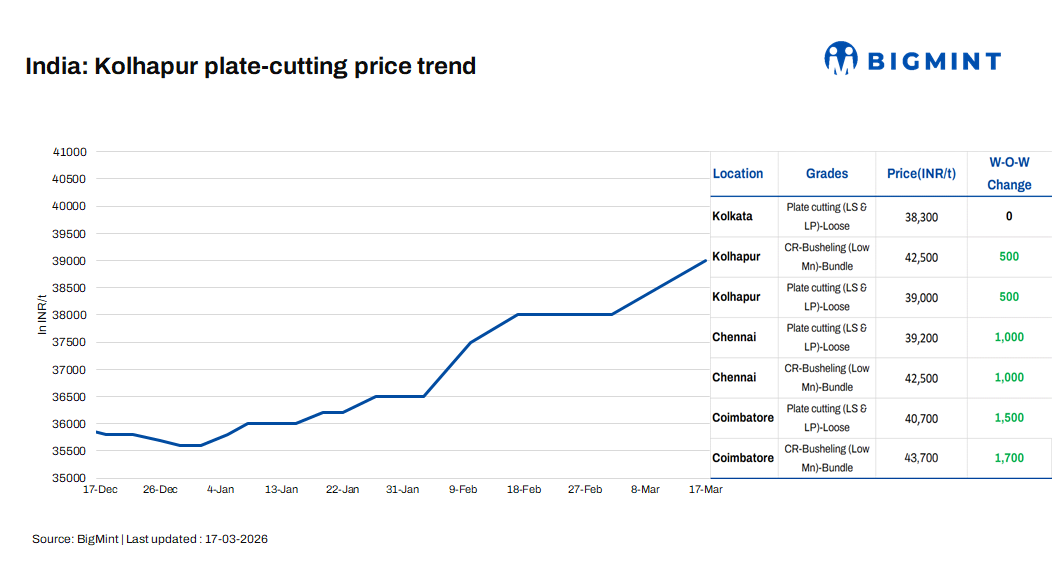
- Prices increase across regions
- Recyclers face tight scrap availability, gas shortage
Domestic foundry scrap prices increased across major markets w-o-w, supported by tight material availability and gas (LPG) shortages at recyclers, which have reduced processing activity and pushed up conversion costs. Additional support came from steady demand from auto and engineering casting segments and higher logistics costs.
Regional price commentary
Kolhapur (west India):
Foundry plate scrap prices increased by INR 500/t to INR 39,000/t, while CR-busheling rose by INR 500/t to INR 42,500/t. The moderate uptick reflects relatively balanced supply-demand conditions, though sentiment remains firm.
Coimbatore (south India):
Prices witnessed the sharpest rise, with foundry plate scrap up by INR 1,500/t to INR 40,700/t and CR-busheling increasing by INR 1,700/t to INR 43,700/t. The surge is driven by acute material shortages, strong local demand, and limited recycler output amid gas constraints.
Chennai (south India):
Foundry plate scrap prices rose by INR 1,000/t to INR 39,200/t, while CR-busheling increased by INR 1,000/t to INR 42,500/t. The market remains well-supported by steady consumption, with supply tightness sustaining the uptrend.
Kolkata (east India):
Prices remained stable at INR 38,300/t, indicating adequate availability and relatively subdued buying activity compared to other regions.
Impact of LPG shortage on foundries
Rising petrochemical prices, driven by non-availability of LPG, are emerging as a significant cost pressure for the foundry sector. LPG is a key fuel used across foundry operations, including melting, heat treatment, and auxiliary processes. Supply constraints are leading to higher fuel costs, directly increasing conversion costs per tonne.
In addition, the ripple effect of petrochemical price hikes is impacting input materials such as resins, binders, and coatings used in moulding and core-making processes. This is further elevating overall production costs. With limited ability to pass on the full cost increase due to competitive market conditions, foundries are likely to face margin pressure.
Outlook
The Iran-Israel conflict is creating a near-term cost-push environment for foundries, driven by energy price spikes, disrupted scrap flows, and rising metallic input costs, while production remains stable but increasingly cautious due to margin pressure and supply uncertainty..
Leave a Reply