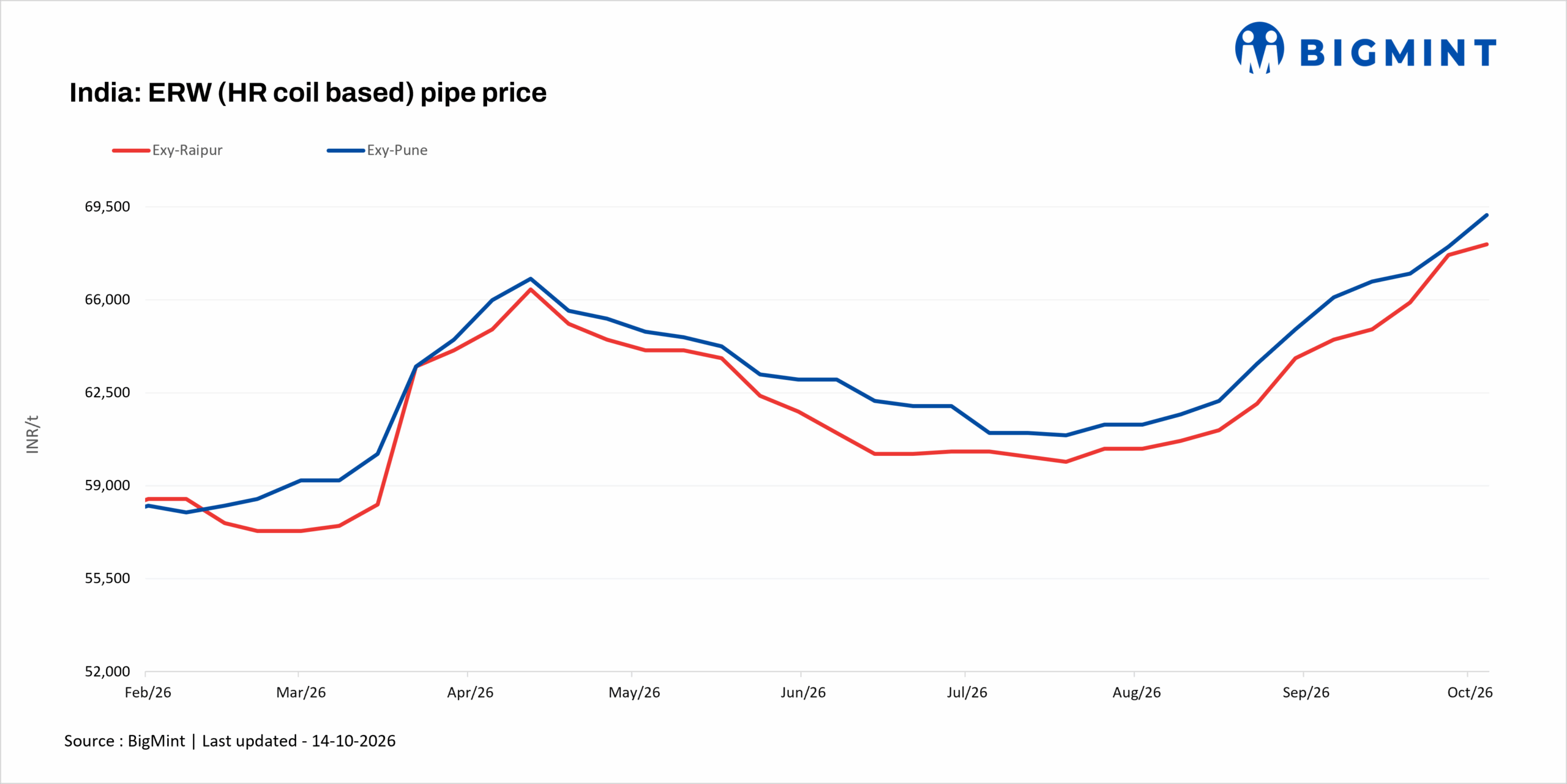
- Trading improves modestly as buyers restock ahead of festive season
- Concerns over labour supply, higher transportation costs boost buying
Indian electric resistance welded (ERW) pipe prices increased by INR 400-1,700/t ($4-17/t) w-o-w across key markets, supported by a major domestic producer’s list-price revision, effective 8 October, and a modest improvement in trading activity. However, the sustainability of the price uptick remains uncertain, with distributors offering discounts in some markets and buyers maintaining a cautious approach to procurement.
Producer price revision lifts market offers
A major domestic ERW pipe producer raised its list prices, effective 8 October, supporting distributor offers across key markets. The revision contributed to the w-o-w price increase, although the extent of the rise varied by region.
A market participant in southern India said, “Distributors are offering discounts in some transactions, so effective prices may differ from announced list prices.”
Pre-festive buying offers limited support
Trading activity improved modestly as buyers made purchases ahead of potential labour shortages in the coming weeks due to the festive season. A leading distributor in northern India said workers travelling to their home regions for the festive season could affect labour availability, while transportation costs could also rise.
“Some buyers are securing material ahead of the festive period amid concerns over labour availability and the possibility of higher transportation costs,” the distributor said.
However, the improvement in trading activity has not translated into a broad-based recovery in demand. Buyers remain cautious, and the extent to which pre-festive procurement can sustain current price levels remains uncertain.
Outlook
ERW pipe prices over the coming month will depend on the strength of end-user demand and distributors’ ability to pass on the producer’s price increase. Fluctuating hot-rolled coil (HRC) prices would ease raw material cost pressure and limit further increases, while a festive-season slowdown may weigh on downstream procurement.
Further price gains may be difficult to sustain without stronger end-user demand. The pace of buying during the festive period will be a key indicator of whether current price increases hold.
Leave a Reply