- Domestic production lags, imports stay competitive
- Cathode imports plunge on BIS certification delays
India’s copper import trends for the first seven months of 2025 (7MCY’25) highlight a marked shift in trade flows, with downstream semi-finished products increasingly filling the gap left by constrained cathode inflows.
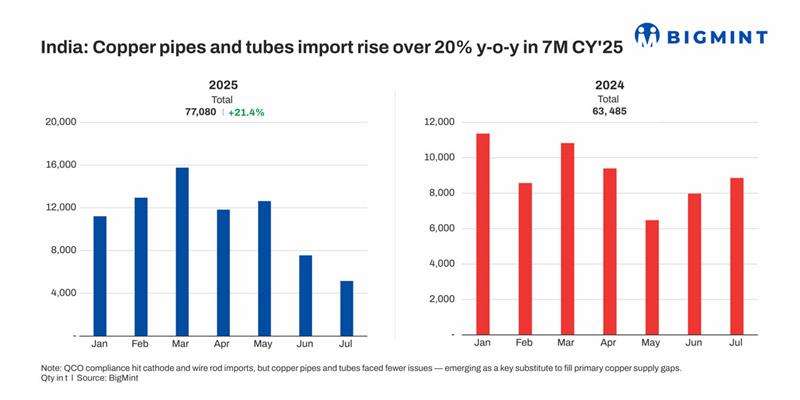
India’s copper pipes and tubes imports increased 21.4% y-o-y in 7MCY’25 to 77,080 t, supported by steady demand from HVAC, plumbing, and construction sectors. With fewer hurdles under the Quality Control Order (QCO), suppliers from Vietnam, Malaysia, and South Korea ramped up shipments, making pipes and tubes a vital channel to meet near-term requirements.
Vietnam remained the single largest source, accounting for nearly half of India’s pipes and tubes imports, while Malaysia and South Korea recorded sharp growth of 49% and 85%, respectively.
Why did pipes, tubes imports surge in 7MCY’25?

The rise in pipes and tubes imports was driven by a mix of seasonal and structural factors. Pre-monsoon stockpiling by HVAC and plumbing manufacturers in March 2025 pushed monthly imports up to 15,761 t, the highest so far this year.
At the same time, domestic output lagged demand, as Hindalco’s new tube facility is still under construction and existing producers are operating near capacity. Import growth was also supported by competitive regional suppliers, with Vietnam leveraging cost advantages, and Malaysia and South Korea quickly securing BIS certification to access the Indian market.
In contrast, copper cathode imports fell 24% y-o-y to 131,485 t over the same period. QCO-related BIS certification delays restricted inflows, with January-February imports collapsing by 70-90% versus last year. Notably, imports slumped to just 109 t in January 2025 against 15,607 t in January 2024, underscoring the severity of the disruption. The shortfall reinforced a shift in India’s supply mix toward semi-finished copper imports such as pipes and tubes.

Domestic capacity expansion accelerates
India is ramping up local copper tube capacity to cut import dependence. Hindalco is setting up an inner-grooved copper tube plant in Gujarat and has partnered with Blue Star to localise HVAC-grade tubes. The project, announced in April 2025, will initially add around 50,000 tonnes per annum (tpa) of tube-making capacity, targeted at the fast-growing air-conditioning market.
Adani Enterprises, through a JV with MetTube, is expanding production for AC, renewable, and construction use. MetTube’s Halol, Gujarat plant, commissioned in 2024, is being scaled up under the JV to double output capacity in the next two years. Meanwhile, Adani’s Kutch smelter is scaling cathode output, supporting downstream demand.
On the policy front, the government is offering subsidies, duty relief, and incentives to attract new smelter and refinery investments. These include a 15% capital subsidy under the Production-Linked Incentive (PLI) framework for non-ferrous downstream projects.
Outlook
India’s copper pipes and tubes imports are likely to stay elevated in the near term, given robust HVAC, plumbing, and construction demand alongside still-limited domestic supply. Hindalco’s inner-grooved tube facility in Gujarat is expected to be operational by late 2026, while the Adani-MetTube JV is scaling up capacity over the next two years. These projects, combined with the Hindalco-Blue Star partnership, should gradually reduce import dependence by 2027. Until then, India will continue leaning on Southeast Asian suppliers to bridge the supply gap, with imports remaining a critical pillar of the supply chain.
Leave a Reply