- Japan accounts for nearly 70% of cathode imports in India
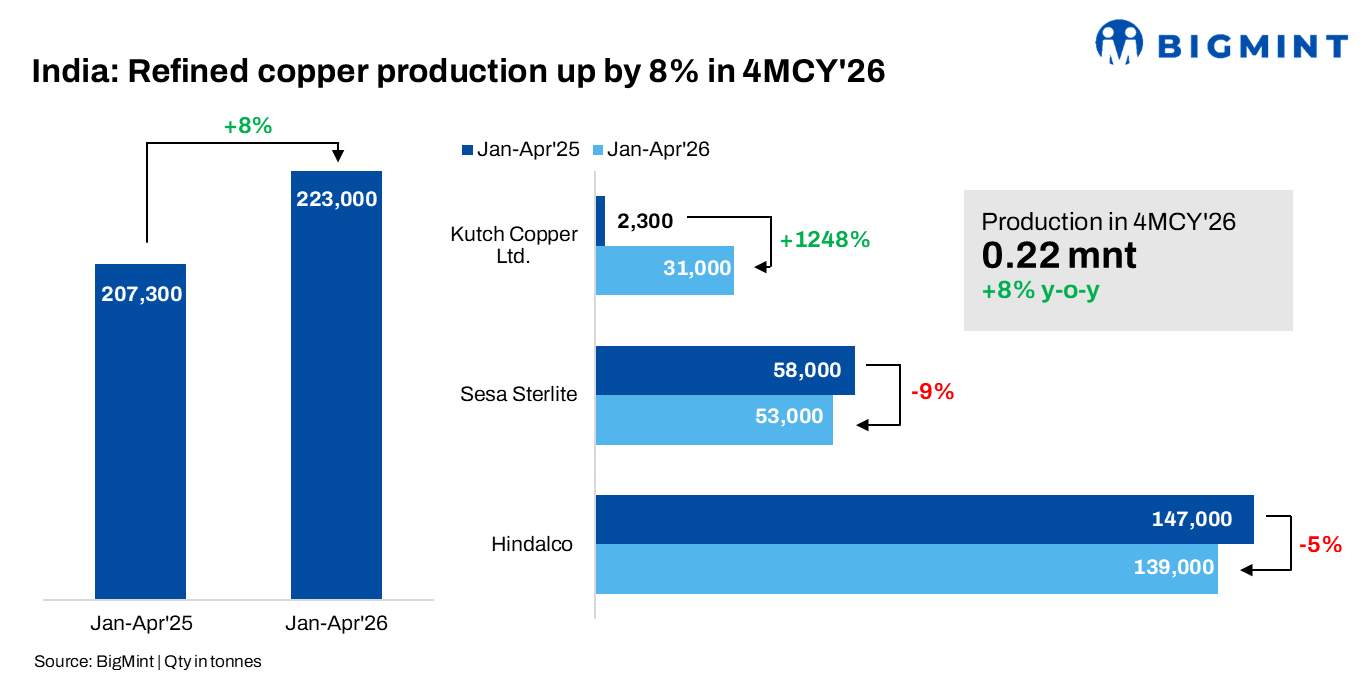
- Adani’s Kutch Copper contributes entire 8% y-o-y rise in India’s output
India’s refined copper industry presented an interesting paradox during the first four months of CY’26. While domestic cathode production expanded steadily following the commissioning of new smelting capacity, imports rose even faster, indicating that the country’s copper demand continues to outpace the increase in local supply.
India’s major copper producers collectively produced 223,000 tonnes (t) of refined copper cathodes during January-April 2026, up 8% y-o-y from 207,300 t in the corresponding period last year. The increase was almost entirely driven by Adani Group’s Kutch Copper Ltd. (KCL), which produced 31,000 t during the period compared with a negligible 2,300 t in January-April 2025, reflecting the successful ramp-up of its newly commissioned smelter.
In contrast, established producers witnessed lower output. Hindalco produced 139,000 t, down around 5% y-o-y, while Sesa Sterlite’s production declined to 53,000 t from 58,000 t a year earlier. Despite these declines, the strong contribution from KCL lifted India’s overall refined copper production.
Why did copper cathode imports rise despite higher domestic output?
Ordinarily, an increase in domestic production would reduce dependence on imported cathodes. However, India’s import data tells a different story.
Copper cathode imports increased sharply by 37% y-o-y to 68,656 t during January-April 2026, compared with 50,049 t in the same period last year. The trend suggests that domestic demand is expanding at a much faster pace than local production capacity.
The increase in imports reflects robust domestic copper consumption, which currently stands at around 1.8 mnt and is projected to surpass 3.0 mnt by 2030, driven by rapidly expanding sectors such as electric vehicles (EVs), renewable energy, battery manufacturing, power transmission infrastructure, and AI-driven data centres.

Why does Japan continue to dominate India’s copper imports?
Japan remained India’s largest supplier of refined copper cathodes during January-April 2026, exporting 47,781 t, accounting for nearly 70% of India’s total imports. Congo followed with 6,251 t.
Japan’s dominance is largely supported by the presence of established global trading houses, which source premium-grade copper cathodes from major producing countries such as Chile, Peru, and the Democratic Republic of Congo before supplying them to Indian consumers.
These trading firms offer integrated services, including logistics management, marine insurance, trade finance, and documentation support, enabling Indian buyers to access reliable supplies with lower procurement and operational risks. Coupled with consistent product quality and dependable delivery schedules, these capabilities have helped Japanese suppliers maintain their position as India’s leading source of refined copper imports.
How are arbitrage opportunities influencing copper imports?
During Q2 2026, the premium of CME copper over the LME widened to nearly $800-1,200/t, incentivizing traders to divert LME-priced cathodes to the US to capitalize on higher premiums. This altered global trade flows, prompting suppliers to rebalance shipments across key consuming regions based on contractual obligations, freight economics and regional demand dynamics.
Against this backdrop, India continued to import refined copper to meet domestic requirements, with imports rising 36% y-o-y to around 0.19 mnt during January-April 2026, even as global trade patterns adjusted to the CME-LME arbitrage.
Outlook
India’s copper market is entering a phase of sustained demand growth, with consumption continuing to outpace additions to domestic refining capacity. While the commissioning of Kutch Copper has strengthened local cathode production, rising imports suggest that the incremental output has been quickly absorbed by robust demand.
Beyond traditional end-use sectors such as power, construction, and electric vehicles, artificial intelligence (AI) and data centres are emerging as new growth drivers. The rapid expansion of AI infrastructure requires copper-intensive power systems, cooling equipment, and servers, with a single large-scale data centre estimated to consume around 28-30 t of copper.
Looking ahead, continued investments in renewable energy, power transmission, electric mobility, manufacturing, and digital infrastructure are expected to underpin copper demand. Unless domestic smelting and refining capacity expands in line with consumption, India is likely to remain a key importer of refined copper cathodes, supported by both structural demand and favourable international trade opportunities.

Leave a Reply