- Chinese exports jump on competitive pricing, domestic surplus
- Indian scrap imports hit 1-year low amid seasonal slowdown
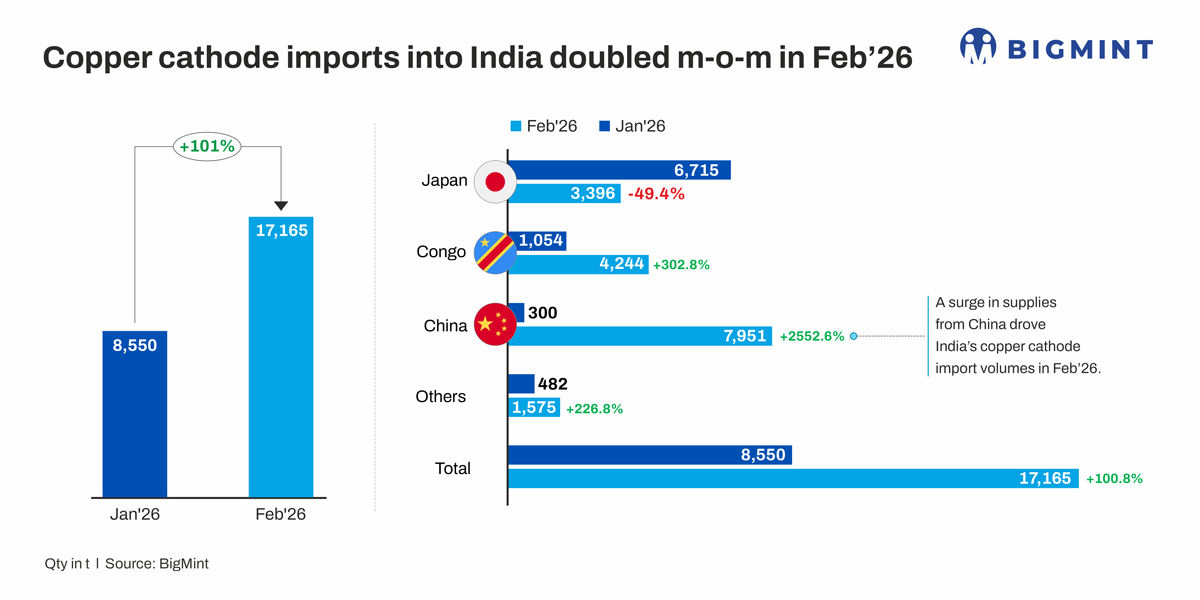
India’s copper cathode imports doubled m-o-m to 17,200 tonnes (t) in February 2026 from 8,600 t in January, as per data maintained by BigMint. This followed a 27% m-o-m decrease in India’s copper scrap imports in February, which hit a one-year low of 25,700 t. With scrap availability tightening, Indian buyers shifted towards sourcing refined copper cathodes, resulting in a sharp increase in imports.
China emerges as leading supplier
There was a notable shift in the supplier mix, with China emerging as a key exporter of cathodes to India during the month. Shipments from China surged from 300 t in January to 8,000 t in February, an increase of over 2,500%, making the country the largest supplier of cathodes to India this month.
The rise was largely driven by competitive pricing from Chinese smelters and ample refined copper availability in China, as domestic demand remained relatively subdued. Chinese exporters were able to offer material at more attractive premiums, allowing them to capture market share in India and overtake Japan as a key supplier.
China has recently emerged as an exporter of refined copper due to surplus availability. The country shipped nearly 800,000 t of refined copper in 2025 compared to 460,000 t in 2024, supported by expanding smelting capacity and global price arbitrage opportunities.
Major producer Tongling Nonferrous Metals Group commissioned two large copper smelters with a combined capacity of about 800,000 t per year. The Tongling Jinxin smelter (500,000 t/yr) began ramping up around mid-2025, while the Tongling Jintong smelter (300,000 t/yr) started operations later in the year. By early 2026, these facilities added significant refined copper output, increasing export availability.
Exports from the Democratic Republic of Congo (DRC) also increased amid rising mining output and refining capacity. With higher production, Congolese exporters are diversifying shipments beyond China toward other Asian markets, including India, while competitive pricing of African-origin cathodes supported these shipments.
Copper scrap imports into India slowed in February, which is typically a seasonally weak period. Many scrap yards and traders in Europe and North America operate at reduced capacity during January due to holiday closures, delaying scrap collection and shipments for February deliveries.
Indian scrap buyers were also cautious ahead of the Union Budget, as the market expected possible changes in import duties or tariffs on copper. Due to this uncertainty, several traders postponed fresh bookings.
As scrap supply tightened, traders and manufacturers increased cathode purchases, aided by competitive pricing from China and DRC. A global commodity trader that entered the Indian cathode import market during the month said it took advantage of an arbitrage opportunity. Anticipating a possible import duty announcement in the Union Budget, the trader brought in cargoes early and later sold them in the domestic market at premiums of around $170-200/t over the London Metal Exchange (LME).
Meanwhile, a growing wire and conductor manufacturer sourced cathodes to support expanding production capacity and to build inventory ahead of higher output levels. A major integrated metal producer also adjusted its raw material sourcing strategy, optimising the mix between cathodes and other intermediates to balance smelter operations and supply commitments.
Outlook
BigMint expects downstream products demand to pick up from April, so buyers are likely to import more cathodes or source scrap from other regions, even at slightly higher costs, to maintain steady raw material supply.
The ongoing tensions between Iran and Israel have not directly disrupted India’s copper trade so far, but they have begun to impact logistics. Shipping risks around the Strait of Hormuz, a key global trade route, have increased freight and insurance costs, slowing cargo movement in some cases. As a result, importers may face slightly higher landed costs for raw materials. If logistics remain tight, Indian buyers may increasingly rely on refined copper cathodes from competitively priced suppliers when scrap availability becomes constrained.
Leave a Reply