- Higher production, rail loading help ease coal supply crunch
- Renewed stock declines leave buyers facing costly imports
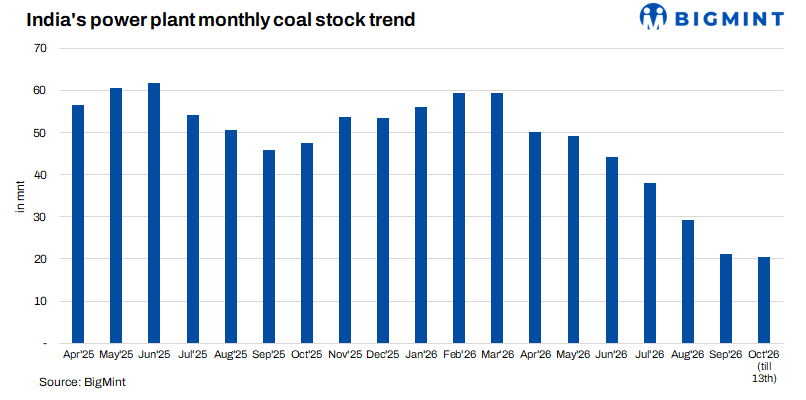
India’s coal supply response has strengthened in October, but power plants have yet to establish a sustained recovery in inventories. The latest daily reports show that the brief improvement in stocks did not hold, highlighting how little room remains between coal deliveries and consumption.
Total monitored power-plant stocks fell to 20.47 mnt on 13 October, from 20.87 mnt on 11 October. Plants classified as having critical inventories increased from 87 to 92 over the same period.
This comes despite rising Coal India production and dispatches and stronger railway loading. Domestic supply is improving, but it is still struggling to create the surplus needed to rebuild depleted buffers.
For buyers considering imported coal as insurance, the timing is difficult. Chinese restocking and Indonesian loading constraints are supporting international prices, making replacement supplies increasingly expensive.
Stock stabilisation remains fragile
Power-plant stocks initially recovered from 20.44 mnt on 6 October to 20.87 mnt on 11 October. However, inventories fell on both subsequent reporting dates, reversing most of that improvement.
On 13 October, monitored plants received 2.47 mnt against consumption of 2.77 mnt — a shortfall of approximately 0.30 mnt. Domestic-coal-based plants accounted for most of the gap, receiving 2.32 mnt while consuming 2.60 mnt.
The distinction between slowing depletion and rebuilding stocks is therefore becoming increasingly important.

Production and dispatches are responding
Coal India produced 27.78 mnt during 1-13 October, with its dashboard reporting growth of 28.5%. Dispatches reached 29.15 mnt, with reported growth of 26.1%.
The operating response is meaningful. Dispatches exceeded the cumulative target by approximately 1.51 mnt, although production remained about 1.27 mnt below plan. Dispatches also exceeded production by 1.37 mnt, indicating continued support from existing inventories, subject to stock adjustments.
The dashboard’s headline update for 14 October subsequently showed daily CIL production of approximately 2.29 mnt and dispatches of 2.34 mnt, indicating that the stronger operating pace continued.
Performance nevertheless varies across subsidiaries. Through 13 October, CCL, MCL, SECL and WCL were dispatching above their cumulative targets, while NCL remained below plan.
These figures cover supplies to all customers. They should not be treated as coal received by power plants on the same dates: transport time, destination and deliveries to other industries affect the relationship.
Better railway loading narrows deficit
The improvement extends beyond the mines.
Power-sector rake loading averaged 469 rakes/day during 1-10 October, compared with 426 in September-an increase of approximately 10%. The Ministry of Coal reported average supplies to the power sector of 2.49 mnt/day, against 2.21 mnt/day in September. Supplies exceeded the government’s daily plan on nine of the first ten October days.
This explains why September’s rapid inventory drawdown slowed considerably. But the latest CEA reports show that improved logistics have not yet produced a dependable surplus over consumption.
Mine dispatches, government supply figures and plant receipts cover different stages of the supply chain. The decisive measure for rebuilding inventories is sustained coal arrival at plants above their daily burn.
Plants away from coalfields remain more exposed
The national stock total also conceals a substantial difference in inventory protection.
On 13 October, domestic-coal-based pithead plants held stocks equivalent to approximately 47% of their normative requirement. Non-pithead plants held only about 28%.
These are the stations more dependent on reliable transport over longer distances. For customers in southern, western and northwestern India, higher mine production provides relief only when additional tonnes arrive consistently.
Imported-coal-based plants had stronger aggregate coverage, at 63% of normative stocks. Even so, six remained critical. Their combined receipts also fell below consumption on 13 October, showing that the imported-coal fleet is not uniformly comfortable.
Imported replacement coal is becoming costly
International conditions offer limited relief.
On 13 October, indicative delivered prices for western India stood at $95.80/t for Indonesian 4,200 GAR coal and $132.50/t for 5,500 NAR coal. Both had increased from the preceding day.
Chinese winter restocking, constraints on domestic coal movement and low Indonesian river levels affecting barging and loading are supporting seaborne offers. Indian buyers may therefore face firm import costs even as domestic supply improves.
BigMint’s latest vessel snapshot shows 10.21 mnt of visible non-coking coal imports, comprising 4.47 mnt recorded through 11 October and 5.74 mnt in the outstanding lineup through 12 October.
That provides replenishment potential, but outstanding cargoes are not immediately available fuel. Loading, arrival, discharge and onward delivery still have to occur, and some listed shipments extend beyond October.
BigMint assessment
India has demonstrated that coal production, dispatches and railway loading can respond. The unresolved challenge is sustaining deliveries above consumption long enough to restore inventories.
The latest figures do not support a conclusion that stock rebuilding is firmly underway. They show a narrower supply deficit, a brief recovery and renewed depletion.
For fuel buyers, the relevant signals are improving stocks at their own plants, reliable delivery schedules and the cost of securing replacement supplies. With imported coal expensive, a national supply recovery offers reassurance-but limited protection where local inventories remain thin.
Leave a Reply