- Mine output to grow 1.3% in 2026; refined production to rise just 0.4%
- Mine production, refined output set for stronger 3% growth in 2027
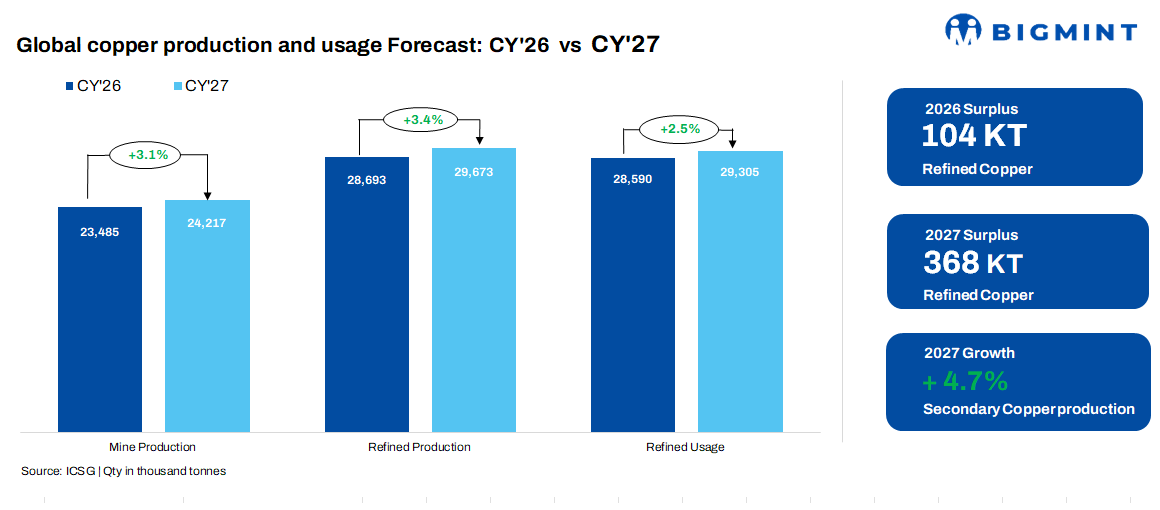
The International Copper Study Group (ICSG), in its latest forecast issued on 14 October 2026, expects the global refined copper market to remain in surplus through 2027. The group slightly raised its 2026 surplus estimate from 96,000 tonnes (t) in April, while maintaining its 2027 projection. The outlook reflects a gradual recovery in refined production amid moderate demand growth, although geopolitical uncertainty and supply constraints could alter the market balance.
Mine supply growth revised down for 2026
Global copper mine production is forecast to increase by 1.3% in 2026, revised down from the 1.6% growth projected in April. Lower output expectations for Chile, China, and Indonesia prompted the revision. New projects and capacity expansions should partly offset these constraints.
The ramp-up of Oyu Tolgoi in Mongolia, Batu Hijau in Indonesia and Malmyz in Russia will support production. Expansions at Julong in China and Svaytogor in Russia, higher output at Antamina in Peru, and stockpile ore processing at Cobre Panama should also contribute.
However, operational constraints at Indonesia’s Grasberg and the DRC’s Kamoa-Kakula mines will continue to limit concentrate supply. Lower Chilean mine production will further weigh on growth. For 2027, ICSG expects mine production to increase by 3.1%, supported by new capacity, improved output in Chile and Zambia, and recovering operations in Indonesia and the DRC.
Refined copper production set for stronger recovery in 2027
Global refined copper production is forecast to grow by just 0.4% in 2026. Limited concentrate availability will constrain primary electrolytic output. However, higher SX-EW production and increased scrap processing should partly offset this weakness.
The outlook improves in 2027, with refined production expected to rise by 3.4%. New smelters and refineries in Indonesia, India and the European Union will drive growth. Higher operating rates in Chile and expanded SX-EW and secondary refining capacity will provide further support. In Indonesia, PT Smelting and Manyar smelters have resumed operations, supporting refined copper output. However, recovery will partly depend on the Grasberg mine’s ramp-up and concentrate availability. ICSG expects primary refined production to grow by around 3%. Meanwhile, secondary production from scrap is projected to increase by 4.7%.
Demand growth remains concentrated in Asia
Global apparent refined copper usage should increase by 1.5% in 2026. Chinese apparent usage is expected to grow by 2.5%, while demand across the rest of the world should remain broadly unchanged. Weaker consumption prospects in the Middle East, North America and the European Union prompted ICSG to lower its forecast slightly.
Demand growth should strengthen to 2.5% in 2027 as economic conditions improve. Planned expansions at semi-manufactured copper product plants and higher operating rates in the Middle East should support consumption.
Asia will remain the main driver of demand growth, supported by manufacturing activity, the energy transition, urbanisation and digitalisation. Investment in data centres and artificial intelligence infrastructure should also sustain copper consumption. However, subdued demand in the European Union and Japan could limit broader growth.
Market signals remain mixed as copper inventories shift
Copper prices and inventories have shown contrasting trends. On 15 October, three-month LME copper traded at around $14,491/t. LME warehouse stocks stood at 231,275 t on 14 October, down around 5% over 30 days.
Meanwhile, US tariff expectations have drawn substantial copper volumes into the country, contributing to regional inventory imbalances and higher COMEX stocks. These shifts complicate assessments of global availability because exchange inventories do not always reflect underlying demand across all regions.
Supply risks also remain relevant. On 14 October, supervisors at BHP’s Escondida mine in Chile accepted a proposed labour agreement, averting a potential strike. This eased an immediate disruption risk, although ICSG still expects Chilean mine production to decline in 2026. The pace of recovery at other mines and the commissioning of new refining capacity will influence how quickly global supply conditions improve.
Outlook
The copper market faces competing pressures from recovering production, moderate demand growth and persistent supply risks. Higher refined output in 2027 could expand availability, but geopolitical uncertainty and uneven regional inventory movements may sustain price volatility. Demand growth in Asia will remain a key support, while the timing of new capacity and the recovery in mine operations will determine how closely the market follows ICSG’s projected balance.
Leave a Reply