- Renewables now drive generation growth, coal’s share declines
- Coal acts as stabiliser for grid reliability amid renewable variability
India’s power market in early 2026 is transitioning into a more mature phase. Demand continues to expand, and generation has grown meaningfully over the past two years, but the pace of growth is clearly moderating. At the same time, the structure of supply is shifting, with renewable energy driving incremental generation while coal’s role evolves from growth engine to system stabiliser.
Demand and generation: Growth continues but slows
A combined view of demand and generation trends highlights both the resilience of India’s power system and the emerging slowdown in momentum.

India recorded a new peak demand of 238 gigawatts (GW) in March 2026, extending the upward trajectory seen over the past two years. However, the growth rate has slowed sharply from 6.1% in 2025 to just 1.3% in 2026.
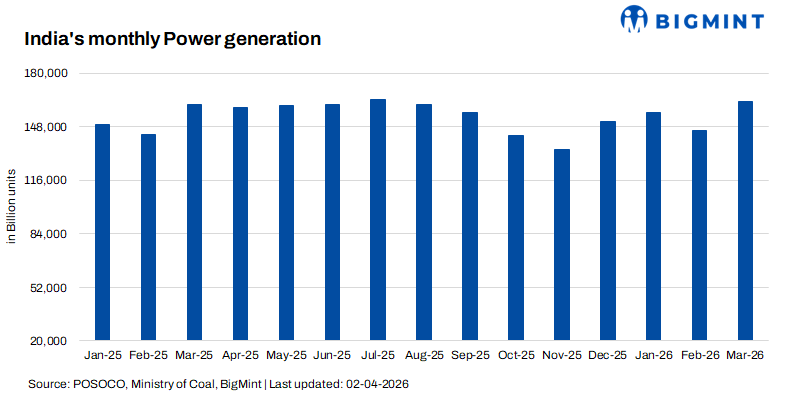
A similar pattern is visible in generation. While total output has increased by nearly 29,000 million units (MU) since Q1CY’24, growth has moderated to 2.6% in Q1CY’26, compared to 4.0% the previous year. Daily demand volatility has also increased, with several days in March 2026 dropping below 200 GW, alongside the emergence of occasional evening peaks. These are clear signs of a system adjusting to changing load dynamics.
Generation mix: Coal plateaus, renewables drive growth
The most important structural shift is visible in how electricity is being generated.

Coal generation has effectively peaked and plateaued, with output in Q1CY’26 slightly below 2025 levels. More importantly, its share in the generation mix has declined steadily — from 78% in 2024 to 73.0% in 2026.
In contrast, renewable energy has expanded rapidly, growing by 46% over two years and adding more than 22,000 MU. Hydro and nuclear have also contributed to the shift, albeit at a more moderate pace. The implication is clear: all incremental generation growth is now being absorbed by non-fossil sources, particularly renewables.
Market signals: Lower prices, higher volumes, rising volatility
These structural changes are now clearly visible in market behaviour on the Indian Energy Exchange (IEX).

Despite higher peak demand, average spot prices declined by around 7% y-o-y in March 2026. This reflects a sharp increase in supply, particularly from renewable sources with near-zero marginal cost.
At the same time, market volumes surged by over 40%, indicating significantly improved liquidity and participation. Sell bids frequently exceeded 400-500 GWh, pointing to periods of surplus supply.
However, this has come with increased volatility. The wider price band in 2026 reflects the growing impact of renewable intermittency — lower prices during periods of high solar generation and sharp spikes during supply tightness.
Coal’s role: From growth engine to system anchor
Coal remains the backbone of India’s power system, accounting for roughly 73% of generation. However, its role is clearly evolving. The era of coal-driven expansion is tapering off, with generation levels remaining flat or beginning to decline as the fuel steadily loses market share — dropping nearly five percentage points in just two years. Rather than acting as the primary engine of growth, coal is transitioning into a vital “balancing fuel” used to maintain grid stability and compensate for variations in a rapidly expanding renewable energy portfolio.
This transition does not diminish coal’s importance; it redefines it. In a system increasingly dominated by intermittent renewable energy, coal-fired generation is becoming critical for flexibility, ramping, and reliability.
Conclusion: A market entering structural transition
India’s power market is no longer just expanding; it is transforming. Demand growth remains positive but is slowing. Generation capacity continues to rise, but increasingly through renewables. Coal remains dominant, yet its share is steadily declining. Meanwhile, market signals point to a more liquid, competitive, and volatile power ecosystem.
Taken together, the data points to a clear structural shift: India has entered a renewables-led growth phase, where coal transitions from being the primary driver of expansion to the stabilising force that underpins grid reliability.

Leave a Reply