- Delhi chana crosses INR 6,675/qtl as key mandis gain
- Falling port stocks and firm import parity support price targets
India’s chana market strengthened on Tuesday, with Delhi prices rising INR 125/qtl from the previous day to cross INR 6,675/qtl. Prices gained across major mandis as limited domestic arrivals, declining Australian chana stocks at ports and firm import parity restricted availability. With the key consumption season approaching, market sentiment remained firm.
Limited arrivals support prices
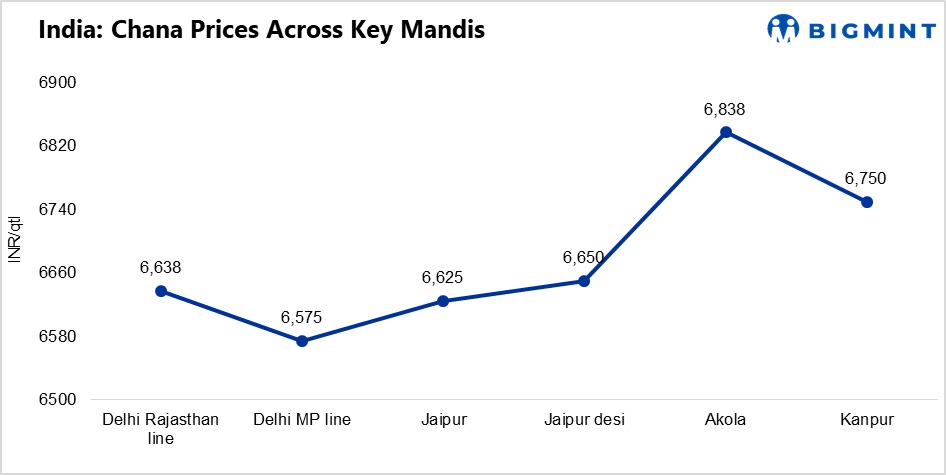
Delhi Rajasthan-line chana was assessed at INR 6,600-6,675/qtl, while MP-line material was at INR 6,550-6,600/qtl. Jaipur prices rose INR 75 to INR 6,625/qtl.
Other major mandis also recorded gains. Jaipur desi chana increased INR 175 to INR 6,650/qtl, while Akola rose INR 125 to INR 6,825-6,850/qtl. Kanpur prices gained INR 100 to INR 6,750/qtl.
Chana dal prices strengthened as well. Prices in Akola, Latur and Mumbai increased INR 100 to INR 7,700-8,300/qtl, while Jaipur chana dal rose INR 175 to INR 7,525/qtl. Bilty prices were reported at INR 6,675/qtl for Akola condition, INR 6,700/qtl for Nagpur condition and INR 6,775/qtl for Raipur warehouse.
Total arrivals across major mandis stood at 2,120.5 t, including 1,500 t in Madhya Pradesh, 225 t in Maharashtra, 100 t in Pipariya, 96 t in Kekri, 80 t in Hinganghat and 70 t in Amravati.
Low arrivals are encouraging sellers to hold back stocks, while buyers are facing limited availability of material at prevailing prices.
Falling Australian stocks tighten import availability
Australian chana stocks at Mundra and Kandla ports declined to around 191,000 t, comprising 72,144 t at Mundra and 119,255 t at Kandla. Continued lifting of imported material is reducing port inventories, although availability remains adequate for now.
Market participants are closely monitoring stocks, with a decline below 100,000 t potentially tightening imported chana availability in the coming months.
Australia new-crop October-November deals were reported at around $695/t, translating to a landed cost of approximately INR 7,404/qtl in Mumbai and Kolkata. Tanzania chana was quoted at $670/t, with landed cost around INR 6,331/qtl.
In the domestic market, Australian chana in Mumbai was assessed at INR 6,575/qtl and Tanzania chana at INR 6,450/qtl. The relatively narrow spread between imported material and domestic prices is limiting aggressive selling by importers.
The rupee-dollar exchange rate, with the dollar at around INR 94.49, remains an important factor for import parity.
Australia’s 2026-27 chana production is estimated at 1-1.2 million t, sharply below 2.182 million t in the previous crop. New-crop offers are around $680-700/t, putting the estimated landed cost in India above INR 7,300/qtl.
Festive demand, limited govt sales underpin sentiment
Government-held chana stocks are estimated at around 2.4 million t. However, sales remain limited, with government material being offered at prices above INR 6,400/qtl. Increased participation in tenders indicates continued buyer interest, while firm bids and limited selling are supporting prices.
The September-December period is typically the key consumption window for chana dal, besan and namkeen. Expectations of stronger festive demand are providing an additional demand-side trigger, with chana dal prices already gaining INR 100-175/qtl across key markets.
Weather remains another factor to monitor. Rainfall deficiency has been reported in producing regions including Rajasthan, Maharashtra, Karnataka, Andhra Pradesh and Telangana. South India’s chana sowing is expected to begin from the first week of October. Any continued rainfall deficit before sowing could raise concerns over the new-crop production outlook.
Outlook
Holding above INR 6,500/qtl remains important for Delhi chana. Sustained trade above this level could open the way toward INR 6,800/qtl, followed by the INR 6,800-7,000/qtl range.
For the near term, limited domestic arrivals, declining port stocks, firm import parity, restricted government selling and improving festive demand are expected to keep the market supported. However, the pace of government stock liquidation, import arrivals and rainfall ahead of the new sowing season will remain key variables for price direction.
Leave a Reply