- Kochi spot prices rise 0.7%, futures gain
- Higher arrivals cap spot price increases
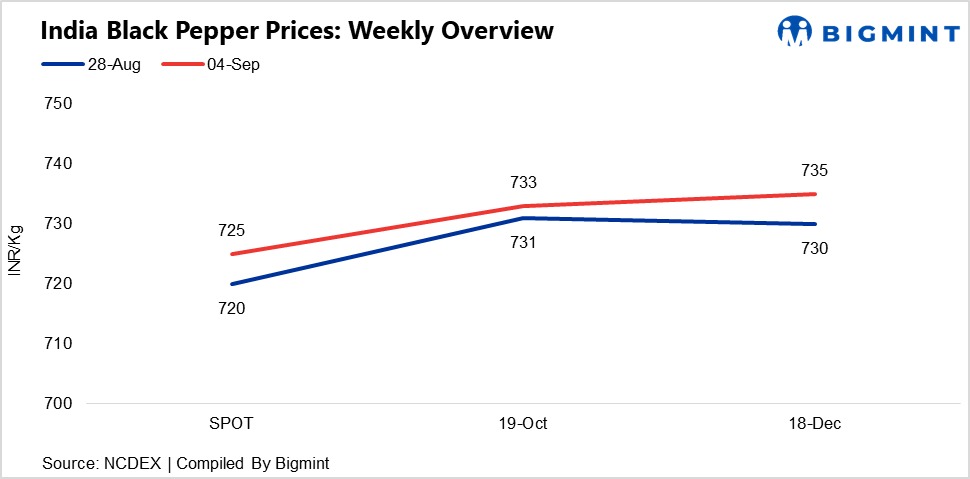
India’s black pepper market remained marginally firm in the week ended 4 September, with Kochi spot prices and near-month futures moving higher despite a sharp increase in arrivals. The Kochi benchmark rose to INR 725/kg on 4 September from INR 720/kg on 28 August, marking a 0.7% w-o-w increase. October and December futures also gained, although the rise in spot prices remained limited as higher arrivals increased supply availability.
Spot market sees modest gains
Kochi spot prices increased INR 5/kg during the week as arrivals rose 21.3% to 956 t from 788 t in the previous week. The increase in arrivals indicates higher availability in the physical market and appears to have restrained the extent of the price rise.
Despite the stronger inflow, prices managed to hold a marginally positive bias, suggesting that the additional supply was not sufficient to exert significant downward pressure during the week. Kochi stocks remained unchanged at 15 t, indicating no reported change in available stocks at the benchmark market.
Futures rise as open interest declines
Futures prices strengthened during the week, with the October contract increasing 0.3% to INR 733/kg from INR 731/kg. The December contract posted a slightly stronger gain of 0.7%, rising to INR 735/kg from INR 730/kg.
However, the price gains were accompanied by a sharp decline in open interest. October OI fell 40.8% to 61 contracts from 103, while December OI declined to zero from 34 contracts. The combination of higher prices and lower OI points more toward position unwinding than fresh long buildup.
Outlook remains cautiously firm
The weekly trend remains mildly positive, but the sharp rise in arrivals and contraction in OI suggest limited conviction among market participants. Unless demand strengthens sufficiently to absorb higher physical availability, black pepper prices are likely to remain range-bound in the near term, with a mild positive bias.
Leave a Reply